Making molecular hydrogen more efficiently
December 9, 2011 By Jared Sagoff
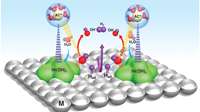
This image depicts the series of reactions by which water is separated into hydrogen molecules and hydroxide (OH-) ions. The process is initiated by nickel-hydroxide clusters (green) embedded on a platinum framework (gray). Credit: Flikr
(PhysOrg.com) -- When it comes to the industrial production of chemicals, often the most indispensable element is one that you can't see, smell, or even taste. It's hydrogen, the lightest element of all.
Researchers at the U.S. Department of Energy's (DOE) Argonne National Laboratory have developed an extraordinarily efficient two-step process that electrolyzes, or separates, hydrogen atoms from water molecules before combining them to make molecular hydrogen (H2), which can be used in any number of applications from fuel cells to industrial processing.
Easier routes to the generation of hydrogen have long been a target of scientists and engineers, principally because the process to create the gas requires a great deal of energy. Approximately 2 percent of all electric power generated in the United States is dedicated to the production of molecular hydrogen, so scientists and engineers are searching for any way to cut that figure. "People understand that once you have hydrogen you can extract a lot of energy from it, but they don't realize just how hard it is to generate that hydrogen in the first place," said Nenad Markovic, an Argonne senior chemist who led the research.
While a great deal of hydrogen is created by reforming natural gas at high temperatures, that process creates carbon-dioxide emissions. "Water electrolyzers are by far the cleanest way of producing hydrogen," Markovic said. "The method we've devised combines the capabilities of two of the best materials known for water-based electrolysis."
Most previous experiments in water-based electrolysis rely on special metals, like platinum, to adsorb and recombine reactive hydrogen intermediates into stable molecular hydrogen. Markovic's research focuses on the previous step, which involves improving the efficiency by which an incoming water molecule would disassociate into its fundamental components. To do this, Markovic and his colleagues added clusters of a metallic complex known as nickel-hydroxideNi(OH)2. Attached to a platinum framework, the clusters tore apart the water molecules, allowing for the freed hydrogen to be catalyzed by the platinum.
"One of the most important points of this experiment is that we're combining two materials with very different benefits," said Markovic. "The advantage of using both oxides and metals in conjunction dramatically improves the catalytic efficiency of the whole system."
According to Argonne materials scientist George Crabtree, who helped to initiate the establishment of Argonne's energy conversion program, the researchers' success is attributable to their ability to work on what are known as "single-crystal" systemsdefect-free materials that allow scientists to accurately predict how certain materials will behave at the atomic level. "We have not only increased catalytic activity by a factor of 10, but also now understand how each part of the system works. By scaling up from the single crystal to a real-world catalyst, this work illustrates how fundamental understanding leads quickly to innovative new technologies."
This work, supported by the DOE Office of Science, is reported in the December 2 issue of Science.
Provided by
Argonne National Laboratory
-
From lemons to lemonade: Reaction uses carbon dioxide to make carbon-based semiconductor,
32 comments
-
Thioridazine kills cancer stem cells in human while avoiding toxic side-effects of conventional cancer treatments,
3 comments
-
SpaceX private rocket blasts off for space station (Update),
42 comments
-
Climate scientists say they have solved riddle of rising sea,
31 comments
-
SpaceX capsule has 'new car' smell, astronauts say (Update),
4 comments
-
Calculating partial pressures Pa and Pw
2 hours ago
-
Gibbs Free Energy Change/Entropy
12 hours ago
-
What's the rule to covalent character
13 hours ago
-
Schwartz reagent-- NMR/MS/IR
May 26, 2012
-
High school chemistry EEI
May 25, 2012
-
oxidation of I- by KMnO4
May 25, 2012
- More from Physics Forums - Chemistry
More news stories
Computer model used to pinpoint prime materials for efficient carbon capture
When power plants begin capturing their carbon emissions to reduce greenhouse gases and to most in the electric power industry, it's a question of when, not if it will be an expensive undertaking.
5 hours ago |
not rated yet |
0
|
Scientists develop ultra-sensitive test that detects diseases in their earliest stages
Scientists have developed an ultra-sensitive test that should enable them to detect signs of a disease in its earliest stages, in research published today in the journal Nature Materials.
Chemistry / Analytical Chemistry
5 hours ago |
not rated yet |
0
|
New CO2-removing catalyst can take the heat
(Phys.org) -- The current method of removing the greenhouse gas carbon dioxide (CO2) from the flues of coal-fired power plants uses so much energy that no one bothers to use it. So says Roger Aines, principal ...
May 24, 2012 |
5 / 5 (9) |
11
|
High-speed method to aid search for solar energy storage catalysts
Eons ago, nature solved the problem of converting solar energy to fuels by inventing the process of photosynthesis.
May 25, 2012 |
5 / 5 (3) |
4
|
Researchers demonstrate possible primitive mechanism of chemical info self-replication
(Phys.org) -- When scientists think about the replication of information in chemistry, they usually have in mind something akin to what happens in living organisms when DNA gets copied: a double-stranded molecule ...
May 25, 2012 |
5 / 5 (4) |
2
|
'Unzipped' carbon nanotubes could help energize fuel cells, batteries
Multi-walled carbon nanotubes riddled with defects and impurities on the outside could replace some of the expensive platinum catalysts used in fuel cells and metal-air batteries, according to scientists at ...
Change in developmental timing was crucial in the evolutionary shift from dinosaurs to birds: study
At first glance, it's hard to see how a common house sparrow and a Tyrannosaurus Rex might have anything in common. After all, one is a bird that weighs less than an ounce, and the other is a dinosaur that ...
T cells 'hunt' parasites like animal predators seek prey, study shows
By pairing an intimate knowledge of immune-system function with a deep understanding of statistical physics, a cross-disciplinary team at the University of Pennsylvania has arrived at a surprising finding: T cells use a movement ...
Land and sea species differ in climate change response: study
(Phys.org) -- Marine and terrestrial species will likely differ in their responses to climate warming, new research by Simon Fraser University and Australia’s University of Tasmania has found.
Yale study concludes public apathy over climate change unrelated to science literacy
Are members of the public divided about climate change because they don't understand the science behind it? If Americans knew more basic science and were more proficient in technical reasoning, would public consensus match ...
10 million years needed to recover from mass extinction
It took some 10 million years for Earth to recover from the greatest mass extinction of all time, latest research has revealed.
Dec 09, 2011
Rank: 1 / 5 (1)