Molecular celebrations for your taste buds
December 26, 2011

Molecular celebrations for your taste buds

Enlarge

Not another turkey, caviar or Yule Log! What if the traditional end-of-year feast was left up to scientists? The menu might surprise a few...

Care for a bit of for the festive season? How about fake caviar for starters, followed by turkey cooked in the and laced with an orange , to end with an eggless and creamless chocolate mousse for dessert? These original dishes were born of a round trip from our tables to labs.

Kit caviar

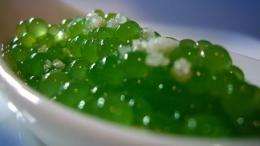
Fake caviar is much more fun than the real stuff! Thanks to two ingredients found in specialist stores – sodium alginate (extracted from brown algae) and calcium lactate – you can produce minute balls which are crunchy outside with a liquid core and look just like the original fish eggs. If you add a flavour (e.g. caviar, why not?) and food colouring, your taste buds won’t know the difference!

This is really easy to make. Just use a syringe to feed droplets of alginate into the calcium lactate at room temperature. They instantly turn into small beads, as the calcium ions bind the alginate chains together just like glue. The result is a gel which captures the liquid droplets. “A bit of practice is in order if you don’t want your caviar balls to be the size and texture of green peas”, says Marc Heyraud, a specialist in molecular gastronomy at the Institute of Chemistry of Neuchâtel University.

Dishwasher-cooked turkey

Ultra-slow cooking at a temperature between 60 and 70°C is getting more and more popular. One the one hand, it avoids killing vitamins and amino acids and, on the other, it produces very tender meat. The collagen binding cells within muscle tissue deteriorates at a temperature as low as about 60°C and moisture clearly evaporates slower at 70°C than 150°C. Perfect balance can only be reached with slow cooking. In practice, this can be done in a normal (convection) oven preheated to a temperature just a few degrees above the chosen heat. A turkey should stay in for at least four hours.

A more original and energy-saving alternative is to cook your turkey in the dishwasher. This is not as crazy as it sounds, as great chefs have successfully tested this solution put forward by chemist Hervé This, a pioneer in molecular gastronomy. Provided of course that the bird is sealed in a watertight bag... You will need to put it in the oven for a few minutes to give it its tasty-looking roasted finish.

Let’s top it all off with an orange emulsion. As everyone knows, for mayonnaise you need a tensioactive agent from egg yolk, fat (oil), and water from vinegar and the egg. Marc Heyraud suggests substituting melted turkey fat, an egg white and orange juice.

Caviar and white chocolate

Can the right wine be scientifically selected to ensure that a given sugar content or soil is the perfect match for a given dish? Some studies by Heston Blumenthal, a leading figure in molecular gastronomy, tend to prove that two products are better suited to each other when they have as many aromatic compounds in common as possible. For instance, he tried combining caviar with white chocolate. Marc Heyraud, who tasted the surprising mixture, found it impressive. However, he doubts that the method could become widespread and considers that “Maybe what he has is the flair of great cooks, who dare to marry such different flavours and obtain great results. When you associate flavours, nothing is as reliable as tradition and experience, and this is how you find the right wine for a particular dish”.

Change of state for dessert

To impress your guests with a stylish, yet light and quickly-made dessert, why not try a mousse with just chocolate and orange juice or tea? Simply whisk the melted chocolate with either liquid on a bed of ice. The change from the liquid to the solid state through cooling captures the air bubbles produced by the whisk.

Provided by Ecole Polytechnique Federale de Lausanne

Filter


Move the slider to adjust rank threshold, so that you can hide some of the comments.


Display comments: newest first

Isaacsname
Dec 26, 2011

Rank: not rated yet
" Dishwasher-cooked turkey "...?

That's an odd sous-vide technique....I would fire anybody I caught doing this in a commercial kitchen though....maybe even deduct the cost of the water used in running the machine 100's of times to cook a bird.

Caviar and white chocolate 'eh ?

....try beets slow-roasted with vanilla beans. After you try them, make the rest into a shake with some vanilla ice cream.

trust me :)
Rank not rated yet
Relevant PhysicsForums posts

More news stories

Change in developmental timing was crucial in the evolutionary shift from dinosaurs to birds: study

At first glance, it's hard to see how a common house sparrow and a Tyrannosaurus Rex might have anything in common. After all, one is a bird that weighs less than an ounce, and the other is a dinosaur that ...

Other Sciences / Archaeology & Fossils

created 5 hours ago | popularity 5 / 5 (4) | comments 0 | with audio podcast

Social welfare cuts ultimately come with heavy price, researchers say

(Phys.org) -- Slashing government funding for Medicaid, food stamps and other programs that serve the poor – while politically popular with some lawmakers and many conservatives – may do more harm ...

Other Sciences / Social Sciences

created May 24, 2012 | popularity 4.2 / 5 (20) | comments 155

Ancient Bethlehem seal unearthed in Jerusalem

Israeli archaeologists have discovered a 2,700-year-old seal that bears the inscription "Bethlehem," the Israel Antiquities Authority announced Wednesday, in what experts believe to be the oldest artifact ...

Other Sciences / Archaeology & Fossils

created May 23, 2012 | popularity 3.3 / 5 (15) | comments 24

Dollars and sense: Why are some people morally against tax?

As the U.S. presidential election campaigns heat up, the economic debate is dominated by bailouts, austerity and, inevitably, taxation. Now a new study published in Symbolic Interaction asks why tax is such an important issue ...

Other Sciences / Social Sciences

created May 23, 2012 | popularity 2.3 / 5 (3) | comments 16

Oldest Jewish archaeological evidence on the Iberian Peninsula

German archaeologists of the Friedrich Schiller University Jena found one of the oldest archaeological evidence so far of Jewish Culture on the Iberian Peninsula at an excavation site in the south of Portugal, ...

Other Sciences / Archaeology & Fossils

created May 25, 2012 | popularity 4.2 / 5 (6) | comments 12


'Unzipped' carbon nanotubes could help energize fuel cells, batteries

Multi-walled carbon nanotubes riddled with defects and impurities on the outside could replace some of the expensive platinum catalysts used in fuel cells and metal-air batteries, according to scientists at ...

Computer model used to pinpoint prime materials for efficient carbon capture

When power plants begin capturing their carbon emissions to reduce greenhouse gases – and to most in the electric power industry, it's a question of when, not if – it will be an expensive undertaking.

T cells 'hunt' parasites like animal predators seek prey, study shows

By pairing an intimate knowledge of immune-system function with a deep understanding of statistical physics, a cross-disciplinary team at the University of Pennsylvania has arrived at a surprising finding: T cells use a movement ...

Land and sea species differ in climate change response: study

(Phys.org) -- Marine and terrestrial species will likely differ in their responses to climate warming, new research by Simon Fraser University and Australia’s University of Tasmania has found.

Yale study concludes public apathy over climate change unrelated to science literacy

Are members of the public divided about climate change because they don't understand the science behind it? If Americans knew more basic science and were more proficient in technical reasoning, would public consensus match ...

10 million years needed to recover from mass extinction

It took some 10 million years for Earth to recover from the greatest mass extinction of all time, latest research has revealed.