The Misplaced Stuff: NASA loses moon, space rocks
December 8, 2011 By SETH BORENSTEIN , AP Science Writer

The Misplaced Stuff: NASA loses moon, space rocks (AP)

Enlarge

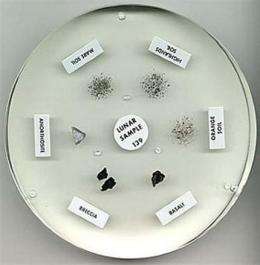
This undated handout photo provided by NASA shows a six-inch lunar sample disk containing three rock pieces and three clumps of lunar dirt, similar to the one shown here, went missing after it was loaned to a Delaware observatory in 1978. NASA’s Inspector General says the space agency has lost or had stolen hundreds of pieces of moon rocks, meteorites and other space samples. In one case. The loan expired in 2010 and when NASA asked what happened, the observatory said the person in charge of the sample had died and they couldn’t find it. It is still missing. (AP Photo/NASA)

Astronauts may have had the `right stuff' to go to the moon, but when it comes to keeping track of what they brought back, NASA seems to have misplaced some of that stuff.

In a report issued by the agency's Inspector General on Thursday, NASA concedes that more than 500 pieces of moon rocks, meteorites, comet chunks and other space material were stolen or have been missing since 1970. That includes 218 moon samples that were stolen and later returned and about two dozen moon rocks and chunks of lunar soil that were reported lost last year.

NASA, which has loaned more than 26,000 samples, needs to keep better track of what's sent to researchers and museums, the report said. The lack of sufficient controls "increases the risk that these unique resources may be lost," the report concluded.

After last year's case of a missing moon sample loaned to a Delaware astronomical observatory - which the astronomers there claimed they returned to NASA - the agency's inspector general decided to audit about one quarter of the thousands of samples of moon rocks, lunar dust, meteorites, and other space material that the agency loaned.

Of those cases, 19 percent of the researchers either couldn't account for the samples or they had material that NASA records indicated had been destroyed or loaned to someone else. That included 22 meteorites and 2 comet samples from a daring mission that grabbed comet chunks.

In two cases, one researcher still had nine lunar samples he borrowed 35 years ago and another had 10 chunks of meteorites he kept for 14 years. Neither had ever worked on them. Another researcher had 36 moon samples and kept them for 16 years after he had finished his research.

The audit also unearthed records that listed hundreds of samples that no longer existed.

In the Delaware case, NASA loaned the Mount Cuba observatory a disk of moon rocks and moon dust in 1978 with the loan expiring in 2008. In 2010, NASA contacted the observatory and learned that its manager had died and the observatory couldn't find the sample, the inspector general's report said.

But that's not how the observatory sees it.

"We didn't lose it," said University of Delaware physics professor Harry Shipman, a trustee of the observatory. Yes, the observatory manager died, but sometime in the 1990s "he returned it to NASA. We don't know what NASA did with it," he said.

NASA told the auditors that the observatory returned meteorites, but not the lunar sample and that's still missing, said inspector general spokeswoman Renee Juhans.

NASA spokesman Michael Cabbage said the agency will continue to loan out material to scientists and for educational display, but will adopt the specific recommendations the inspector general made to improve its tracking.

"NASA does not consider these national treasure assets to be at high risk," he said.

More information: Inspector General's report: http://bit.ly/t5Zvmh

©2011 The Associated Press. All rights reserved. This material may not be published, broadcast, rewritten or redistributed.

Filter


Move the slider to adjust rank threshold, so that you can hide some of the comments.


Display comments: newest first

omatumr
Dec 08, 2011

Rank: 2.2 / 5 (13)
This is an intriguing story at this time of many intrigues in science and politics.

A special investigator from NASA showed up at my lab at the University of Missouri in ~1972 and accused us of losing Moon samples.

I showed him receipts for every sample received, every sample melted/vaporized/analyzed, and every sample returned to the Lunar Curator.

We sent him back to Houston, but he never told us if he found out why he had been sent on this "wild goose chase."

With kind regards,
Oliver K. Manuel
Former NASA Principal
Investigator for Apollo
http://www.omatumr.com
Nerdyguy
Dec 08, 2011

Rank: 5 / 5 (5)
"The Misplaced Stuff: NASA loses moon, space rocks"

NASA lost the moon?
Pirouette
Dec 08, 2011

Rank: 1.5 / 5 (8)
350
Dec 09, 2011

Rank: 4.3 / 5 (4)
Can you two children shut up and take your ranting at each other to PMs please...
Pirouette
Dec 09, 2011

Rank: 1.6 / 5 (7)
LOL. . . .please try to understand that FrankHerbert$hit follows me and certain others into different threads just to harass and try to intimidate. He is attempting to drive people off Physorg and he wants us to stop commenting
MarkyMark
Dec 10, 2011

Rank: 3 / 5 (4)
Can you two children shut up and take your ranting at each other to PMs please...

Agreed someone ban the immature child Pirouette pls.
Vendicar_Decarian
Dec 11, 2011

Rank: 2.6 / 5 (5)
"He is attempting to drive people off Physorg" - Spirochete

Ah, if only we could get rid of childish fools like you.

The world would be such a better place.
Vendicar_Decarian
Dec 11, 2011

Rank: 2.3 / 5 (3)
As to the loss of the lunar samples.

1. They couldn't have been very important if they were encased in hardened plastic.

2. Entropy wins this round.

antonima
Dec 11, 2011

Rank: 5 / 5 (1)
Sold on the black market, 5,000$ no problem
jsdarkdestruction
Dec 12, 2011

Rank: 3.7 / 5 (3)
too bad he didnt investigate you for other things oliver.
Callippo
Dec 12, 2011

Rank: 3 / 5 (2)
Sold on the black market, 5,000$ no problem
I believe in this mechanism too. NASA is gettin' poor, many people from there are losing their jobs, the organization level and internal control mechanisms are in decline. The more time passed from lunar missions, the more lunar samples are rare and their price increases. So that the enticement to materialize the remnants of wealth era with various individuals is significant. We should see the things in their historical context.
Pirouette
Dec 14, 2011

Rank: 1 / 5 (1)
"He is attempting to drive people off Physorg" - Spirochete

Ah, if only we could get rid of childish fools like you.

The world would be such a better place.

That from the boy who calls people 'tard if he doesn't agree with them.
FrankHerbert
Dec 15, 2011

Rank: 3 / 5 (106)
"He is attempting to drive people off Physorg" - Spirochete

Ah, if only we could get rid of childish fools like you.

The world would be such a better place.

That from the boy who calls people 'tard if he doesn't agree with them.


LMAO you are such a hypocrite.
Rank 5 /5 (1 vote)
Relevant PhysicsForums posts
  • Distance of planets from stars and revolution
    created5 hours ago
  • revamping general concept and cosmological principle
    createdMay 25, 2012
  • Transiting Exoplanet Light Curve
    createdMay 25, 2012
  • Math behind Theoretical Physics
    createdMay 24, 2012
  • Do we know whats at the center of galaxies yet?
    createdMay 23, 2012
  • Structure of the Milky Way?
    createdMay 20, 2012
  • More from Physics Forums - General Astronomy

More news stories

Land and sea species differ in climate change response: study

(Phys.org) -- Marine and terrestrial species will likely differ in their responses to climate warming, new research by Simon Fraser University and Australia’s University of Tasmania has found.

Space & Earth / Environment

created 3 hours ago | popularity 3.7 / 5 (3) | comments 3 | with audio podcast

Yale study concludes public apathy over climate change unrelated to science literacy

Are members of the public divided about climate change because they don't understand the science behind it? If Americans knew more basic science and were more proficient in technical reasoning, would public consensus match ...

Space & Earth / Environment

created 5 hours ago | popularity 4.8 / 5 (4) | comments 11 | with audio podcast

10 million years needed to recover from mass extinction

It took some 10 million years for Earth to recover from the greatest mass extinction of all time, latest research has revealed.

Space & Earth / Earth Sciences

created 5 hours ago | popularity 5 / 5 (3) | comments 1 | with audio podcast

Sophisticated simulations predict future warming

The chances of our planet being hit by a global warming of 3 degrees Celsius by 2050 is as likely as it being hit by an increase of 1.4 degrees, new research shows. Presented in the journal Nature Geoscience, the British study ...

Space & Earth / Earth Sciences

created May 22, 2012 | popularity 4.4 / 5 (9) | comments 51

Aliens don't want to eat us, says former SETI director

Alien life probably isn’t interested in having us for dinner, enslaving us or laying eggs in our bellies, according to a recent statement by former SETI director Jill Tarter.

Space & Earth / Space Exploration

created May 25, 2012 | popularity 4.4 / 5 (14) | comments 41


'Unzipped' carbon nanotubes could help energize fuel cells, batteries

Multi-walled carbon nanotubes riddled with defects and impurities on the outside could replace some of the expensive platinum catalysts used in fuel cells and metal-air batteries, according to scientists at ...

Change in developmental timing was crucial in the evolutionary shift from dinosaurs to birds: study

At first glance, it's hard to see how a common house sparrow and a Tyrannosaurus Rex might have anything in common. After all, one is a bird that weighs less than an ounce, and the other is a dinosaur that ...

Computer model used to pinpoint prime materials for efficient carbon capture

When power plants begin capturing their carbon emissions to reduce greenhouse gases – and to most in the electric power industry, it's a question of when, not if – it will be an expensive undertaking.

T cells 'hunt' parasites like animal predators seek prey, study shows

By pairing an intimate knowledge of immune-system function with a deep understanding of statistical physics, a cross-disciplinary team at the University of Pennsylvania has arrived at a surprising finding: T cells use a movement ...

Scientists develop ultra-sensitive test that detects diseases in their earliest stages

Scientists have developed an ultra-sensitive test that should enable them to detect signs of a disease in its earliest stages, in research published today in the journal Nature Materials.

Manufacturing genes to attack flu virus

An international research team has manufactured a new protein that can combat deadly flu epidemics.