A major step forward towards drought tolerance in crops
December 19, 2011

A major step forward towards drought tolerance in crops

Enlarge

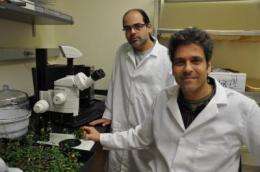
Assaf Mosquna (standing) is a postdoctoral researcher working with Sean Cutler (seated), an associate professor of plant cell biology in the Department of Botany and Plant Sciences at UC Riverside. Credit: UCR Strategic Communications.

When a plant encounters drought, it does its best to cope with this stress by activating a set of protein molecules called receptors. These receptors, once activated, turn on processes that help the plant survive the stress.

A team of plant has discovered how to rewire this to heighten the plants' response – a finding that can be used to engineer crops to give them a better shot at surviving and displaying increased yield under drought conditions.

The discovery, made in the laboratory of Sean Cutler, an associate professor of biology at the University of California, Riverside, brings drought-tolerant crops a step closer to becoming a reality.

It's the hormones

When plants encounter drought, they naturally produce abscisic acid, a stress hormone that helps them cope with the drought conditions. Specifically, the hormone turns on in the plants, resulting in a suite of beneficial changes that help the plants survive. These changes typically include guard cells closing on leaves to reduce water loss, cessation of plant growth to reduce water consumption and myriad other stress-relieving responses.

The discovery by Cutler and others of abscisic acid receptors, which orchestrate these responses, was heralded by Science magazine as a breakthrough of the year in 2009 due to the importance of the receptor proteins to drought and stress tolerance.

Tweaking the receptor

Working on Arabidopsis, a model plant used widely in plant biology labs, the Cutler-led research team has now succeeded supercharging the plant's stress response pathway by modifying the abscisic acid receptors so that they can be turned on at will and stay on.

"Receptors are the cell's conductors and the abscisic acid receptors orchestrate the specific symphony that elicits stress tolerance," said Cutler, a member of UC Riverside's Institute for Integrative Genome Biology. "We've now figured out how to turn the orchestra on at will."

He explained that each stress hormone receptor is equipped with a lid that operates like a gate. For the receptor to be in the on state, the lid must be closed. Using receptor genes engineered in the laboratory, the group created and tested through more than 740 variants of the stress hormone receptor, hunting for the rare variants that caused the lid to be closed for longer periods of time.

"We found many of these mutations," Cutler said. "But each one on its own gave us only partly what we were looking for. But when we carefully stacked the right ones together, we got the desired effect: the receptor locked in its on state, which, in turn, was able to activate the pathway in ."

Study results appear in tomorrow's (Dec. 20) issue of the Proceedings of the National Academy of Sciences.

Next, the research team plans to take this basic science from the lab into the field – a process that could take many years.

Journal reference: Proceedings of the National Academy of Sciences search and more info website

Provided by University of California - Riverside search and more info website

Filter


Move the slider to adjust rank threshold, so that you can hide some of the comments.


Display comments: newest first

Todecule
Dec 20, 2011

Rank: not rated yet
Drought is obviously nothing new in the history of plant evolution. So why haven't the plants evolved this ability for heightened stress response on their own, if it does indeed allow them to survive better?

Perhaps it's a capability they once had but lost through domestication. Or do we just hope to be able to run the on/off switch for the stress response more intelligently than the plant would on it's own, thus giving it a better shot at surviving a particular drought event?
Rank 5 /5 (3 votes)
Relevant PhysicsForums posts

More news stories

Scientist: Evolution debate will soon be history

(AP) -- Richard Leakey predicts skepticism over evolution will soon be history. Not that the avowed atheist has any doubts himself.

Biology / Evolution

created 23 hours ago | popularity 3.5 / 5 (20) | comments 87

Manufacturing genes to attack flu virus

An international research team has manufactured a new protein that can combat deadly flu epidemics.

Biology / Biotechnology

created 5 hours ago | popularity not rated yet | comments 0 | with audio podcast

More plant species responding to global warming than previously thought

(Phys.org) -- Far more wild plant species may be responding to global warming than previous large-scale estimates have suggested.

Biology / Ecology

created May 22, 2012 | popularity 4.6 / 5 (14) | comments 18 | with audio podcast

For monogamous sparrows, it doesn't pay to stray (but they do it anyway)

It's quite common for a female song sparrow to stray from her breeding partner and mate with the male next door, but a new study shows that sleeping around can be costly.

Biology / Plants & Animals

created May 22, 2012 | popularity 5 / 5 (2) | comments 8 | with audio podcast

Thousands of shellfish found dead in Peru

Thousands of crustaceans were found dead off the coast of Lima following the mystery mass death of dolphins and pelicans, the Peruvian Navy said Friday.

Biology / Ecology

created May 26, 2012 | popularity 4.7 / 5 (7) | comments 7


Nvidia trumpets Tegra 3 phone design wins for 2012

(Phys.org) -- Nvidia’s competitive war paint has a name, Tegra 3. On the heels of Nvidia announcements about lowering costs of its Tegra 3 processors and Nvidia-enabled tablets running Android Ice Cream ...

'Unzipped' carbon nanotubes could help energize fuel cells, batteries

Multi-walled carbon nanotubes riddled with defects and impurities on the outside could replace some of the expensive platinum catalysts used in fuel cells and metal-air batteries, according to scientists at ...

T cells 'hunt' parasites like animal predators seek prey, study shows

By pairing an intimate knowledge of immune-system function with a deep understanding of statistical physics, a cross-disciplinary team at the University of Pennsylvania has arrived at a surprising finding: T cells use a movement ...

Computer model used to pinpoint prime materials for efficient carbon capture

When power plants begin capturing their carbon emissions to reduce greenhouse gases – and to most in the electric power industry, it's a question of when, not if – it will be an expensive undertaking.

Change in developmental timing was crucial in the evolutionary shift from dinosaurs to birds: study

At first glance, it's hard to see how a common house sparrow and a Tyrannosaurus Rex might have anything in common. After all, one is a bird that weighs less than an ounce, and the other is a dinosaur that ...

Land and sea species differ in climate change response: study

(Phys.org) -- Marine and terrestrial species will likely differ in their responses to climate warming, new research by Simon Fraser University and Australia’s University of Tasmania has found.