Lubricant in metal-on-metal hip implants found to be graphite, not proteins
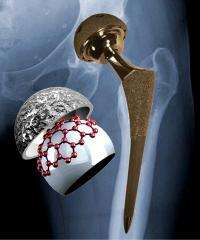
A team of engineers and physicians have made a surprising discovery that offers a target for designing new materials for hip implants that are less susceptible to the joint's normal wear and tear.
Researchers from Northwestern University, Rush University Medical Center, Chicago, and the University of Duisburg-Essen Germany found that graphitic carbon is a key element in a lubricating layer that forms on metal-on-metal hip implants. The lubricant is more similar to the lubrication of a combustion engine than that of a natural joint.
The study will be published Dec. 23 by the journal Science.
Prosthetic materials for hips, which include metals, polymers and ceramics, have a lifetime typically exceeding 10 years. However, beyond 10 years the failure rate generally increases, particularly in young, active individuals. Physicians would love to see that lifespan increased to 30 to 50 years. Ideally, artificial hips should last the patient's lifetime.
"Metal-on-metal implants can vastly improve people's lives, but it's an imperfect technology," said Laurence D. Marks, a co-author on the paper who led the experimental effort at Northwestern. "Now that we are starting to understand how lubrication of these implants works in the body, we have a target for how to make the devices better."
Marks is a professor of materials science and engineering at Northwestern's McCormick School of Engineering and Applied Science.
The ability to extend the life of implants would have enormous benefits, in terms of both cost and quality of life. More than 450,000 Americans, most with severe arthritis, undergo hip replacement each year, and the numbers are growing. Many more thousands delay the life-changing surgery until they are older, because of the limitations of current implants.
"Hip replacement surgery is the greatest advancement in the treatment of end-stage arthritis in the last century," said co-author and principal investigator Dr. Joshua J. Jacobs, the William A. Hark, M.D./Susanne G. Swift Professor of Orthopedic Surgery and professor and chair of the department of orthopedic surgery at Rush. "By the time patients get to me, most of them are disabled. Life is unpleasant. They have trouble working, playing with their grandchildren or walking down the street. Our findings will help push the field forward by providing a target to improve the performance of hip replacements. That's very exciting to me."
Earlier research by team members Alfons Fischer at the University of Duisburg-Essen and Markus Wimmer at Rush University Medical Center discovered that a lubricating layer forms on metallic joints as a result of friction. Once formed, the layer reduces friction as well as wear and corrosion. This layer is called a tribological layer and is where the sliding takes place, much like how an ice skate slides not on the ice but on a thin layer of water.
But, until now, researchers did not know what the layer was. (It forms on the surfaces of both the ball and the socket.) It had been assumed that the layer was made of proteins or something similar in the body that got into the joint and adhered to the implant's surfaces.
The interdisciplinary team studied seven implants that were retrieved from patients for a variety of reasons. The researchers used a number of analytical tools, including electron and optical microscopies, to study the tribological layer that formed on the metal parts. (An electron microscope uses electrons instead of light to image materials.)
The electron-energy loss spectra, a method of examining how the atoms are bonded, showed a well-known fingerprint of graphitic carbon. This, together with other evidence, led the researchers to conclude that the layer actually consists primarily of graphitic carbon, a well-established solid lubricant, not the proteins of natural joints.
"This was quite a surprise," Marks said, "but the moment we realized what we had, all of a sudden many things started to make sense."
Metal-on-metal implants have advantages over other types of implants, Jacobs said. They are a lower wear alternative to metal-on-polymer devices, and they allow for larger femoral heads, which can reduce the risk of hip dislocation (one of the more common reasons for additional surgery). Metal-on-metal also is the only current option for a hip resurfacing procedure, a bone-conserving surgical alternative to total hip replacement.
"Knowing that the structure is graphitic carbon really opens up the possibility that we may be able to manipulate the system in a way to produce graphitic surfaces," Fischer said. "We now have a target for how we can improve the performance of these devices."
"Nowadays we can design new alloys to go in racing cars, so we should be able to design new materials for implants that go into human beings," Marks added.
The next phase, Jacobs said, is to examine the surfaces of retrieved devices and correlate the researchers' observations of the graphitic layer with the reason for removal and the overall performance of the metal surfaces. Marks also hopes to learn how graphitic debris from the implant might affect surrounding cells.
The science of tribology is the study of friction, lubrication and wear. The term comes from the Greek word "tribos," meaning rubbing or sliding.
More information: The Science paper is titled "Graphitic Tribological Layers in Metal-on-Metal Hip Replacements."
Journal information: Science
Provided by Northwestern University


