Japan 'was unprepared' for nuclear disaster: official probe
December 26, 2011 by Hiroshi Hiyama

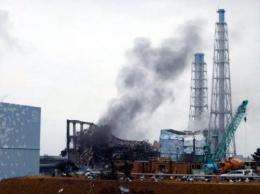
A picture from March shows black smoke rising from the third reactor building at TEPCO's Fukushima nuclear plant

Enlarge

The operators of the tsunami-stricken Fukushima nuclear power plant and government regulators were woefully unprepared for disaster, the first official probe into the March 11 catastrophe said Monday.

The operators of the tsunami-stricken Fukushima nuclear power plant and government regulators were woefully unprepared for disaster, the first official probe into the March 11 catastrophe said Monday.

An independent panel set up to investigate the events around the world's worst in a generation said Power (TEPCO) and the Nuclear and Industrial Safety Agency had failed to think beyond the risks for which the was designed.

"TEPCO did not take precautionary measures in anticipation that a severe accident could be caused by (a) tsunami such as the one (that) hit... Neither did the regulatory authorities," the report said.

"TEPCO did not incorporate measures against tsunamis exceeding the design basis. This indicates the limit of voluntary safety measures."

The panel's interim report sharply contrasted with TEPCO's own probe, which said the utility could have had no way to prepare for the 9.0-magnitude earthquake and that sparked meltdowns and explosions at the plant.

The 500-page document, based on interviews with 456 people involved in the accident, comes nine months after the crisis forced the evacuation of tens of thousands of people as radiation leaked into the air, sea and food chain.

The panel said its aim was not to apportion blame for the disaster, but to learn why the accident happened in the way it did.

TEPCO's accident management programmes assumed only relatively minor internal incidents such as mechanical failures and human errors, the panel said.

Risks such as "earthquakes and tsunamis were not included in the scope of consideration," the panel said, adding that regulatory bodies also failed to force TEPCO to establish thorough safety measures.

"Measures against severe accidents should not be left with the operator’s voluntary activities," the provisional English translation of the report said.

"The nuclear safety regulatory bodies should consider and determine legal requirements when they deem necessary."

Emergency procedures set out by TEPCO and the government were not followed and were found to be impractical, the report said.

For example, Fukushima workers mistakenly believed that the plant's cooling system was working even after the tsunami actually knocked it out. They then missed opportunities to correct that misunderstanding, the report said.

The error caused delays in the pouring of water into overheating reactor No. 1, which eventually went into meltdown and exploded, it said.

Communication failures among crews working on site left small groups of individuals to make their own decisions and meant that actions were not reported to supervisors.

Such errors also caused delays in the cooling of reactor No. 3, the panel said.

"Collection of accurate and most up-to-date information is a prerequisite for timely and appropriate decision-making. This issue, together with the need for providing information to the nation, is of a major concern," the report said.

TEPCO's "preparedness for such (an) accident as severe (as) damage at the core of (a) reactor as a result of natural disasters was quite insufficient".

The public's mistrust in the government grew as Tokyo repeatedly stressed that despite nuclear explosions, health risks were low, the panel said.

The government decided to withhold simulations of how radioactive materials from the wrecked plant could spread, while repeatedly playing down health worries.

"If the information were provided (in a timely way), it could have helped local governments and populations to choose (a) more appropriate route and direction of evacuation," the panel said.

The government also failed to use the simulation for itself due to miscommunication among officials, it said.

TEPCO and government officials did not ensure information flowed during the crisis, with bureaucrats failing to ask about the reactors, relying on the utility to report to them instead.

The panel also pointed to insufficient communication among government officials themselves.

It said a crisis management headquarters, headed by the premier, was launched in a fifth-floor office of the prime minister's residence, while working-level officials gathered at the crisis management centre in the basement of the same building.

The final version of the report is due to be published in summer 2012.

(c) 2011 AFP

Filter


Move the slider to adjust rank threshold, so that you can hide some of the comments.


Display comments: newest first

Shootist
Dec 26, 2011

Rank: 5 / 5 (1)
Japan 'was unprepared' for nuclear disaster: official probe


No one expects the Spanish Inquisition.
Callippo
Dec 26, 2011

Rank: 5 / 5 (2)
Because they were flooded with 10 m tsunami wave at the same moment. We would probably feel "unprepared" too being at their place. But it's true, whole the risk of tsunami was deeply underestimated at Japan. In the same area the tsunami reached the height 24 m in 1933, the height 38 m in 1896. The Fukushima plant was destroyed with tsunami wave lower than 14 meters.
http://en.wikiped...rthquake
Pirouette
Dec 26, 2011

Rank: 1.8 / 5 (6)
That would be gross negligence on the part of the nuclear power plant admins, as well as local government for not ensuring some modicum of indestructibility of the core housings and related equipment. The flooding enveloping houses, et sl, was apparently unavoidable, as was the loss of lives and property. Japan as an island is in a bad location as it is. Perhaps they will be more prepared for the next earthquake and tsunami after this tragedy.
dacarls
Dec 26, 2011

Rank: not rated yet
I was amazed to hear that the engineers cut down the cliff where the reactors were planned by about 25 feet to save money in pumping cooling water up so high. Apparently nobody paid attention to previous tsunami history there.
Bad decision, to go along with the other bad design decisions.
dan42day
Dec 27, 2011

Rank: 1 / 5 (1)
Yet another way that America rebuilt Japan in it's own image after WWII. If Japanese culture had prevailed, there would have been a run on fine cutlery over there by now instead of the American tradition of CYA.
Tausch
Dec 27, 2011

Rank: not rated yet
Design for Demise.
Since nothing can trump Nature, design all objects for any demise. A demise of any nature of which the aftermath is harmless for anyone in the aftermath.
CHollman82
Dec 27, 2011

Rank: 3 / 5 (2)
You can't fault people for not anticipating every possible eventuality.

But I agree with Tausch, if you design things to fail gracefully (as much as possible anyway) there's no need to try to predict the future.
Rank 5 /5 (1 vote)
Relevant PhysicsForums posts

More news stories

Browser wars flare in mobile space

The browser wars are heating up again, but this time the fight is for dominance of the mobile Internet.

Technology / Software

created 12 hours ago | popularity 5 / 5 (2) | comments 3

Probability of contamination from severe nuclear reactor accidents is higher than expected: study

Catastrophic nuclear accidents such as the core meltdowns in Chernobyl and Fukushima are more likely to happen than previously assumed. Based on the operating hours of all civil nuclear reactors and the number ...

Technology / Energy & Green Tech

created May 22, 2012 | popularity 3.6 / 5 (22) | comments 56 | with audio podcast

HyperSolar shows dirty water no barrier to power world

(Phys.org) -- The Santa Barbara, California, company, HyperSolar, is set to transparently share the ups and downs of its research experiences toward the company’s ultimate vision, successfully producing ...

Technology / Energy & Green Tech

created May 24, 2012 | popularity 4.8 / 5 (16) | comments 17 | with audio podcast report

SpotterRF debuts Radar Backpack Kit (w/ Video)

(Phys.org) -- SpotterRF has announced a special radar backpack kit designed to enhance situational awareness for soldiers on the ground. The company says its special radar is designed for warfighters as part ...

Technology / Hi Tech & Innovation

created May 26, 2012 | popularity 5 / 5 (5) | comments 13 | with audio podcast report

Tesla to launch electric sedan in US on June 22

Tesla Motors said Tuesday it would begin deliveries of "the world's first premium electric sedan" on June 22, slightly ahead of schedule.

Technology / Energy & Green Tech

created May 22, 2012 | popularity 4.5 / 5 (12) | comments 18


Nvidia trumpets Tegra 3 phone design wins for 2012

(Phys.org) -- Nvidia’s competitive war paint has a name, Tegra 3. On the heels of Nvidia announcements about lowering costs of its Tegra 3 processors and Nvidia-enabled tablets running Android Ice Cream ...

'Unzipped' carbon nanotubes could help energize fuel cells, batteries

Multi-walled carbon nanotubes riddled with defects and impurities on the outside could replace some of the expensive platinum catalysts used in fuel cells and metal-air batteries, according to scientists at ...

T cells 'hunt' parasites like animal predators seek prey, study shows

By pairing an intimate knowledge of immune-system function with a deep understanding of statistical physics, a cross-disciplinary team at the University of Pennsylvania has arrived at a surprising finding: T cells use a movement ...

Computer model used to pinpoint prime materials for efficient carbon capture

When power plants begin capturing their carbon emissions to reduce greenhouse gases – and to most in the electric power industry, it's a question of when, not if – it will be an expensive undertaking.

Change in developmental timing was crucial in the evolutionary shift from dinosaurs to birds: study

At first glance, it's hard to see how a common house sparrow and a Tyrannosaurus Rex might have anything in common. After all, one is a bird that weighs less than an ounce, and the other is a dinosaur that ...

Land and sea species differ in climate change response: study

(Phys.org) -- Marine and terrestrial species will likely differ in their responses to climate warming, new research by Simon Fraser University and Australia’s University of Tasmania has found.