Japan nuclear meltdown 'maybe worse than thought'
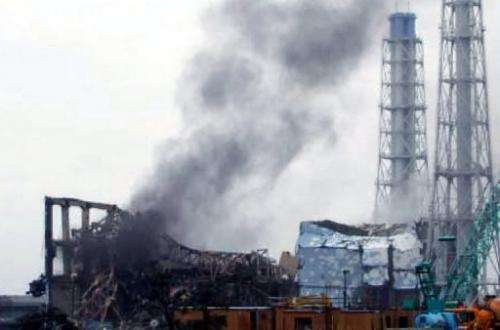
Black smoke rises from reactor number three at the Fukushima nuclear power plant, March 21, 2011. Molten nuclear fuel at Japan's Fukushima plant might have eaten two thirds of the way through a concrete containment base, its operator said, citing a new simulation of the extent of the March disaster.
Molten nuclear fuel at Japan's Fukushima plant might have eaten two thirds of the way through a concrete containment base, its operator said, citing a new simulation of the extent of the March disaster.
Tokyo Electric Power (TEPCO) said their latest calculations showed the fuel inside the No. 1 reactor at the tsunami-hit plant could have melted entirely, dropping through its inner casing and eroding a concrete base.
In the worst-case scenario, the molten fuel could have reached as far as 65 centimetres (2 feet) through the concrete, leaving it only 37 centimetres short of the outer steel casing, the report, released Wednesday, said.
Until now, TEPCO had said some fuel melted through the inner pressure vessel and dropped to the containment vessel, without saying how much and what it did to the concrete, citing a lack of data.
"Almost no fuel remains at its original position," TEPCO said in the report.
Two other reactors at the Fukushima Daiichi plant also went into meltdown when the tsunami knocked out cooling systems at the plant.
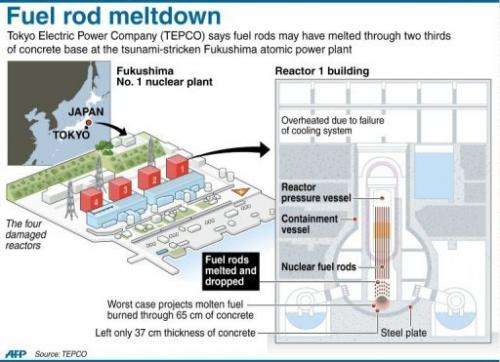
Graphic showing how molten fuel rods may have burned two thirds of the way through a concrete containment base, according to new information released by Tokyo Electric Power company.
However, only about 60 percent of their fuel dropped through to the concrete floor and caused less damage, the report projected.The molten fuel in the three reactors is believed to have stayed cool and stable because water has been injected into the vessels, the utility said.
TEPCO added, however, that it has yet to closely study many areas of the damaged reactors due to high level of radiation and stressed its findings were based on modelling.
The exact position of the fuel believed to have eaten its way through the concrete and to what extent it is being exposed to the cooling water is not known.
"Uncertainly involved in the analysis is significant due to the uncertain nature of the original conditions and data used," the report said.
"Using (realistically assumed) conditions for the evaluation, the concrete could have been penetrated, but (the fuel) stayed inside the casing," it said.
Fukushima Daiichi has spewed radioactive materials across eastern Japan since it was inundated by the huge waves of March 11.
The world's worst nuclear disaster since Chernobyl in 1986 has not directly claimed any lives, but has left tens of thousands of people displaced and rendered tracts of land uninhabitable, possibly for decades.
TEPCO and the Japanese government have pledged to bring all the plant's reactors to a state of cold shutdown by the end of 2011.
(c) 2011 AFP
-
From lemons to lemonade: Reaction uses carbon dioxide to make carbon-based semiconductor,
32 comments
-
Thioridazine kills cancer stem cells in human while avoiding toxic side-effects of conventional cancer treatments,
3 comments
-
SpaceX private rocket blasts off for space station (Update),
42 comments
-
Climate scientists say they have solved riddle of rising sea,
31 comments
-
SpaceX capsule has 'new car' smell, astronauts say (Update),
4 comments
-
Hypothetical desert earth
20 hours ago
-
More human population = greater mass?
May 25, 2012
-
Conversion from aircraft bearing to normal degrees
May 23, 2012
-
Interpretation/Analysis of the Lab results(HEPA filter)
May 22, 2012
-
Has anyone here attended the The Urbino Summer School in Paleoclimatology?
May 22, 2012
-
Earthquakes: Mag 6 N. Italy and Mag 5.6 W. Bulgaria
May 21, 2012
- More from Physics Forums - Earth
More news stories
Land and sea species differ in climate change response: study
(Phys.org) -- Marine and terrestrial species will likely differ in their responses to climate warming, new research by Simon Fraser University and Australia’s University of Tasmania has found.
3 hours ago |
3.7 / 5 (3) |
2
|
Yale study concludes public apathy over climate change unrelated to science literacy
Are members of the public divided about climate change because they don't understand the science behind it? If Americans knew more basic science and were more proficient in technical reasoning, would public consensus match ...
5 hours ago |
4.8 / 5 (4) |
11
|
10 million years needed to recover from mass extinction
It took some 10 million years for Earth to recover from the greatest mass extinction of all time, latest research has revealed.
Space & Earth / Earth Sciences
5 hours ago |
5 / 5 (3) |
1
|
Sophisticated simulations predict future warming
The chances of our planet being hit by a global warming of 3 degrees Celsius by 2050 is as likely as it being hit by an increase of 1.4 degrees, new research shows. Presented in the journal Nature Geoscience, the British study ...
Space & Earth / Earth Sciences
May 22, 2012 |
4.4 / 5 (9) |
51
Aliens don't want to eat us, says former SETI director
Alien life probably isnt interested in having us for dinner, enslaving us or laying eggs in our bellies, according to a recent statement by former SETI director Jill Tarter.
Space & Earth / Space Exploration
May 25, 2012 |
4.4 / 5 (14) |
40
Nvidia trumpets Tegra 3 phone design wins for 2012
(Phys.org) -- Nvidias competitive war paint has a name, Tegra 3. On the heels of Nvidia announcements about lowering costs of its Tegra 3 processors and Nvidia-enabled tablets running Android Ice Cream ...
'Unzipped' carbon nanotubes could help energize fuel cells, batteries
Multi-walled carbon nanotubes riddled with defects and impurities on the outside could replace some of the expensive platinum catalysts used in fuel cells and metal-air batteries, according to scientists at ...
T cells 'hunt' parasites like animal predators seek prey, study shows
By pairing an intimate knowledge of immune-system function with a deep understanding of statistical physics, a cross-disciplinary team at the University of Pennsylvania has arrived at a surprising finding: T cells use a movement ...
Computer model used to pinpoint prime materials for efficient carbon capture
When power plants begin capturing their carbon emissions to reduce greenhouse gases and to most in the electric power industry, it's a question of when, not if it will be an expensive undertaking.
Change in developmental timing was crucial in the evolutionary shift from dinosaurs to birds: study
At first glance, it's hard to see how a common house sparrow and a Tyrannosaurus Rex might have anything in common. After all, one is a bird that weighs less than an ounce, and the other is a dinosaur that ...
Scientist: Evolution debate will soon be history
(AP) -- Richard Leakey predicts skepticism over evolution will soon be history. Not that the avowed atheist has any doubts himself.

Dec 01, 2011
Rank: 5 / 5 (1)
What is under the buildings? What were the buildings built on?
Does "cold shutdown" become meaningless in this scenario?
Will contact to bare earth cause an explosion?
Dec 01, 2011
Rank: 5 / 5 (1)
Dec 01, 2011
Rank: 5 / 5 (1)
Dec 01, 2011
Rank: 5 / 5 (1)
So.. Nuclear fuel that is so hot that it burns through concrete and steel will not cause an explosion? No nuclear explosion, no. But you'll have continuous (huge) explosions when the fuel reaches the water table. Something like a nuclear geyser..
Dec 01, 2011
Rank: 1.4 / 5 (7)
Dec 01, 2011
Rank: 5 / 5 (1)
Your last question is a valid one. Even when the facility is built on solid rock, it will continue to burn through the rock. When enough water comes into the shaft for example, it will result in contaminating steam explosions. This will go on until this burning blob of nuclear fuel is cooled down enough. It's a blob now, no rods which you can cool in a controlled way.
Dec 01, 2011
Rank: 1 / 5 (1)
The main problem with a complete meltdown is ground water contamination. That is the nightmare scenario here.
Dec 01, 2011
Rank: 3.7 / 5 (6)
It is an unworkable fantasy.
Dec 02, 2011
Rank: 1 / 5 (1)
Right. Nuclear God-like power should only be kept bottled up in billions-dollars nuclear warheads so we can always have our God-like Thor's hammer brandishing over the heads of upstarts who wants to use/perfect nuclear power for something else. Especially, the developing and perfecting part! If once it is known that safe nuclear is not only possible but technically doable by any country with reasonably competent industrial base, our God-like power will go down the toilet. It is absolutely good to be able to bully, rater than to be bullied! "Never again" will be engraved on every warhead!
Dec 02, 2011
Rank: 2.3 / 5 (3)
No, it pretty much keeps melting through the foundation and through the crust of the Earth until it runs out of energy or gets mixed and dilluted in the magma it makes out of the concrete and soil.
Yeah, contaminating everything along the way, namely the water table and anything down stream, both above and below the surface.
Dec 04, 2011
Rank: 5 / 5 (1)
I'm still waiting for somebody to realize that Fukushima is actually a major stop for migrating fish, mammals, bugs and more. All you guys/gals should check out migratory pathways on that side of the world, the East-Asia Flyway is one.
Hell, there are pacific salmon that come all the way from Japan to swim hundreds of miles into the West coast of the US for example.
Dec 04, 2011
Rank: 1 / 5 (1)
Dec 04, 2011
Rank: 1 / 5 (2)
It just illustrates, how strong destructive force the intersubjective religion can be.