Hundreds of threatened species not on official US list
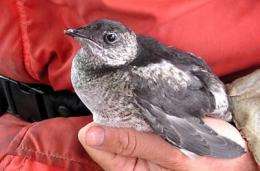
This is a critically endangered Kittlitz's murrelet (Brachyramphus brevirostris), which is not on the ESA protection list. Credit: Photo by the US Fish & Wildlife Service
Many of the animal species at risk of extinction in the United States have not made it onto the country's official Endangered Species Act (ESA) list, according to new research from the University of Adelaide.
National "red lists" are used by many countries to evaluate and protect locally threatened species. The ESA is one of the best known national lists and arguably the world's most effective biodiversity protection law.
A study - now published in Conservation Letters - has compared the ESA list of endangered species with the world's leading threatened species list, the International Union for the Conservation of Nature (IUCN) Red List.
The study has found that of the American species included on the IUCN Red List, 40% of birds, 50% of mammals, and 80-95% of other species such as amphibians, gastropods, crustaceans, and insects, were not recognised by the ESA as threatened.
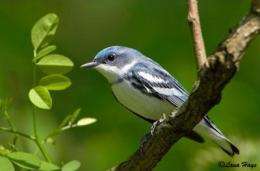
This is a cerulean warbler (Dendroica cerulea), which is not on the ESA protection list. Credit: Photo by Lana Hays: http://homepage.mac.com/lhays/website/index.html
This amounts to approximately 531 American species on the IUCN Red List that have not made the ESA protection list. These include bird species such as the critically endangered Kittlitz's murrelet (Brachyramphus brevirostris), the endangered ashy storm-petrel (Oceanodroma homochroa), and the vulnerable cerulean warbler (Dendroica cerulea)."The ESA has protected species since its establishment in 1973, and it may have prevented 227 extinctions. However, the implementation of the ESA by successive US governments has been problematic, including poor coverage of imperilled species, inadequate funding, and political intervention," says study leader Bert Harris, a native of Alabama who is undertaking his PhD with the University of Adelaide's Environment Institute and School of Earth & Environmental Sciences.
"Vague definitions of 'endangered' and 'threatened' and the existence of a 'warranted but precluded' category on the ESA list are also contributing to the gap in species classification," he says.
Mr Harris says a detailed evaluation of the ESA's coverage of the IUCN Red List was "well overdue".
"The ESA is a powerful environmental law but its impact is limited. With many species being overlooked, this does not bode well for the ESA's ability to mitigate species decline before they become critically imperilled.
"The IUCN Red List is imperfect, but it is the leading global threatened species list. It involves collaboration of many scientists, and regular refinement of its categories and criteria," Mr Harris says.
The study was conducted in collaboration with the University of California, Santa Cruz, the National University of Singapore and the University of Göttingen, Germany.
Provided by
University of Adelaide
-
From lemons to lemonade: Reaction uses carbon dioxide to make carbon-based semiconductor,
32 comments
-
Thioridazine kills cancer stem cells in human while avoiding toxic side-effects of conventional cancer treatments,
3 comments
-
SpaceX private rocket blasts off for space station (Update),
42 comments
-
Climate scientists say they have solved riddle of rising sea,
31 comments
-
SpaceX capsule has 'new car' smell, astronauts say (Update),
4 comments
-
What would stain as translucent on light-coloured fabric?
May 26, 2012
-
How do I identify different bacteria on culture plates?
May 26, 2012
-
Why Do Dogs do Strange things...
May 25, 2012
-
What does exophillic and endophillic mean in terms of mosquito and their control?
May 24, 2012
-
Semen stains glows under black lights (uv light)?
May 23, 2012
-
Question on Human Chromosome 2
May 23, 2012
- More from Physics Forums - Biology
More news stories
Manufacturing genes to attack flu virus
An international research team has manufactured a new protein that can combat deadly flu epidemics.
7 hours ago |
not rated yet |
0
|
Scientist: Evolution debate will soon be history
(AP) -- Richard Leakey predicts skepticism over evolution will soon be history. Not that the avowed atheist has any doubts himself.
May 26, 2012 |
3.5 / 5 (20) |
95
More plant species responding to global warming than previously thought
(Phys.org) -- Far more wild plant species may be responding to global warming than previous large-scale estimates have suggested.
May 22, 2012 |
4.6 / 5 (14) |
18
|
For monogamous sparrows, it doesn't pay to stray (but they do it anyway)
It's quite common for a female song sparrow to stray from her breeding partner and mate with the male next door, but a new study shows that sleeping around can be costly.
May 22, 2012 |
5 / 5 (2) |
8
|
Thousands of shellfish found dead in Peru
Thousands of crustaceans were found dead off the coast of Lima following the mystery mass death of dolphins and pelicans, the Peruvian Navy said Friday.
May 26, 2012 |
4.7 / 5 (7) |
7
Stunning image of smallest possible five-ringed structure
Scientists have created and imaged the smallest possible five-ringed structure about 100,000 times thinner than a human hair and you'll probably recognise its shape.
'Unzipped' carbon nanotubes could help energize fuel cells, batteries
Multi-walled carbon nanotubes riddled with defects and impurities on the outside could replace some of the expensive platinum catalysts used in fuel cells and metal-air batteries, according to scientists at ...
Change in developmental timing was crucial in the evolutionary shift from dinosaurs to birds: study
At first glance, it's hard to see how a common house sparrow and a Tyrannosaurus Rex might have anything in common. After all, one is a bird that weighs less than an ounce, and the other is a dinosaur that ...
Computer model used to pinpoint prime materials for efficient carbon capture
When power plants begin capturing their carbon emissions to reduce greenhouse gases and to most in the electric power industry, it's a question of when, not if it will be an expensive undertaking.
T cells 'hunt' parasites like animal predators seek prey, study shows
By pairing an intimate knowledge of immune-system function with a deep understanding of statistical physics, a cross-disciplinary team at the University of Pennsylvania has arrived at a surprising finding: T cells use a movement ...
Land and sea species differ in climate change response: study
(Phys.org) -- Marine and terrestrial species will likely differ in their responses to climate warming, new research by Simon Fraser University and Australia’s University of Tasmania has found.

Dec 13, 2011
Rank: not rated yet