New Horizons becomes closest spacecraft to approach Pluto
December 5, 2011 By Dr. Tony Phillips
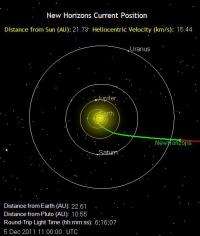
NASAs New Horizons mission reached a special milestone yesterday, Dec. 2, 2011, on its way to reconnoiter the Pluto system, coming closer to Pluto than any other spacecraft.
Its taken New Horizons 2,143 days of high-speed flight covering more than a million kilometers per day for nearly six yearsto break the closest-approach mark of 1.58 billion kilometers set by NASAs Voyager 1 in January 1986.
What a cool milestone! says New Horizons Principal Investigator Alan Stern, of the Southwest Research Institute. Although were still a long way 1.5 billion kilometers from Pluto were now in new territory as the closest any spacecraft has ever gotten to Pluto, and getting closer every day by over a million kilometers.
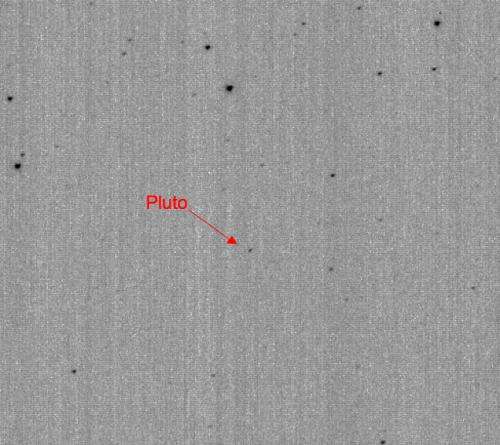
New Horizons’ current view of Pluto still resembles this image snapped by the spacecraft’s long-range telescopic camera in 2007; that will change exponentially beginning in late 2014, as New Horizons speeds closer to its target planet and its cameras begin to resolve details.
Now New Horizons, which is healthy, on course and closer to Pluto than Voyager ever came, will continue to set proximity-to-Pluto records every day until its closest approach about 7,767 miles (12,500 kilometers) from the planet on July 14, 2015.Weve come a long way across the solar system, says Glen Fountain, New Horizons project manager at the Johns Hopkins University Applied Physics Laboratory. When we launched [on Jan. 19, 2006] it seemed like our 10-year journey would take forever, but those years have been passing us quickly. Were almost six years in flight, and its just about three years until our encounter begins.
From New Horizons current distance to Pluto about as far as Earth is from Saturn Pluto remains just a faint point of light. But by the time New Horizons sails through the Pluto system in mid-2015, the planet and its moons will be so close that the spacecrafts cameras will spot features as small as a football field.
I wonder how long it will be until the next Pluto spacecraft perhaps a future orbiter or lander crosses this distance marker? Stern continues. It could be decades.
New Horizons is currently in hibernation, with all but its most essential systems turned off, speeding away from the Sun at more than 55,500 kilometers per hour. Operators at the Applied Physics Lab will wake the spacecraft in January for a month of testing and maintenance activities.
More information: Check the New Horizons homepage for more information and updates en route to Pluto: http://pluto.jhuapl.edu
Source: Science@NASA
-
From lemons to lemonade: Reaction uses carbon dioxide to make carbon-based semiconductor,
32 comments
-
Thioridazine kills cancer stem cells in human while avoiding toxic side-effects of conventional cancer treatments,
3 comments
-
SpaceX private rocket blasts off for space station (Update),
42 comments
-
Climate scientists say they have solved riddle of rising sea,
31 comments
-
SpaceX capsule has 'new car' smell, astronauts say (Update),
4 comments
-
Distance of planets from stars and revolution
7 hours ago
-
revamping general concept and cosmological principle
May 25, 2012
-
Transiting Exoplanet Light Curve
May 25, 2012
-
Math behind Theoretical Physics
May 24, 2012
-
Do we know whats at the center of galaxies yet?
May 23, 2012
-
Structure of the Milky Way?
May 20, 2012
- More from Physics Forums - General Astronomy
More news stories
Land and sea species differ in climate change response: study
(Phys.org) -- Marine and terrestrial species will likely differ in their responses to climate warming, new research by Simon Fraser University and Australia’s University of Tasmania has found.
5 hours ago |
3.7 / 5 (3) |
5
|
Yale study concludes public apathy over climate change unrelated to science literacy
Are members of the public divided about climate change because they don't understand the science behind it? If Americans knew more basic science and were more proficient in technical reasoning, would public consensus match ...
7 hours ago |
4.8 / 5 (5) |
19
|
10 million years needed to recover from mass extinction
It took some 10 million years for Earth to recover from the greatest mass extinction of all time, latest research has revealed.
Space & Earth / Earth Sciences
7 hours ago |
4 / 5 (4) |
1
|
Sophisticated simulations predict future warming
The chances of our planet being hit by a global warming of 3 degrees Celsius by 2050 is as likely as it being hit by an increase of 1.4 degrees, new research shows. Presented in the journal Nature Geoscience, the British study ...
Space & Earth / Earth Sciences
May 22, 2012 |
4.1 / 5 (10) |
51
Aliens don't want to eat us, says former SETI director
Alien life probably isnt interested in having us for dinner, enslaving us or laying eggs in our bellies, according to a recent statement by former SETI director Jill Tarter.
Space & Earth / Space Exploration
May 25, 2012 |
4.4 / 5 (15) |
41
Stunning image of smallest possible five-ringed structure
Scientists have created and imaged the smallest possible five-ringed structure about 100,000 times thinner than a human hair and you'll probably recognise its shape.
'Unzipped' carbon nanotubes could help energize fuel cells, batteries
Multi-walled carbon nanotubes riddled with defects and impurities on the outside could replace some of the expensive platinum catalysts used in fuel cells and metal-air batteries, according to scientists at ...
Change in developmental timing was crucial in the evolutionary shift from dinosaurs to birds: study
At first glance, it's hard to see how a common house sparrow and a Tyrannosaurus Rex might have anything in common. After all, one is a bird that weighs less than an ounce, and the other is a dinosaur that ...
Computer model used to pinpoint prime materials for efficient carbon capture
When power plants begin capturing their carbon emissions to reduce greenhouse gases and to most in the electric power industry, it's a question of when, not if it will be an expensive undertaking.
T cells 'hunt' parasites like animal predators seek prey, study shows
By pairing an intimate knowledge of immune-system function with a deep understanding of statistical physics, a cross-disciplinary team at the University of Pennsylvania has arrived at a surprising finding: T cells use a movement ...
Scientists develop ultra-sensitive test that detects diseases in their earliest stages
Scientists have developed an ultra-sensitive test that should enable them to detect signs of a disease in its earliest stages, in research published today in the journal Nature Materials.

Dec 05, 2011
Rank: 1.4 / 5 (12)
not so for those who know about the secret space program
witch has nothing to do with rockets or probes
and evrything to do with antigravity fleets moon and mars bases
the secret space fleet craft have superluminal capacity
they can visit any planet or star in the galaxy
and make it back for lunch with telemetry ans soil sampels
believe it or not
Dec 05, 2011
Rank: 1.4 / 5 (9)
Flying all the way out there, and so close, just to do a one-time flyby of a single planet/dwarf planet, whatever they call it now.
What a waste of equipment.
How hard could it have been to add a detachable orbiter or lander module?
I don't know, it's a damn shame.
Features as large as a football field? That ought to be useful for next to nothing.
"Yep, there's a bit of a hill. Oh there's a valley..."
Wow, typical, scientifically useless stuff you already know exists on any icy or rocky planetoid anyway...
Dec 05, 2011
Rank: 1 / 5 (9)
Former National Aeronautics and Space Administration Data and Photo Control Department manager, Ken Johnston, who worked for the space agency's Lunar Receiving Laboratory during the Apollo missions??
check what he has to say :
http://beforeitsn...ist.html
Dec 05, 2011
Rank: 1.5 / 5 (10)
http://beforeitsn...oon.html
Dec 05, 2011
Rank: 4.6 / 5 (11)
I almost had a stroke trying to parse this sentence. I probably should have my coffee in the mornings before reading the rantings of the mentally disturbed.
Dec 05, 2011
Rank: 3 / 5 (2)
I thought Pluto wasn't classed as a planet anymore :/
Dec 05, 2011
Rank: 5 / 5 (2)
Dec 05, 2011
Rank: 5 / 5 (2)
1. There is a huge amount of info you can gain in football field resolution compared to the 4 pixel images we can get now...spectrographically, feature wise, atmoshpher, geology, etc. etc.
2. I kinda agree with you regarding the orbiter or lander, but that would add substantially to weight/cost/complexity. The craft is traveling very fast, and it would take a lot of work to get a part or all of it to slow down safely to orbital or landing speed.
The radiothermal generator has a half life, so they want to get it there as quickly as possible to get the most power for their instruments - in addition to any other objects they may want to visit.
Dec 07, 2011
Rank: not rated yet