Heritage site under attack by flowers
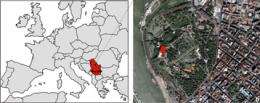
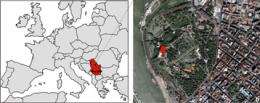
Location of the Belgrade fortress in Serbia. Credit: V. Matovic and Google
The results of a study conducted by Serbian researchers, in collaboration with the Laboratoire de Dynamique, Interactions et Réactivité, are unequivocal: the Belgrade fortress is not only threatened by the effects of coal burning, as was assumed until now, but also by flower beds. The deterioration of the fortress walls could be partially caused by the large quantities of potassium present in fertilizers used by gardeners and could be responsible for the formation of black crusts on the ramparts. To preserve this heritage, the researchers recommend avoiding excessive use of fertilizers. Their conclusions are due to be published in the first quarter of 2012 in the Journal of Cultural Heritage and could prove to be of value to other historical sites across the world.
North and South gates of the Belgrade fortress. Credit: V. Matovic
In Belgrade, fortifications were built from the Middle Ages on the Kalemegdan plateau, which stands above the confluence of the Danube and Sava rivers. Today, the ramparts of the fortress of the Serbian capital have become a vast public park with flowers and shady areas, near the town centre, attracting inhabitants and tourists alike. However, during the last twenty years or so, black crusts have been spreading on its limestone walls. Until now, these crusts were solely attributed to the high levels of sulfur dioxide released by the coal heating used by the inhabitants of Belgrade.In collaboration with Philippe Colomban, CNRS researcher at LADIR, the University of Belgrade and the Serbian Highway Institute analyzed the black crusts on the King's Gate of the fortress. Their objective was to determine the actual deterioration process in order to propose the most appropriate conservation solutions to the authorities. Different samples of the limestone and lime mortars were studied by porometry, X-ray diffractometry, infrared and Raman spectroscopy, electron microscopy and elementary analysis.
Above a certain concentration of sulfur dioxide in damp air, acid rain or acid fog can form. This leads to the emergence of black calcium sulfates and carbonates, giving the outer walls a somewhat unsightly appearance. Surprisingly enough, the researchers detected large amounts of syngenite, a double sulfate of potassium and calcium. This corrosion product normally forms on potassium-containing medieval stained-glass windows, as well as granite constructions or those using a mortar containing potassium. Yet it had never been observed on very pure limestone before. So where does it come from? After performing a series of analyses, the researchers revealed an abnormal concentration of potassium in the soil, near the rampart walls. Incidently, the latter contain flowerbeds where potassium-rich fertilizers are used. A simulation of the action of acidified potassium-charged water on pieces of limestone confirmed that it triggered the formation of syngenite, as observed on the King's Gate. Pretty flowers and monument preservation therefore require a subtle balance in potassium input in order to avoid such pollution. On-site measurements are scheduled to map the extent of the phenomenon.
More information: The origin of syngenite in black crusts on the limestone monument King's Gate (Belgrade Fortress, Serbia) the role of agriculture fertilizer, Vesna Matovic, et al., Journal of Cultural Heritage (2011), doi:10.1016/j.culher.2011.09.003
Provided by
CNRS
-
From lemons to lemonade: Reaction uses carbon dioxide to make carbon-based semiconductor,
32 comments
-
Thioridazine kills cancer stem cells in human while avoiding toxic side-effects of conventional cancer treatments,
3 comments
-
SpaceX private rocket blasts off for space station (Update),
42 comments
-
Climate scientists say they have solved riddle of rising sea,
31 comments
-
SpaceX capsule has 'new car' smell, astronauts say (Update),
4 comments
-
What would stain as translucent on light-coloured fabric?
May 26, 2012
-
How do I identify different bacteria on culture plates?
May 26, 2012
-
Why Do Dogs do Strange things...
May 25, 2012
-
What does exophillic and endophillic mean in terms of mosquito and their control?
May 24, 2012
-
Semen stains glows under black lights (uv light)?
May 23, 2012
-
Question on Human Chromosome 2
May 23, 2012
- More from Physics Forums - Biology
More news stories
Manufacturing genes to attack flu virus
An international research team has manufactured a new protein that can combat deadly flu epidemics.
7 hours ago |
not rated yet |
0
|
Scientist: Evolution debate will soon be history
(AP) -- Richard Leakey predicts skepticism over evolution will soon be history. Not that the avowed atheist has any doubts himself.
May 26, 2012 |
3.5 / 5 (20) |
95
More plant species responding to global warming than previously thought
(Phys.org) -- Far more wild plant species may be responding to global warming than previous large-scale estimates have suggested.
May 22, 2012 |
4.6 / 5 (14) |
18
|
For monogamous sparrows, it doesn't pay to stray (but they do it anyway)
It's quite common for a female song sparrow to stray from her breeding partner and mate with the male next door, but a new study shows that sleeping around can be costly.
May 22, 2012 |
5 / 5 (2) |
8
|
Thousands of shellfish found dead in Peru
Thousands of crustaceans were found dead off the coast of Lima following the mystery mass death of dolphins and pelicans, the Peruvian Navy said Friday.
May 26, 2012 |
4.7 / 5 (7) |
7
Stunning image of smallest possible five-ringed structure
Scientists have created and imaged the smallest possible five-ringed structure about 100,000 times thinner than a human hair and you'll probably recognise its shape.
'Unzipped' carbon nanotubes could help energize fuel cells, batteries
Multi-walled carbon nanotubes riddled with defects and impurities on the outside could replace some of the expensive platinum catalysts used in fuel cells and metal-air batteries, according to scientists at ...
Change in developmental timing was crucial in the evolutionary shift from dinosaurs to birds: study
At first glance, it's hard to see how a common house sparrow and a Tyrannosaurus Rex might have anything in common. After all, one is a bird that weighs less than an ounce, and the other is a dinosaur that ...
Computer model used to pinpoint prime materials for efficient carbon capture
When power plants begin capturing their carbon emissions to reduce greenhouse gases and to most in the electric power industry, it's a question of when, not if it will be an expensive undertaking.
T cells 'hunt' parasites like animal predators seek prey, study shows
By pairing an intimate knowledge of immune-system function with a deep understanding of statistical physics, a cross-disciplinary team at the University of Pennsylvania has arrived at a surprising finding: T cells use a movement ...
Land and sea species differ in climate change response: study
(Phys.org) -- Marine and terrestrial species will likely differ in their responses to climate warming, new research by Simon Fraser University and Australia’s University of Tasmania has found.
