Hedgerows can be managed better for wildlife
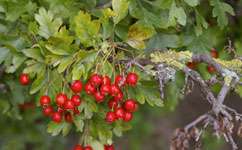
Simple changes to hedgerow management could significantly improve winter habitats and food supplies for wildlife, according to new research by the Centre for Ecology & Hydrology.
Hedgerow berries are an essential food for small mammals and birds, including blackbirds, fieldfares and redwings, and their flowers provide nectar for pollinating insects. When and how often hedges are trimmed makes a big difference to the amount of both flowers and berries they produce.
'These emerging results have national and even international implications, as there are an increasing number of countries implementing agri-environment schemes or other forms of hedgerow management regulations,' says Dr Joanna Staley of the Centre for Ecology & Hydrology, who led the research.
The study, published in Biological Conservation, compared the effects of different management regimes on hawthorn hedges over five years. It found that cutting every three years rather than annually produced 2.1 times more flowers and 3.4 times the mass of berries.
Cutting every two years also increased flowers and berry provision, but the increase in berry weight depended on the hedges being cut in late winter rather than autumn.
Hedgerows have been part of our landscape for centuries and are important for farming, culture and archaeology as well as wildlife. They have to be actively managed to stop them spreading.
Common practice is to cut them back every year, typically in late summer or early autumn directly after harvest, which removes young berries before winter starts. In England, 41 per cent of hedgerows are now under one of three agri-environment scheme (AES) options, which aim to reduce cutting frequency to increase the flowers and berries available to wildlife. The most popular option, which covers 32 per cent of managed hedgerows in England, is to cut every two years.
So measures are in place to manage hedges in the interests of wildlife, but this is the first time the benefits of each scheme have been rigorously tested and compared.
The research team carried out their five-year experiment in Cambridgeshire. They managed 32 sections of hawthorn hedge by cutting back every one, two or three years, either in autumn or winter.
The team then used a simple model to explore the impacts of their results on England's hedgerows. This showed that moving to a three-year cutting regime would substantially increase the resources available to over-wintering birds and pollinators in most years.
If those hedges currently under the most popular AES option (cutting every two years) were instead managed under a three-year cutting regime, the weight of berries would increase by an estimated 40 per cent.
Alternatively, if these were timed every two years in later winter rather than autumn, berry weight is estimated to increase by 20 per cent.
There are further benefits to cutting in winter rather than autumn. For example several butterfly species lay eggs in late summer or early autumn, many of which may be removed if hedgerows are cut before they hatch. The decline of the brown hairstreak butterfly population – a species considered seriously under threat in the UK – has been partly attributed to annual trimming of hedgerows.
'It's fortunate that we effectively have a ready-made channel in the AES that can quickly turn these findings into action,' says Staley.
'We are broadening the research to cover a wider range of hedgerow species and across more sites to allow us to generate robust evidence to help revise and improve future policies,' she concludes.
More information: Staley, JT et al. Long-term effects of hedgerow management policies on resource provision for wildlife. Biological Conservation, (2011). doi:10.1016/j.biocon.2011.09.006
Provided by PlanetEarth Online
This story is republished courtesy of Planet Earth online, a free, companion website to the award-winning magazine Planet Earth published and funded by the Natural Environment Research Council (NERC).


