Harvard group takes complexity out of video face replacement (w/ video)
Dec 05, 2011 by Nancy Owano report
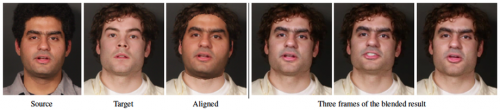
The method for face replacement requires only single-camera video of the source (a) and target (b) subject, which allows for simple acquisition and reuse of existing footage. It tracks both performances with a multilinear morphable model then spatially and temporally align the source face to the target footage (c). Researchrs then compute an optimal seam for gradient domain compositing that minimizes bleeding and flickering in the final result (d). Image credit: Kevin Dale / Harvard University

(PhysOrg.com) -- From Facebook to YouTube to on the fly film projects, the presentation of content that entertains or instructs or both draws on visual tools, ranging from simple to complex. Novice as well as expert creatives are being increasingly equipped with technologies to help them make something creative. Out to prove that point even further, a computer scientist from Harvard University’s School of Engineering and Applied Sciences and colleagues have come up with face-transplant software.

The tool claims to be able to replace faces using only single-camera video with minimal user input. The software can render a ten-second video in about twenty minutes. The software is promoted as a system that can be used by amateur and budget-wary film makers.

Kevin Dale, part of the school’s Graphics, Vision and Interaction (GVI) Group, is co-author of a paper, “Video Face Replacement,” which discusses the approach. The facial replacement method used, according to the authors, requires no substantial manual operations or complex hardware, only single-camera video.

This video is not supported by your browser at this time.

For tracking facial performance, a 3-D multilinear model is used in both videos. With the corresponding 3-D geometry, the source is warped to the target face and the source is retimed to march the target performance. “We then compute an optimal seam through the video volume that maintains temporal consistency in the final composite,” according to the team. They note that the results are difficult to distinguish from real video footage.

The software has been met by favorable comments that it can be useful, though not a high end tool to compete with tools and techniques at major studios. Quoted in New Scientist, computer graphics researcher Paul Debevec sees Dale’s work as a potential YouTube plug in or just generally an easy to use tool.

While easy to use, the difficulty may arise in questions about technology privileges of fair use and abuse, as with many controversial software tools that make use of people’s faces with and without their explicit permission. Gizmodo Australia opines,"it could open a whole new world of piracy issues when even an actor’s face and performance are used without their permission.”

The face-swapping tool, meanwhile, is just one extension of goals for image and compositing at the Harvard GVI group.

We are likely to hear more from them. “Merging images and videos to create high-quality composites is a very difficult problem, and even professional artists using sophisticated can take many hours of work to create results that are photo-realistic,” says the group statement. They want to deliver tools that make compositing easier by automating most of the process.

The group says its work involves developing algorithms that analyze and match the visual appearance of objects in images--color, contrast, noise, texture, and blur. They fundamentally want to make the creation of composites from diverse images easy.

Similar interest was sparked in September, when Arturo Castro and Kyle McDonald demonstrated a technique called Real-Time Face Substitution. The software made use of the open source platform openFrameworks, which Castro helped to drive along with Zachary Lieberman and Theodore Watson.

Explore further: Computer scientist publishes new algorithm cluster to data mine health records

More information: gvi.seas.harvard.edu/node/318

Related Stories

A new window to the face

Aug 09, 2011

The human face is a complicated thing—powered by 52 muscles; contoured by the nose, eyebrows, and other features; and capable of an almost infinite range of expressions, from joy to anger to sorrow to ...

YouTube adds video editing tool

Sep 15, 2011

YouTube on Wednesday added an editing tool that lets creators of videos make changes to snippets after they have been uploaded to the popular website.

Faster computer graphics

Jun 13, 2011

Photographs of moving objects are almost always a little blurry — or a lot blurry, if the objects are moving rapidly enough. To make their work look as much like conventional film as possible, game and ...

A 360 degree camera that sees in 3D (w/ Video)

Dec 01, 2010

Surround sight has come to the camera. Inspired by the eye of a fly, EPFL scientists have invented a camera that can take pictures and film in 360° and reconstruct the images in 3D.

Researcher sees new angles in visual search

Oct 26, 2011

Engineering professor Shih-Fu Chang is trying to make visual search technology as effortless as typing a keyword like “Morningside restaurants” into Google.

Recommended for you

The brain as a model for future supercomputers

May 14, 2013

(Phys.org) —The brain's repute took a big hit in 1997 when an IBM supercomputer defeated world chess champion Gary Kasparov in a match reported around the world. But in the second round, the brain is back.

User comments : 3

Adjust slider to filter visible comments by rank

Display comments: newest first

antonima
not rated yet Dec 05, 2011
This is the beginning of a very very special technology - but the aligned faces doesn't look anything like either one. I guess it could be used by a one man film studio to generate diversity, for one.
Jimee
not rated yet Dec 05, 2011
Good enough for a beginning. Think of the deceptions possible if ever it is perfected!
dallasgoldbug
not rated yet Dec 06, 2011
When they perfect the ability to manipulate the ears then I will be impressed.

More news stories

German energy shift faces headwinds

Tense engineers have their eyes peeled on complex colour-coded diagrams on a wall-sized screen that makes their control room look like the inside of a spaceship.

Internet in 'coma' as Iran election looms

Iran is tightening control of the Internet ahead of next month's presidential election, mindful of violent street protests that social networkers inspired last time around over claims of fraud, users and ...

Immune protein could stop diabetes in its tracks

Melbourne researchers have identified an immune protein that has the potential to stop or reverse the development of type 1 diabetes in its early stages, before insulin-producing cells have been destroyed.

Competition in the quantum world

Innsbruck physicists led by Rainer Blatt and Peter Zoller experimentally gained a deep insight into the nature of quantum mechanical phase transitions. They are the first scientists that simulated the competition ...

Cracking the ice code

(Phys.org) —What happened the last time a vegetated Earth shifted from an extremely cold climate to desert-like conditions? And what does it tell us about climate change today?

NEC phone is liquid-cooled and gender-specific

(Phys.org) —Pink is the color of princess fairy-tale gowns, magic slippers, upscale cupcake icing, and everything else favorable to girls who just want to be girls. "Ladyphones" appear to be concepts for ...