Half of greenhouse gases 'emitted by five nations'
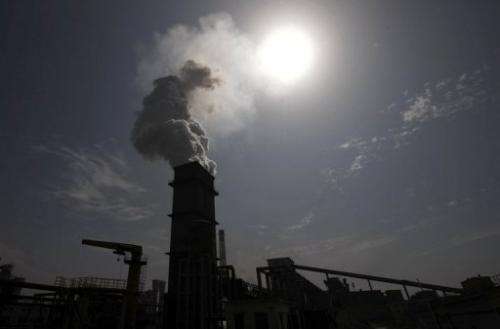
More than half of all carbon pollution released into the atmosphere comes from five countries, according to a national ranking of greenhouse gas emissions released Thursday.
The first 10 countries on the list, made available during UN climate talks in Durban, South Africa, account for two-thirds of global emissions, said the report, compiled by British-based firm Maplecroft, specialists in risk analysis.
China, the United States, India, Russia and Japan top the ranking, with Brazil, Germany, Canada, Mexico and Iran just behind.
Three of the top six nations are energy-hungry emerging giants developing their economies at breakneck speed.
China, which eclipsed the United States several years ago to head the list, produced 9,441 megatons of CO2 equivalent (CO2e), a measure that combines C02 with other heat-trapping gases such as methane and nitrous oxide.
The method of calculation used combines 2009 figures for energy consumption with estimated numbers for 2010.
The majority of the countries' emissions are carbon dioxide, thanks to massive energy demand. Renewable energy use is increasing, but remains dwarfed by fossil fuel use.
India produced 2272.45 megatons of CO2e, a significant portion from methane generated by agriculture.
"Although per capita energy use in China and India is relatively low, overall energy demand is very large," said Maplecroft Analyst, Chris Laws.
"When combined with high use of coal and other fossil fuels, this results in large emissions in both countries."
Brazil's output of 1,144 megatons from energy use would be significantly higher if deforestation were taken into account.
Among advanced economies, the United States -- No. 1 among large nations for per capita emissions -- produced 6,539 megatons of CO2e.
Russia, at 1,963 megatons, ranked fourth. Its emissions dropped after the collapse of the Soviet Union, but are expected to rise.
In Japan, where output was at 1,203 megatonnes of CO2e, safety fears over nuclear power could lead to a greater reliance on fossil fuels -- and a spike in carbon emissions, Laws said.
He noted, however, that the Japanese government has announced their intention to fill the energy gap with renewable energy sources.
"The trend of increasing global greenhouse gas emissions is unlikely to be abated in the short-to-medium term," he said by e-mail.
The index of 176 nations ranks countries based on the total annual level of greenhouse gas emissions, combining data on CO2 emissions from energy use and non-CO2 emissions.
Data comes from several sources, including the US Energy Information Administration and the US Environmental Protection Agency.
The 194-nation negotiations in Durban, under the UN Framework Convention on Climate Change (UNFCCC), run until December 9.
(c) 2011 AFP
-
From lemons to lemonade: Reaction uses carbon dioxide to make carbon-based semiconductor,
32 comments
-
Thioridazine kills cancer stem cells in human while avoiding toxic side-effects of conventional cancer treatments,
3 comments
-
SpaceX private rocket blasts off for space station (Update),
42 comments
-
Climate scientists say they have solved riddle of rising sea,
31 comments
-
SpaceX capsule has 'new car' smell, astronauts say (Update),
4 comments
-
Hypothetical desert earth
22 hours ago
-
More human population = greater mass?
May 25, 2012
-
Conversion from aircraft bearing to normal degrees
May 23, 2012
-
Interpretation/Analysis of the Lab results(HEPA filter)
May 22, 2012
-
Has anyone here attended the The Urbino Summer School in Paleoclimatology?
May 22, 2012
-
Earthquakes: Mag 6 N. Italy and Mag 5.6 W. Bulgaria
May 21, 2012
- More from Physics Forums - Earth
More news stories
Land and sea species differ in climate change response: study
(Phys.org) -- Marine and terrestrial species will likely differ in their responses to climate warming, new research by Simon Fraser University and Australia’s University of Tasmania has found.
5 hours ago |
3.7 / 5 (3) |
5
|
Yale study concludes public apathy over climate change unrelated to science literacy
Are members of the public divided about climate change because they don't understand the science behind it? If Americans knew more basic science and were more proficient in technical reasoning, would public consensus match ...
7 hours ago |
4.8 / 5 (5) |
19
|
10 million years needed to recover from mass extinction
It took some 10 million years for Earth to recover from the greatest mass extinction of all time, latest research has revealed.
Space & Earth / Earth Sciences
7 hours ago |
4 / 5 (4) |
1
|
Sophisticated simulations predict future warming
The chances of our planet being hit by a global warming of 3 degrees Celsius by 2050 is as likely as it being hit by an increase of 1.4 degrees, new research shows. Presented in the journal Nature Geoscience, the British study ...
Space & Earth / Earth Sciences
May 22, 2012 |
4.1 / 5 (10) |
51
Aliens don't want to eat us, says former SETI director
Alien life probably isnt interested in having us for dinner, enslaving us or laying eggs in our bellies, according to a recent statement by former SETI director Jill Tarter.
Space & Earth / Space Exploration
May 25, 2012 |
4.4 / 5 (15) |
41
Stunning image of smallest possible five-ringed structure
Scientists have created and imaged the smallest possible five-ringed structure about 100,000 times thinner than a human hair and you'll probably recognise its shape.
'Unzipped' carbon nanotubes could help energize fuel cells, batteries
Multi-walled carbon nanotubes riddled with defects and impurities on the outside could replace some of the expensive platinum catalysts used in fuel cells and metal-air batteries, according to scientists at ...
Change in developmental timing was crucial in the evolutionary shift from dinosaurs to birds: study
At first glance, it's hard to see how a common house sparrow and a Tyrannosaurus Rex might have anything in common. After all, one is a bird that weighs less than an ounce, and the other is a dinosaur that ...
Computer model used to pinpoint prime materials for efficient carbon capture
When power plants begin capturing their carbon emissions to reduce greenhouse gases and to most in the electric power industry, it's a question of when, not if it will be an expensive undertaking.
T cells 'hunt' parasites like animal predators seek prey, study shows
By pairing an intimate knowledge of immune-system function with a deep understanding of statistical physics, a cross-disciplinary team at the University of Pennsylvania has arrived at a surprising finding: T cells use a movement ...
Scientists develop ultra-sensitive test that detects diseases in their earliest stages
Scientists have developed an ultra-sensitive test that should enable them to detect signs of a disease in its earliest stages, in research published today in the journal Nature Materials.
Dec 01, 2011
Rank: 5 / 5 (3)
Dec 01, 2011
Rank: 1.1 / 5 (54)
United States: 307,006,550
India: 1,170,938,000
Russia: 141,750,000
Japan: 127,450,460
Total: 3,085,444,510
World population just surpassed 7 billion.
So it's ~44% which is a lot closer to 50% than I expected it to be.
It's also important to notice that at least a billion or so of those persons are in poverty and are not contributing as much to the problem as their more advantaged countrymen.
Dec 01, 2011
Rank: 2.6 / 5 (5)
Dec 01, 2011
Rank: 2.6 / 5 (5)
http://www.jaxa.j...i_e.html
http://joannenova...rbed-by-
Dec 01, 2011
Rank: 3 / 5 (6)
http://www.jaxa.j...i_e.html
we have measurements for this now, turns out alarmists were wrong again.
Dec 02, 2011
Rank: 2 / 5 (4)
From JAXA is this beautiful work.
http://www.youtub...dlItQkXs
Climate Alarmists? Don't you mean Climate Realists?
Dec 02, 2011
Rank: 3 / 5 (3)
Good call. Though we shouldn't become complacent. If (when) China and India become as industrialized as the others in
the top 10 then that percentage will start to look a lot worse.
Added to that that saying "half the people produce half the greenhouse gases" sounds good - but if the total amount of greenhouse gases is, say, 5 times higher than the planet can cope with at any one time then that doesn't win us any prizes.
Dec 02, 2011
Rank: 2.6 / 5 (5)
The slope of the keeling curve is currently 2.2PPM/year, which represents the net annual gain.
Above, China alone produces 1.88PPM/year equivalent of CO2...
When the oceans and forests can no long uptake any more of what we are making due to acidification reaching physical limits, and deforestation, then the only place left for CO2 to build up will be directly in the atmosphere.
Unfortunately, change isn't going to be fast.
We inherited this technology and this life style, and changing to wind, solar, and other TRULY clean alternatives is going to take many years realistically, probably several decades if not longer.
Sadly, history even suggests you won't be able to force people to do the right thing until no other choice is available anyway.
There'll always be the greedy republican or FOX news anchor who insists coal and oil are perfectly safe and nothing to worry about...
Dec 02, 2011
Rank: 1 / 5 (1)
It's kind of a double whammy... Producing greenhouse gasses to extract a substance that, when used, produces greenhouse gasses.
I think it must be fairly significant if you look at Canada's population of about 34 million.
Dec 02, 2011
Rank: not rated yet
I think it's more of a single whammy for them, since we in the US use the lions share of the oil produced there.
Dec 02, 2011
Rank: 1 / 5 (1)
http://www.youtub...dlItQkXs
Its worth a visit.