The 2011 Geminid meteor shower
December 13, 2011 By Dr. Tony Phillips

The 2011 Geminid meteor shower

Enlarge

Credit: Tony Phillips

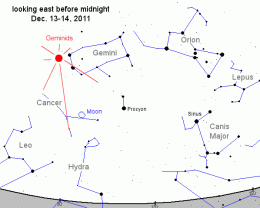
The 2011 Geminid meteor shower peaks on the night of Dec. 13-14, and despite the glare of a nearly-full Moon, it might be a good show.

"Observers with clear skies could see as many as 40 Geminids per hour," predicts Bill Cooke of the Environment Office.  "Our all-sky network of meteor cameras has captured several early Geminid fireballs.  They were so bright, we could see them despite the moonlight."

The best time to look is between 10 pm local time on Tuesday, Dec. 13, and sunrise on Wednesday, Dec. 14th. Geminids, which spray out of the constellation Gemini, can appear anywhere in the sky. "Dress warmly and look up," says Cooke.  "It's that simple."

This video is not supported by your browser at this time.

The source of the Geminids is near-Earth asteroid 3200 Phaethon. Most meteor showers come from comets, so having an asteroid as a parent makes the Geminids a bit of an oddball.

"This is the thing I love most about Geminids," says Cooke.  "They're so strange."

Every year in mid-December, Earth runs through a trail of dusty debris that litters the orbit of 3200 Phaethon. Comets vaporizing in hot sunlight naturally produce such debris trails, but rocky asteroids like 3200 Phaethon do not. At least they're not supposed to. The incongruity has baffled researchers since 1983 when 3200 Phaethon was discovered by NASA's IRAS satellite.

One clue: 3200 Phaethon travels unusually close to the sun. The asteroid's eccentric orbit brings it well inside the orbit of Mercury every 1.4 years. The rocky body thus receives a regular blast of solar heating that might somehow boil jets of dust into the Geminid debris stream.

In 2009, NASA's STEREO-A spacecraft saw this process at work.  Coronagraphs onboard the solar observatory watched 3200 Phaethon as it was swinging by the sun.  Sure enough, the asteroid doubled in brightness, probably because it was spewing jets of dust.

"The most likely explanation is that Phaethon ejected dust, perhaps in response to a break-down of surface rocks (through thermal fracture and decomposition cracking of hydrated minerals) in the intense heat of the Sun," wrote UCLA planetary scientists David Jewitt and Jing Li, who analyzed the data.

Jewett and Li's "rock comet" hypothesis is compelling, but they point out a problem: The amount of dust 3200 Phaethon ejected during its 2009 sun-encounter added a mere 0.01% to the mass of the Geminid debris stream--not nearly enough to keep the stream replenished over time. Perhaps the rock comet was more active in the past …?

"We just don't know," says Cooke. "Every new thing we learn about the seems to deepen the mystery."

Led by Cooke, the Meteoroid Environment Office has just released an app for iPhones and iPads to help citizen scientists count and report their observations to NASA. The "Meteor Counter" is available for free from Apple's app store: http://itunes.apple.com/us/app/meteor-counter/id466896415

Source: Science@NASA

4.9 /5 (8 votes)  

Filter


Move the slider to adjust rank threshold, so that you can hide some of the comments.


Display comments: newest first

Pirouette
Dec 13, 2011

Rank: 3.7 / 5 (3)
Hoping there's no cloud cover tonight so we can watch the show.
GSwift7
Dec 13, 2011

Rank: 5 / 5 (1)
I hope I have good seeing conditions tonight. I love a good meteor shower.
Cave_Man
Dec 13, 2011

Rank: 3 / 5 (2)
Oh man I hope tonight the sky clears up, im about to start on my igloo and I could put a huge plexiglass skylight in the top for some really comfortable meteor shower viewing, I just have to figure out where the constellation gemini is.
Pirouette
Dec 13, 2011

Rank: 3 / 5 (2)
Cave_Man. . .look at the skymap in the article. When you go outside tonight, look to the East and locate Orion's Belt, then go across to your left to the Gemini and a little left of that is where the Geminid shower will show up Good hunting.
Rank 4.9 /5 (8 votes)
Related Stories
created Dec 03, 2007 comments 0

Asteroid Shower

Relevant PhysicsForums posts
  • Distance of planets from stars and revolution
    created7 hours ago
  • revamping general concept and cosmological principle
    createdMay 25, 2012
  • Transiting Exoplanet Light Curve
    createdMay 25, 2012
  • Math behind Theoretical Physics
    createdMay 24, 2012
  • Do we know whats at the center of galaxies yet?
    createdMay 23, 2012
  • Structure of the Milky Way?
    createdMay 20, 2012
  • More from Physics Forums - General Astronomy

More news stories

Land and sea species differ in climate change response: study

(Phys.org) -- Marine and terrestrial species will likely differ in their responses to climate warming, new research by Simon Fraser University and Australia’s University of Tasmania has found.

Space & Earth / Environment

created 5 hours ago | popularity 3.7 / 5 (3) | comments 5 | with audio podcast

Yale study concludes public apathy over climate change unrelated to science literacy

Are members of the public divided about climate change because they don't understand the science behind it? If Americans knew more basic science and were more proficient in technical reasoning, would public consensus match ...

Space & Earth / Environment

created 7 hours ago | popularity 4.8 / 5 (5) | comments 19 | with audio podcast

10 million years needed to recover from mass extinction

It took some 10 million years for Earth to recover from the greatest mass extinction of all time, latest research has revealed.

Space & Earth / Earth Sciences

created 7 hours ago | popularity 4 / 5 (4) | comments 1 | with audio podcast

Sophisticated simulations predict future warming

The chances of our planet being hit by a global warming of 3 degrees Celsius by 2050 is as likely as it being hit by an increase of 1.4 degrees, new research shows. Presented in the journal Nature Geoscience, the British study ...

Space & Earth / Earth Sciences

created May 22, 2012 | popularity 4.1 / 5 (10) | comments 51

Aliens don't want to eat us, says former SETI director

Alien life probably isn’t interested in having us for dinner, enslaving us or laying eggs in our bellies, according to a recent statement by former SETI director Jill Tarter.

Space & Earth / Space Exploration

created May 25, 2012 | popularity 4.4 / 5 (15) | comments 41


Stunning image of smallest possible five-ringed structure

Scientists have created and imaged the smallest possible five-ringed structure – about 100,000 times thinner than a human hair – and you'll probably recognise its shape.

'Unzipped' carbon nanotubes could help energize fuel cells, batteries

Multi-walled carbon nanotubes riddled with defects and impurities on the outside could replace some of the expensive platinum catalysts used in fuel cells and metal-air batteries, according to scientists at ...

Change in developmental timing was crucial in the evolutionary shift from dinosaurs to birds: study

At first glance, it's hard to see how a common house sparrow and a Tyrannosaurus Rex might have anything in common. After all, one is a bird that weighs less than an ounce, and the other is a dinosaur that ...

Computer model used to pinpoint prime materials for efficient carbon capture

When power plants begin capturing their carbon emissions to reduce greenhouse gases – and to most in the electric power industry, it's a question of when, not if – it will be an expensive undertaking.

T cells 'hunt' parasites like animal predators seek prey, study shows

By pairing an intimate knowledge of immune-system function with a deep understanding of statistical physics, a cross-disciplinary team at the University of Pennsylvania has arrived at a surprising finding: T cells use a movement ...

Scientists develop ultra-sensitive test that detects diseases in their earliest stages

Scientists have developed an ultra-sensitive test that should enable them to detect signs of a disease in its earliest stages, in research published today in the journal Nature Materials.