A galaxy blooming with new stars
December 15, 2011

A galaxy blooming with new stars

Enlarge

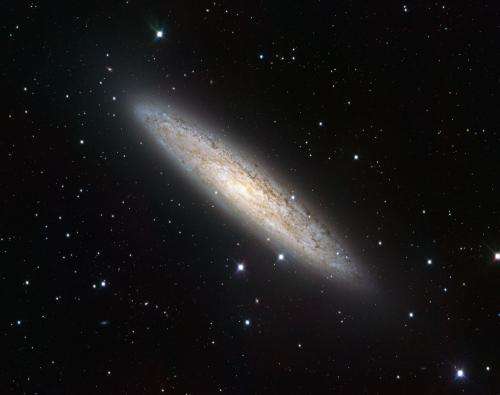
The VLT Survey Telescope has captured in sharp detail the beauty of the nearby spiral galaxy NGC 253. This new portrait is probably the best wide-field view of this object and its surroundings ever taken. It demonstrates that the VST, the newest telescope at ESO's Paranal Observatory, provides broad views of the sky while also offering impressive image quality. Luminous regions of ongoing star formation are spread throughout NGC 253, which is pumping out new stars at a furious pace. The data were processed using the VST-Tube system developed by A. Grado and collaborators at the INAF-Capodimonte Observatory. Credit: ESO/INAF-VST Acknowledgement: A. Grado/L. Limatola/INAF-Capodimonte Observatory

(PhysOrg.com) -- The VLT Survey Telescope (VST) has captured the beauty of the nearby spiral galaxy NGC 253. The new portrait is probably the most detailed wide-field view of this object and its surroundings ever taken. It demonstrates that the VST, the newest telescope at ESO's Paranal Observatory, provides broad views of the sky while also offering impressive image sharpness.

NGC 253 gleams about eleven and a half million light-years away in the southern constellation of Sculptor. It is often just called the , although other descriptive names include the Silver Coin or Silver Dollar Galaxy. It is easy to get a good look at NGC 253 through binoculars as it is one of the brightest galaxies in the sky after the Milky Way's closest, big galactic neighbour, the .

Astronomers have noted the widespread active star formation in NGC 253 and labelled it a "starburst" galaxy. The many bright clumps dotting the galaxy are stellar nurseries where hot have just ignited. The radiation streaming from these giant blue-white babies makes the surrounding clouds glow brightly (green in this image).

This video is not supported by your browser at this time.

This zoom video sequence starts with a view of a rather empty part of the sky that includes the constellations of Cetus and Sculptor. As we close in an elongated haze appears. This is the nearby spiral galaxy NGC 253, one of the brightest in the southern skies. The final sequence shows a very detailed new view of this galaxy from the VLT Survey Telescope. Credit: ESO/INAF-VST, Nick Risinger

This nearby spiral galaxy was discovered by the German–British astronomer Caroline Herschel, the sister of the famed astronomer William Herschel, as she searched for comets in 1783. The Herschels would have been delighted by the crisp, richly detailed view of NGC 253 that the VST can provide.

This latest image of NGC 253 was taken during VST's science verification phase — when the telescope's scientific performance is assessed before it enters operations. The VST data are being combined with infrared images from VISTA to identify the younger generations of stars in NGC 253. This picture is more than 12 000 pixels across and the superb sky conditions at ESO's Paranal Observatory, combined with the fine telescope optics, result in sharp star images over the entire image.

The VST is a 2.6-metre wide-field survey telescope with a one-degree field of view — twice as broad as the full Moon. The VST programme is a joint venture between the INAF–Osservatorio Astronomico di Capodimonte, Naples, Italy and ESO. The 268-megapixel camera OmegaCAM at its heart is designed to map the sky both quickly and with very fine image quality. VST is the largest telescope in the world designed to exclusively survey the sky in visible light, complementing ESO's VISTA infrared survey telescope, also located at Paranal.

Zooming into this new picture not only allows a very detailed inspection of the star-forming spiral arms of the galaxy to be made, but also reveals a very rich tapestry of much more distant galaxies far beyond .

Provided by ESO search and more info website

4.7 /5 (6 votes)  

Filter


Move the slider to adjust rank threshold, so that you can hide some of the comments.


Display comments: newest first

omatumr
Dec 15, 2011

Rank: 1 / 5 (2)
Thanks for the story and the zoom video sequence.

How long was the observation time and how was it was decided that:

Luminous regions of ongoing star formation are spread throughout NGC 253, which is pumping out new stars at a furious pace ??


With kind regards,
Oliver K. Manuel
Former NASA Principal
Investigator for Apollo
www.omatumr.com/
http://myprofile....anuelo09
Rank 4.7 /5 (6 votes)
Relevant PhysicsForums posts
  • Distance of planets from stars and revolution
    created8 hours ago
  • revamping general concept and cosmological principle
    createdMay 25, 2012
  • Transiting Exoplanet Light Curve
    createdMay 25, 2012
  • Math behind Theoretical Physics
    createdMay 24, 2012
  • Do we know whats at the center of galaxies yet?
    createdMay 23, 2012
  • Structure of the Milky Way?
    createdMay 20, 2012
  • More from Physics Forums - General Astronomy

More news stories

Land and sea species differ in climate change response: study

(Phys.org) -- Marine and terrestrial species will likely differ in their responses to climate warming, new research by Simon Fraser University and Australia’s University of Tasmania has found.

Space & Earth / Environment

created 5 hours ago | popularity 3.7 / 5 (3) | comments 5 | with audio podcast

Yale study concludes public apathy over climate change unrelated to science literacy

Are members of the public divided about climate change because they don't understand the science behind it? If Americans knew more basic science and were more proficient in technical reasoning, would public consensus match ...

Space & Earth / Environment

created 7 hours ago | popularity 4.8 / 5 (5) | comments 19 | with audio podcast

10 million years needed to recover from mass extinction

It took some 10 million years for Earth to recover from the greatest mass extinction of all time, latest research has revealed.

Space & Earth / Earth Sciences

created 7 hours ago | popularity 4 / 5 (4) | comments 1 | with audio podcast

Sophisticated simulations predict future warming

The chances of our planet being hit by a global warming of 3 degrees Celsius by 2050 is as likely as it being hit by an increase of 1.4 degrees, new research shows. Presented in the journal Nature Geoscience, the British study ...

Space & Earth / Earth Sciences

created May 22, 2012 | popularity 4.1 / 5 (10) | comments 51

Aliens don't want to eat us, says former SETI director

Alien life probably isn’t interested in having us for dinner, enslaving us or laying eggs in our bellies, according to a recent statement by former SETI director Jill Tarter.

Space & Earth / Space Exploration

created May 25, 2012 | popularity 4.4 / 5 (15) | comments 41


Stunning image of smallest possible five-ringed structure

Scientists have created and imaged the smallest possible five-ringed structure – about 100,000 times thinner than a human hair – and you'll probably recognise its shape.

'Unzipped' carbon nanotubes could help energize fuel cells, batteries

Multi-walled carbon nanotubes riddled with defects and impurities on the outside could replace some of the expensive platinum catalysts used in fuel cells and metal-air batteries, according to scientists at ...

Change in developmental timing was crucial in the evolutionary shift from dinosaurs to birds: study

At first glance, it's hard to see how a common house sparrow and a Tyrannosaurus Rex might have anything in common. After all, one is a bird that weighs less than an ounce, and the other is a dinosaur that ...

Computer model used to pinpoint prime materials for efficient carbon capture

When power plants begin capturing their carbon emissions to reduce greenhouse gases – and to most in the electric power industry, it's a question of when, not if – it will be an expensive undertaking.

T cells 'hunt' parasites like animal predators seek prey, study shows

By pairing an intimate knowledge of immune-system function with a deep understanding of statistical physics, a cross-disciplinary team at the University of Pennsylvania has arrived at a surprising finding: T cells use a movement ...

Scientists develop ultra-sensitive test that detects diseases in their earliest stages

Scientists have developed an ultra-sensitive test that should enable them to detect signs of a disease in its earliest stages, in research published today in the journal Nature Materials.