The future cometh: Science, technology and humanity at Singularity Summit 2011 (Part I)
December 1, 2011 by Stuart Mason Dambrot
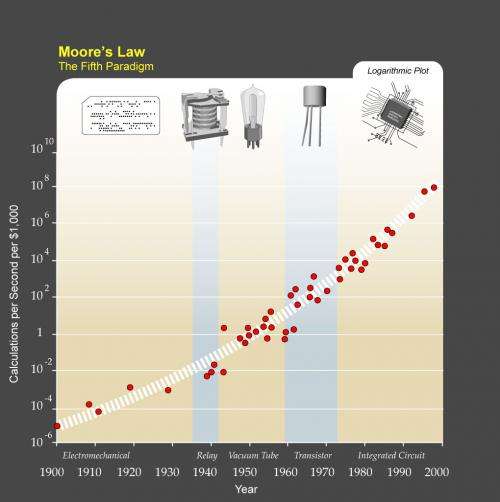
Kurzweil writes that, due to paradigm shifts, a trend of exponential growth extends Moore's law from integrated circuits to earlier transistors, vacuum tubes, relays, and electromechanical computers. He predicts that the exponential growth will continue, and that in a few decades the computing power of all computers will exceed that of human brains, with superhuman artificial intelligence appearing around the same time. Courtesy of Ray Kurzweil and Kurzweil Technologies, Inc.
(PhysOrg.com) -- In its essence, technology can be seen as our perpetually evolving attempt to extend our sensorimotor cortex into physical reality: From the earliest spears and boomerangs augmenting our arms, horses and carts our legs, and fire our environment, were now investigating and manipulating the fabric of that reality including the very components of life itself. Moreover, this progression has not been linear, but instead follows an iterative curve of inflection points demarcating disruptive changes in dominant societal paradigms. Suggested by mathematician Vernor Vinge in his acclaimed science fiction novel True Names (1981) and introduced explicitly in his essay The Coming Technological Singularity (1993), the term was popularized by inventor and futurist Ray Kurzweil in The Singularity is Near (2005). The two even had a Singularity Chat in 2002.
While the Singularity is not to be confused with the astronomical description of an infinitesimal object of infinite density, it can be seen as a technological event horizon at which present models of the future may break down in the not-too-distant future when the accelerating rate of scientific discovery and technological innovation approaches a real-time asymptote. Beyond lies a future (be it utopian or dystopian) in which a key question emerges: Evolving at dramatically slower biological time scales, must Homo sapiens become Homo syntheticus in order to retain our position as the self-acclaimed crown of creation or will that title be usurped by sentient Artificial Intelligence? The Singularity and all of its implications were recently addressed at Singularity Summit 2011 in New York City.
Vinge opens his groundbreaking 1993 essay with a fundamental definition of the Singularity:
The acceleration of technological progress has been the central feature of this century. We are on the edge of change comparable to the rise of human life on Earth. The precise cause of this change is the imminent creation by technology of entities with greater-than-human intelligence. Science may achieve this breakthrough by several means (and this is another reason for having confidence that the event will occur):
Computers that are "awake" and superhumanly intelligent may be developed. (To date, there has been much controversy as to whether we can create human equivalence in a machine. But if the answer is "yes," then there is little doubt that more intelligent beings can be constructed shortly thereafter.)
Large computer networks (and their associated users) may "wake up" as superhumanly intelligent entities.
Computer/human interfaces may become so intimate that users may reasonably be considered superhumanly intelligent.
Biological science may provide means to improve natural human intellect.
For Kurzweil, the core of the Singularity remains the augmentation and surpassing of human biology through the accelerating evolution of technology (notably genetics, nanotechnology, and Artificial Intelligence) enabled by exponential increases in computational power and speed coupled plummeting costs and size. Not surprisingly, then, in his opening address, From Eliza to Watson to Passing the Turing Test, Kurzweil ever the low-key evangelist focused largely on what he described as the remarkable continuing evidentiary support for his original projections. He voiced a clear differentiation between basing our AI offspring using biologically-inspired principles and, alternatively, crafting biomorphic substrates: In short, he favors the former, viewing the latter as unnecessary.
This video is not supported by your browser at this time.
Ray Kurzweil on "From Eliza to Watson to Passing the Turing Test" at Singularity Summit 2011
In his post-presentation press conference, Kurzweil was asked about the role of our evolutionarily-determined biological drives and thereby motivation and emotion as minds merge with machines and AI equals or surpasses human levels. Kurzweil noted that we have a remarkable ability to sublimate our drives, and we do so largely into innovation. Since he sees the purpose of technology as the transcendence of our biological limitations, one interpretation of his response is that he might well define human-like AI as being motivated by the goal of achieving unfettered, ever-accelerating innovation and that achieving that goal will generate a positive AE (artificial emotional) state. Whether or not thats the case, in an Australian Broadcasting Corporation interview earlier this year, Kurzweil has predicted that AI will achieve human-level emotional thought by roughly 2030:That's really the big frontier right now is for computers, in general, to master human emotions.
Emotion is not some sideshow to human intelligence. It's actually the most complicated intelligent thing we do, being funny, getting the joke, expressing a loving sentiment. That's the cutting edge of human intelligence. If we were to say intelligence is only logical intelligence, computers are already smarter than us.
I believe it's going to be about over the next 20 years where we close that gap in terms of human superiority today in emotional intelligence.
Today computers can understand human emotions in certain situations. Watson, the IBM computer that won Jeopardy, did have to understand some things about human emotion to master the language in that game, but they're not yet at human levels. They're getting there.
True to the Singularitys premise of accelerating technological innovation, this achievement may be arriving sooner expected: Recently, research conducted by Zoraida Callejas, David Griol and Ramón López-Cózar at the University of Granada and University of Madrid, has demonstrated a method for predicting a persons mental state in spoken dialog from that individuals emotional state and intention by means of a module bridging natural language understanding and dialogue management architecture.
MIT wunderkind Alexander Wissner-Gross says that it will be sufficient for a post-Singularity AI to understand human feelings rather than having to develop emotive thought. In his much-anticipated talk, Planetary-Scale Intelligence, he suggested that a global human-level AI could emerge from the mathematical world of quantitative finance and high-frequency trading and that it may already have.
This video is not supported by your browser at this time.
Alexander Wissner-Gross on "Planetary Scale Intelligence" at Singularity Summit 2011
In The Undivided Mind Science and Imagination, filmmaker, aesthetic philosopher and ecstatic futurist Jason Silva the speaker that most energized the crowd called for passion and artistic sensibility to inform ideation and instantiation of the Singularity. Silva displayed this perspective by showing his short film The Beginning of Infinity, which visually expresses an epistemological epiphany. Silva is also the first guest to be interviewed on Critical Thought TV.
VIDEO: THE BEGINNING OF INFINITY
Whats fantastic about having a Singularity Summit, Silva notes, is that it provides an anchor that gives legitimacy to these ideas that theyre not just something on the fringe of academia. Our story then spills over into a variety of substrates books, magazine articles, television, film, websites, and so on. However, he points out, I think they need to work on their aesthetic framing the essence of his talk which I hope provided an injection of art and design. As Rebecca Elson wrote in her book, A Responsibility to Awe, facts are only as interesting as the possibilities they open up to the imagination. For Silva, one of those possibilities is our achieving the God-like qualities of immortality and omniscience long promised, but never delivered, by religion.
Silva also differs from Kurzweil and Wissner-Gross in his view of emotion in coming human-analogous AIs. For example, he refers to Leonard Shlains Art & Physics, which Silva cites as pointing out that art and science are two sides of the same coin. Silva agrees that this appears to be supported by fMRI studies of human brain activity, which seem to show that their common ground lies in the emotional content of experience, as well as by very recent findings that visual encoding in the human ventral temporal (VT) cortex is common across individuals viewing the same movie content.
Truth, concludes Silva, is a symphony.
More information: Part II: http://www.physorg … anity_1.html
Copyright 2011 PhysOrg.com.
All rights reserved. This material may not be published, broadcast, rewritten or redistributed in whole or part without the express written permission of PhysOrg.com.
-
From lemons to lemonade: Reaction uses carbon dioxide to make carbon-based semiconductor,
32 comments
-
Thioridazine kills cancer stem cells in human while avoiding toxic side-effects of conventional cancer treatments,
3 comments
-
SpaceX private rocket blasts off for space station (Update),
42 comments
-
Climate scientists say they have solved riddle of rising sea,
31 comments
-
SpaceX capsule has 'new car' smell, astronauts say (Update),
4 comments
-
Need a rigid insulation material???
22 hours ago
-
magnets or EMF in car bumpers to protect from fender bender
May 26, 2012
-
length of wire in a coil of known dimensions?
May 25, 2012
-
India Engineering Powerhouse
May 25, 2012
-
electromagnet core dereference between hard and soft iron
May 25, 2012
-
Measuring water pressure in an open tank
May 24, 2012
- More from Physics Forums - General Engineering
More news stories
Browser wars flare in mobile space
The browser wars are heating up again, but this time the fight is for dominance of the mobile Internet.
15 hours ago |
5 / 5 (2) |
3
Probability of contamination from severe nuclear reactor accidents is higher than expected: study
Catastrophic nuclear accidents such as the core meltdowns in Chernobyl and Fukushima are more likely to happen than previously assumed. Based on the operating hours of all civil nuclear reactors and the number ...
Technology / Energy & Green Tech
May 22, 2012 |
3.6 / 5 (25) |
56
|
HyperSolar shows dirty water no barrier to power world
(Phys.org) -- The Santa Barbara, California, company, HyperSolar, is set to transparently share the ups and downs of its research experiences toward the companys ultimate vision, successfully producing ...
SpotterRF debuts Radar Backpack Kit (w/ Video)
(Phys.org) -- SpotterRF has announced a special radar backpack kit designed to enhance situational awareness for soldiers on the ground. The company says its special radar is designed for warfighters as part ...
Tesla to launch electric sedan in US on June 22
Tesla Motors said Tuesday it would begin deliveries of "the world's first premium electric sedan" on June 22, slightly ahead of schedule.
Technology / Energy & Green Tech
May 22, 2012 |
4.5 / 5 (12) |
18
Stunning image of smallest possible five-ringed structure
Scientists have created and imaged the smallest possible five-ringed structure about 100,000 times thinner than a human hair and you'll probably recognise its shape.
'Unzipped' carbon nanotubes could help energize fuel cells, batteries
Multi-walled carbon nanotubes riddled with defects and impurities on the outside could replace some of the expensive platinum catalysts used in fuel cells and metal-air batteries, according to scientists at ...
Change in developmental timing was crucial in the evolutionary shift from dinosaurs to birds: study
At first glance, it's hard to see how a common house sparrow and a Tyrannosaurus Rex might have anything in common. After all, one is a bird that weighs less than an ounce, and the other is a dinosaur that ...
Computer model used to pinpoint prime materials for efficient carbon capture
When power plants begin capturing their carbon emissions to reduce greenhouse gases and to most in the electric power industry, it's a question of when, not if it will be an expensive undertaking.
T cells 'hunt' parasites like animal predators seek prey, study shows
By pairing an intimate knowledge of immune-system function with a deep understanding of statistical physics, a cross-disciplinary team at the University of Pennsylvania has arrived at a surprising finding: T cells use a movement ...
Land and sea species differ in climate change response: study
(Phys.org) -- Marine and terrestrial species will likely differ in their responses to climate warming, new research by Simon Fraser University and Australia’s University of Tasmania has found.
Dec 01, 2011
Rank: 3.6 / 5 (11)
Dec 01, 2011
Rank: 4.6 / 5 (8)
I think exciting times are coming...
Dec 01, 2011
Rank: 5 / 5 (6)
I imagine being composed of nanites, with a fusion powered core. With a remarkable understanding of reality (All will have the knowledge, or we will all be one), an unprecedented increase in intelligence, and near unlimited power...we will remake the universe with our imagination. This I believe is the only path to "heaven" or "hell".
Dec 01, 2011
Rank: not rated yet
or starts http://medicalxpr...als.html
Dec 01, 2011
Rank: 1.5 / 5 (8)
Dec 01, 2011
Rank: 5 / 5 (1)
Dec 01, 2011
Rank: 1 / 5 (52)
If the augmented are a function of their wealth, you may very well have a point. You could end up with a Eugenics Wars a la Star Trek.
However if it is a post-scarcity society and anyone who wants it can have it, I doubt it would play out that way. As long as the primitives didn't try to perform acts of terrorism I doubt there would be any desire among the augmented to exact any harm upon them. Even then I doubt the augmented could be whipped up into enough of a furor to commit genocide. Their technology and thought would likely be so advanced that the primitives wouldn't really be capable of harming the on a large scale.
The point is I doubt it would be the augmented wishing to eradicate the non-augmented, but the opposite, likely on silly religious grounds.
My grandpa worked for IBM and is quite elderly :)
Dec 01, 2011
Rank: 4.2 / 5 (5)
Dec 01, 2011
Rank: 2.8 / 5 (5)
Kurzwell has had to switch his metric from computing speed to computing speed per dollar because his initial claims of increases in raw computing speeds were false.
There are limits to the speed at which transistors can change state and be useful.
We are pretty much at those speeds now. CPU's have not increased substantially in clock speed since over the last 10 years.
On a cost per dollar basis the situation is much the same.
Transistor gates are now just a few silicon atoms across and as a result quantum noise - which can not effectively be negated - is becoming problematic, and will eventually swamp the signals that transistors are trying to produce.
Current transistor sizes are 20 nm and might be able to be shrunk to 10 nm, producing 4 times the density of today's chips.
That will be it. cont.
Dec 01, 2011
Rank: 2.8 / 5 (5)
So at that point the exponential nature of growth in computational speeds will be at an end.
Growth in the speed of General purpose computers will never see the 10**4 speed increase over the next 30 years that they saw over the last 30 years. The technology just isn't capable of it.
On the other hand, non-general purpose CPU's for Neural Nets have the capacity of much higher computational speeds - thousands of times faster - compared to general purpose CPU's.
But since these CPU's are not general purpose, their market is limited and their invention and production will therefore be highly impeded.
Kurzwell - if I was to guess - is optimistic in his time scale by 100 to 150 years.
Dec 01, 2011
Rank: 5 / 5 (3)
I fixed this for you -
Cannot Afford richest poorest. wealthiest
Dec 01, 2011
Rank: 0.7 / 5 (48)
Limited resources and post-scarcity are not mutually exclusive. Are there a limited number of protons in the universe? Yes. Are protons scarce? No.
With the perfection of fusion, and possibly unforeseen technologies, there is no reason to believe the Earth could not sustain many more people than it currently does at a much higher quality of life for all.
It's optimistic but not foolish. If not for the Green Revolution we'd only be able to feed what, 1 billion people? Technology is already far surpassing the Earth's "natural" abilities to support humans. There is no reason to expect this trend to stop.
Dec 01, 2011
Rank: 5 / 5 (2)
Dec 01, 2011
Rank: 1 / 5 (2)
Cooling requirements make that difficult. Further each layer needs to be constructed on a flat foundation. But every component layer has significant vertical structure.
You can stack chips, with layers of cooling between layers, but none of this alters the fact that while you might be physically packing components closer together physically, you aren't actually lowering costs.
In fact the added manufacturing steps increase costs per unit of silicon wafer area.
Your exponential growth in speed per dollar is still gone. In fact, it has reversed direction.
Dec 01, 2011
Rank: not rated yet
Computers outperform humans in many tasks. Even if computers are basically tools their capabilities are amazing.
Computers save lives everyday. Computers will save even more lives in the future.
Dec 01, 2011
Rank: 2.3 / 5 (3)
There is. But space isn't the limiting factor for computational speed per dollar.
Clock rate and transistor density are.
Dec 01, 2011
Rank: 5 / 5 (2)
D Wave sold a basic quantum computer to Lockheed a few months ago.
So I think quantum computing is what will take us beyond the age of the integrated circuit in the 2020s.
Dec 01, 2011
Rank: 2.3 / 5 (4)
Dec 01, 2011
Rank: 3 / 5 (2)
Dec 01, 2011
Rank: 5 / 5 (1)
I for one welcome our new machine overlords.
Dec 01, 2011
Rank: 1.3 / 5 (4)
It will come to that. If your children's children play their cards right, they may manage to become the pets or our machine replacements, rather than simply extinct.
Dec 01, 2011
Rank: not rated yet
Dec 01, 2011
Rank: not rated yet
Sounds like a plan... Get on board for the big win, kids.
Dec 02, 2011
Rank: 5 / 5 (1)
Dec 02, 2011
Rank: not rated yet
Dec 02, 2011
Rank: not rated yet
@Vendicar_Decarian
Good point on adiabatic quantum computing. I am not really read enough to make statements on that field heh. However it seems a lot of people are researching quantum physics.
Dec 02, 2011
Rank: not rated yet
Dec 02, 2011
Rank: 1 / 5 (2)
Speed 8 petaflops = 8 * 10 ** 15 flops
Cost $1.25 billion US.
Calculations per second per $1000 = 6.4 * 10**9
Included on the chart above. That data point would continue the trend shown in the reset of the plot.
But note.. Computational speeds with existing technology per unit of wafer size are not going to increase beyond an order of magnitude at best. So increases in computational speed will only come from an increase in the number of computational units. More chips, more servers, more memory etc. This all adds up to more cost.
If the fastest computer is already costing 1.2 billion and we tollerate costs that are 100 times larger then this means that the fastest machines affordable will be 100 * 10 * 4 (increased chip integration) faster than today.
So lets say they will be 4,000 times faster.
Maybe I am being too pessimistic so lets add another factor of 25 and say 100,000 times faster than today.
Cont.
Dec 02, 2011
Rank: 1 / 5 (1)
That is the end of the line for general purpose VonNuman types of computing.
This may be just large enough to simulate a human brain. But probably not.
Dec 02, 2011
Rank: not rated yet
Not sure, but possibly this at the bottom of the article explains it:
"More information: The 2nd part will be published tomorrow."
Dec 02, 2011
Rank: not rated yet
Even now with our limited intelligence we know not to reinvent the wheel every time a new problem comes along. Why do away with what millions of years of evolution have produced? A primate with exceptional concentration and awareness that can communicate well enough to be useful.
Face it, these computers are going to be enhancing us, not replacing us. It's simply the most cost-effective method.
I wonder if technology can get to the stage where brain/tech interfaces rely entirely on non-invasive magnetism for two-way interaction.
Why? Nobody wants to be an early adopter when early adoption means surgery.
Dec 02, 2011
Rank: 3 / 5 (2)
Brave words coming from someone who is so easily replaced.
Dec 02, 2011
Rank: not rated yet
Wrong. Just really, really wrong. There are countless examples of things where, regardless of the level of understanding, the proven technology, the knowledge available, we continue to do the stupid thing time and time again.
This is just one of the reasons that I think the concept of a mapping out a timeline for a singularity event is a little silly. Of course, it's hard to define "singularity event". What it means really depends on whom you ask, as this is not some sort of scientific term that has wide acceptance. In fact, it's been written about in science fiction far more than outside that realm.
In any case, it's pretty easy to do a little history reading to get a feel for how technology and innovation happen in a herky-jerky fashion that is difficult to predict.
Dec 02, 2011
Rank: 5 / 5 (2)
You are truly out of your gourd.
I, too, am a huge fan of science fiction and enjoy fantasizing about these things. But, that doesn't make them reality.
By 2100, we will be very, very lucky if we leave the solar system, let alone the galaxy.
Dec 02, 2011
Rank: 3 / 5 (2)
"There are countless examples of things where, regardless of the level of understanding, the proven technology, the knowledge available, we continue to do the stupid thing time and time again." - NerdBoy
Dec 02, 2011
Rank: 1 / 5 (2)
By 2020, America will not exist as a single nation.
By 2100, What is left of the American South will be incapable of feeding itself.
Dec 02, 2011
Rank: 1 / 5 (4)
In my country, to call for support for an authoritarian regime that would enslave human beings, is criminal act.
I am sure the same holds for any civilized country. Despite free speech, open support for anti-human, slavery-enabling, fascistoid society with human beings as slaves, is open attack against constitutional rights.
The pure belief of author and his fellows, that human beings does not posse mechanically irreducible qualities that make humans superior to any machine, does not allow him to implement his anti-humanistic picture into reality; we have plenty of examples of such attempts with tragic outcomes from not-long-ago past.
We should stop all the potential murders masked as messiahs right now!
Dec 02, 2011
Rank: 5 / 5 (1)
a) All effects have limits. There are always boundary conditions, saturation effects, etc. which will counteract the trend at some point - forcing it to level off.
b) They usually look at these trends just as they start (when saturation effects haven't even begun to become obvious)
Ever accelerating innovation is also a myth. It will, too, be limited (if only by the laws of physics themselves. But still, that IS a limit). We hav more people researching stuff - at the same time stuff gets more complex. This will one day counteract the increase in research speeddue to technology or numbers of researchers.
Prime example would be the 'population explosion' or any kind of epidemic forecast.
Dec 02, 2011
Rank: 3 / 5 (2)
Why?
Which country would that be?
Wrong. In a civilized country, you should be able to call for whatever you want.
Psycho-babble. I'm hopeful it's just a translator problem. I'm going to ask the TechnoCore to check you out now.
Dec 02, 2011
Rank: not rated yet
>>
Dec 02, 2011
Rank: not rated yet
What does the Singularity really mean? Remember that the analogy has its limits so don't get stuck on the physical event horizon metaphor.
I think when the Singularity is depends on when you are. As things continue to accelerate, I agree, there is going to be a "plateau" where we hit some kind of limit. I think VD is way too pessimistic though in his flops.
More better is coming faster than most of us imagine.
Dec 02, 2011
Rank: 5 / 5 (1)
I thought that the "singularity" was defined at the time when humans were no longer needed to Design and Produce increasingly powerful computers. I.E., technological advancement became a self-sutaining process.
There's a lot of jibber jabber about robotics and physical processing limits, but if you accept the above definition, well, it could be considered a somewhat discrete time.
Dec 02, 2011
Rank: not rated yet
The FAQ at singularityU puts it like this:
"For Singularity University, the concept of singularity relates to the unexpected moments of dramatic technological change and the need to foresee their implications and opportunities." http://singularit..._id=2262
But I like the definition at 2006 Singularity Summit:
"In futures studies, the singularity represents an "event horizon" in the predictability of human technological development past which present models of the future cease to give reliable or accurate answers, following the creation of strong AI or the enhancement of human intelligence. "
http://singinst.o...ularity/
Dec 02, 2011
Rank: 1 / 5 (1)
And what constitution would that be?
Dec 02, 2011
Rank: 1.7 / 5 (3)
Humanity is destined for extinction or near extinction (pets) within the current millennium.
Dec 04, 2011
Rank: 3 / 5 (2)
Dec 04, 2011
Rank: 3 / 5 (2)
Dec 05, 2011
Rank: 3.5 / 5 (2)
Not so. The oceans, skies, and other marginal lands will become more habitable by virtue of technologies that enhance our ability to live in different, sometimes even extreme, conditions.
Living in new places will come with new found abilities to convert the energy of the sun and earth to produce healthy food, etc. At present, we use only 1/10,000 of the energy input from the sun. There is, and will be, plenty of room and resources to produce a pleasantly prosperous lifestyle for everyone. We have,and will continue to have, the technical prowess to produce such a result.
War,famine, and other tragic outcomes are not inevitable. Being realistic about it means we need to focus on understanding our options and choosing well. And creating new options.
Dec 07, 2011
Rank: 2 / 5 (1)
Dec 18, 2011
Rank: not rated yet
More of the daft anthropocentric ramblings of the transhumanist cult.
Certainly if we can avoid extinction and can make our species compatible with the new non-biological phase of the life process which is already a "work in progress" as what we at present call the Internet, then we might indeed experience a "golden age".
But to become successful symbiotes we must suppress the belligerence which has been so important in the evolution of our species.
Such matters are addressed in "The Goldilocks Effect: What Has Serendipity Ever Done For Us?" (free download in e-book formats from the "Unusual Perspectives" website)