Explorers track down Queen Elizabeth II
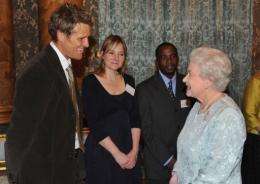
Queen Elizabeth II (R) speaks with James Cracknell and Alice Roberts (C) during a special exhibition of artefacts from the Royal Collection and Royal Archives at Buckingham Palace in London. The exhibition will show artefacts from the Artic, Antarctica and the Everest campaigns.
Some of Britain's greatest adventurers, explorers and astronauts trekked to Buckingham Palace on Thursday to meet Queen Elizabeth II.
They included Ranulph Fiennes, the first man to reach the North and South Poles by land unaided, and Ellen MacArthur, who broke the world record for the fastest solo circumnavigation of the globe, who were joined by veteran BBC naturalist David Attenborough, mountaineer Chris Bonington and James Cracknell, the double Olympic rowing gold medallist who has since rowed the Atlantic Ocean and trekked to the South Pole.
The event coincided with an exhibition at the palace showing items related to exploration and adventure from the royal archives.
Bear Grylls, the British chief scout and survival broadcaster, summed up what he described as Britain's unique relationship with exploring.
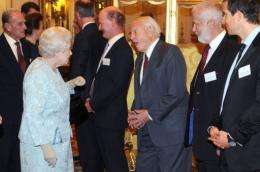
Duke of Edinburgh (L) stand as Queen Elizabeth II (2L) speaks with naturist David Attenborough (3R) as Chief Scout Bear Grylls (R) and mountaineer Chris Bonnington (2R) look on during a special exhibition of artefacts from the Royal Collection and Royal Archives at Buckingham Palace in London. The exhibition will show artefacts from the Artic, Antarctica and the Everest campaigns.
"I think exploration is essentially fantastically British, and for generations and hundreds of years the Brits led the way around the world in exploration," he said."I totally believe that's still the case today. Britain without doubt is at the forefront of the exploration world," he said, citing his fellow guests.
Spurning the traditional smart black shoes, he wore a pair of loafers with the British flag on.
"If you can't wear Union Jack shoes in Buckingham Palace, where can you wear them?", he said.
Other guests included Monty Python comedian Michael Palin, who went around the world in 80 days, Britain's first astronaut Helen Sharman, Edward Stafford, European explorer of the year 2011 and survival expert Ray Mears.
Comedian David Walliams, who swam the River Thames this year for charity, Brian Jones, who co-piloted the first balloon circumnavigation of the globe, and Rebecca Stephens, the first British woman to climb Mount Everest, also attended.
(c) 2011 AFP
-
From lemons to lemonade: Reaction uses carbon dioxide to make carbon-based semiconductor,
32 comments
-
Thioridazine kills cancer stem cells in human while avoiding toxic side-effects of conventional cancer treatments,
3 comments
-
SpaceX private rocket blasts off for space station (Update),
42 comments
-
Climate scientists say they have solved riddle of rising sea,
31 comments
-
SpaceX capsule has 'new car' smell, astronauts say (Update),
4 comments
-
Interesting WWII Public INformation Leaflet
May 19, 2012
-
Treaty of the Pyrenees
May 08, 2012
- More from Physics Forums - History & Humanities
More news stories
Change in developmental timing was crucial in the evolutionary shift from dinosaurs to birds: study
At first glance, it's hard to see how a common house sparrow and a Tyrannosaurus Rex might have anything in common. After all, one is a bird that weighs less than an ounce, and the other is a dinosaur that ...
Other Sciences / Archaeology & Fossils
7 hours ago |
5 / 5 (4) |
0
|
Social welfare cuts ultimately come with heavy price, researchers say
(Phys.org) -- Slashing government funding for Medicaid, food stamps and other programs that serve the poor while politically popular with some lawmakers and many conservatives may do more harm ...
Other Sciences / Social Sciences
May 24, 2012 |
4 / 5 (21) |
155
Ancient Bethlehem seal unearthed in Jerusalem
Israeli archaeologists have discovered a 2,700-year-old seal that bears the inscription "Bethlehem," the Israel Antiquities Authority announced Wednesday, in what experts believe to be the oldest artifact ...
Other Sciences / Archaeology & Fossils
May 23, 2012 |
3.3 / 5 (15) |
24
Dollars and sense: Why are some people morally against tax?
As the U.S. presidential election campaigns heat up, the economic debate is dominated by bailouts, austerity and, inevitably, taxation. Now a new study published in Symbolic Interaction asks why tax is such an important issue ...
Other Sciences / Social Sciences
May 23, 2012 |
2.3 / 5 (3) |
19
Oldest Jewish archaeological evidence on the Iberian Peninsula
German archaeologists of the Friedrich Schiller University Jena found one of the oldest archaeological evidence so far of Jewish Culture on the Iberian Peninsula at an excavation site in the south of Portugal, ...
Other Sciences / Archaeology & Fossils
May 25, 2012 |
4.2 / 5 (6) |
12
Stunning image of smallest possible five-ringed structure
Scientists have created and imaged the smallest possible five-ringed structure about 100,000 times thinner than a human hair and you'll probably recognise its shape.
'Unzipped' carbon nanotubes could help energize fuel cells, batteries
Multi-walled carbon nanotubes riddled with defects and impurities on the outside could replace some of the expensive platinum catalysts used in fuel cells and metal-air batteries, according to scientists at ...
Computer model used to pinpoint prime materials for efficient carbon capture
When power plants begin capturing their carbon emissions to reduce greenhouse gases and to most in the electric power industry, it's a question of when, not if it will be an expensive undertaking.
T cells 'hunt' parasites like animal predators seek prey, study shows
By pairing an intimate knowledge of immune-system function with a deep understanding of statistical physics, a cross-disciplinary team at the University of Pennsylvania has arrived at a surprising finding: T cells use a movement ...
Land and sea species differ in climate change response: study
(Phys.org) -- Marine and terrestrial species will likely differ in their responses to climate warming, new research by Simon Fraser University and Australia’s University of Tasmania has found.
Yale study concludes public apathy over climate change unrelated to science literacy
Are members of the public divided about climate change because they don't understand the science behind it? If Americans knew more basic science and were more proficient in technical reasoning, would public consensus match ...
