Ex-US general warns of growing cyber threat
December 7, 2011

A US adversary would currently be unable to bring down the entire US electrical grid using cyber weapons

Enlarge

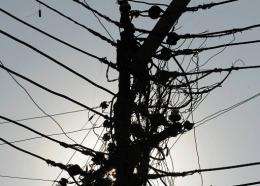
Tangled electric wires are seen in Kabul in 2008. A US adversary would currently be unable to bring down the entire US electrical grid using cyber weapons but such a scenario is conceivable within two to five years, the former vice chairman of the Joint Chiefs of Staff said Tuesday.

A US adversary would currently be unable to bring down the entire US electrical grid using cyber weapons but such a scenario is conceivable within two to five years, the former vice chairman of the Joint Chiefs of Staff said Tuesday.

"Today, the likelihood that a nation-state or any actor is going to knock down the entire of a country, of the United States let's say, is very remote," retired General James Cartwright said.

"That's probably two to five years off," Cartwright said during a panel discussion at the Washington-based Center for Strategic and International Studies here.

"It's a very difficult thing to do," he said of disabling the entire US electrical grid. "It's not some 19-year-old sitting at a keyboard."

Cartwright, who retired as a four-star general from the Marine Corps earlier this year and now holds the Harold Brown chair in defense policy studies at CSIS, said cyber weapons can potentially have devastating consequences.

"A could knock out the electrical grid in any city," he said. "Cyber could knock it out in the entire country -- in milliseconds.

"And so that's the worry, that it could progress in that direction," he said. "And now you really are talking about an equivalency of a weapon of mass destruction. And how do we handle that? What do we do about that?"

"You can see a direction in which this threat could move," he said.

Cartwright also said that while the United States possesses capabilities they would probably be employed only as a "supporting arm" in the event of a conventional conflict.

"It's really more in the venue of a supporting arm like artillery or something like that," he said.

(c) 2011 AFP

3.3 /5 (3 votes)  

Filter


Move the slider to adjust rank threshold, so that you can hide some of the comments.


Display comments: newest first

Nerdyguy
Dec 07, 2011

Rank: 3.7 / 5 (3)
""It's really more in the venue of a supporting arm like artillery or something like that," he said."

Got a chuckle from reading this. Cartwright is even older than ancient me, so it's not surprising that he'd view cyber warfare in this light.

But, it would be interesting to see what some of the young colonels and majors in the direct cyber command are saying about the reality of cyber warfare in the 21st century. I've a feeling "supporting role...like artillery" wouldn't be how they view their work. lol
kochevnik
Dec 07, 2011

Rank: 5 / 5 (2)
How about updating the passwords from "knockknock" and "password", Bevis?
Shifty0x88
Dec 07, 2011

Rank: 3.7 / 5 (3)
Hah, we just had the east coast(and Canada) go dark for the second time(last time was 2003), and these were just overloads in the system. 2-5 years, ya right, I bet they could do it right now, all they need is to get access to the critical junctions(power plants) in the power grid, and once those are out the cascading failures will take out the entire grid. Oh and that's how the grid was designed. The fact that we haven't updated the grid and that we are using more power then ever is just an accident waiting to happen.
Hengine
Dec 07, 2011

Rank: not rated yet
This article has minimal worthwhile content.
Caliban
Dec 07, 2011

Rank: not rated yet
This article has minimal worthwhile content.


Hengine,

Agreed. No doubt this is just a bit or advance marketing for the group of cyberwarfare contractors the general is being paid to drum for.

Rank 3.3 /5 (3 votes)
Relevant PhysicsForums posts

More news stories

Browser wars flare in mobile space

The browser wars are heating up again, but this time the fight is for dominance of the mobile Internet.

Technology / Software

created 15 hours ago | popularity 5 / 5 (2) | comments 3

Probability of contamination from severe nuclear reactor accidents is higher than expected: study

Catastrophic nuclear accidents such as the core meltdowns in Chernobyl and Fukushima are more likely to happen than previously assumed. Based on the operating hours of all civil nuclear reactors and the number ...

Technology / Energy & Green Tech

created May 22, 2012 | popularity 3.6 / 5 (25) | comments 56 | with audio podcast

HyperSolar shows dirty water no barrier to power world

(Phys.org) -- The Santa Barbara, California, company, HyperSolar, is set to transparently share the ups and downs of its research experiences toward the company’s ultimate vision, successfully producing ...

Technology / Energy & Green Tech

created May 24, 2012 | popularity 4.8 / 5 (16) | comments 17 | with audio podcast report

SpotterRF debuts Radar Backpack Kit (w/ Video)

(Phys.org) -- SpotterRF has announced a special radar backpack kit designed to enhance situational awareness for soldiers on the ground. The company says its special radar is designed for warfighters as part ...

Technology / Hi Tech & Innovation

created May 26, 2012 | popularity 5 / 5 (5) | comments 13 | with audio podcast report

Tesla to launch electric sedan in US on June 22

Tesla Motors said Tuesday it would begin deliveries of "the world's first premium electric sedan" on June 22, slightly ahead of schedule.

Technology / Energy & Green Tech

created May 22, 2012 | popularity 4.5 / 5 (12) | comments 18


Stunning image of smallest possible five-ringed structure

Scientists have created and imaged the smallest possible five-ringed structure – about 100,000 times thinner than a human hair – and you'll probably recognise its shape.

'Unzipped' carbon nanotubes could help energize fuel cells, batteries

Multi-walled carbon nanotubes riddled with defects and impurities on the outside could replace some of the expensive platinum catalysts used in fuel cells and metal-air batteries, according to scientists at ...

Change in developmental timing was crucial in the evolutionary shift from dinosaurs to birds: study

At first glance, it's hard to see how a common house sparrow and a Tyrannosaurus Rex might have anything in common. After all, one is a bird that weighs less than an ounce, and the other is a dinosaur that ...

Computer model used to pinpoint prime materials for efficient carbon capture

When power plants begin capturing their carbon emissions to reduce greenhouse gases – and to most in the electric power industry, it's a question of when, not if – it will be an expensive undertaking.

T cells 'hunt' parasites like animal predators seek prey, study shows

By pairing an intimate knowledge of immune-system function with a deep understanding of statistical physics, a cross-disciplinary team at the University of Pennsylvania has arrived at a surprising finding: T cells use a movement ...

Land and sea species differ in climate change response: study

(Phys.org) -- Marine and terrestrial species will likely differ in their responses to climate warming, new research by Simon Fraser University and Australia’s University of Tasmania has found.