New dye will lead to more efficient solar energy technology
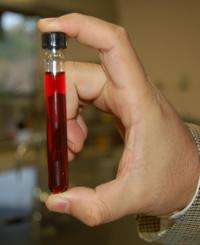
NCSU-10 can be used to create more effective solar cells.
(PhysOrg.com) -- A North Carolina State University invention has significant potential to improve the efficiency of solar cells and other technologies that derive energy from light.
Dr. Ahmed El-Shafeis research group invented a new sensitizer, or dye, that harvests more ambient and solar light than any dyes currently on the market for use in dye-sensitized solar cells (DSSCs).
A third-party solar energy company compared our new dye, NCSU-10, against the state-of-the-art dye on the market. Our dye had 14 percent more power density, says El-Shafei, an assistant professor in the Textile Engineering, Chemistry and Science department. In other words, NCSU-10 allows us to harvest more energy from the same amount of light.
The new dye should significantly boost the efficiency of DSSCs, which have a host of applications. Indoors, these DSSCs can be used in technology to power cellular phones, laptop computers and MP3 players using ambient light. Outdoors, they could be used in conventional solar arrays or in improved energy-driven applications for building-integrated photovoltaic products including, but not limited to, windows, facades and skylights.
Compared to the state-of-the-art dye on the market, NCSU-10 can absorb more photons at lower dye concentrations, and can therefore be used to create more effective solar cells on windows and facades while still allowing the windows to be highly transparent.
DSSCs are made of inexpensive and environmentally benign materials including a dye, an electrolyte and titanium dioxide (TiO2) the white component used in toothpaste. DSSCs work by absorbing photons, or discrete packets of light energy, from incident light (or direct light that falls on a surface) to create free electrons in nanoporous semiconductors such as TiO2, in the cell. These electrons travel to the outside circuit to generate an electric current. Owing to their independence on the angle of incident light and high response to low level of lighting conditions, DSSCs outperform conventional silicon photovoltaic by 20 to 40 percent under diffuse light, on cloudy and/or rainy days, and in indoor ambient light, which make DSSCs a unique class of photovoltaics.
A patent is pending on the new dye, and the university is in communication with potential industry partners about licensing use of NCSU-10, as well as funding additional research in this area.
Provided by
North Carolina State University
-
From lemons to lemonade: Reaction uses carbon dioxide to make carbon-based semiconductor,
32 comments
-
Thioridazine kills cancer stem cells in human while avoiding toxic side-effects of conventional cancer treatments,
3 comments
-
SpaceX private rocket blasts off for space station (Update),
42 comments
-
Climate scientists say they have solved riddle of rising sea,
31 comments
-
SpaceX capsule has 'new car' smell, astronauts say (Update),
4 comments
-
How to determine the flexural rigidity of a composite
3 hours ago
-
microstructure of titanium
May 26, 2012
-
Steam in My Espresso Machine
May 26, 2012
-
Density question
May 24, 2012
-
Mass transport originating from a point source at a solid gas interface
May 22, 2012
-
Ammonia dispersion in Air
May 22, 2012
- More from Physics Forums - Materials & Chemical Engineering
More news stories
Stunning image of smallest possible five-ringed structure
Scientists have created and imaged the smallest possible five-ringed structure about 100,000 times thinner than a human hair and you'll probably recognise its shape.
1 hour ago |
4.5 / 5 (2) |
1
|
'Unzipped' carbon nanotubes could help energize fuel cells, batteries
Multi-walled carbon nanotubes riddled with defects and impurities on the outside could replace some of the expensive platinum catalysts used in fuel cells and metal-air batteries, according to scientists at ...
Nanotechnology / Nanomaterials
7 hours ago |
1 / 5 (1) |
0
|
Dopant gives graphene solar cells highest efficiency yet
(Phys.org) -- By taking advantage of graphenes favorable electrical and optical properties, and then adding an organic dopant, researchers have achieved the highest power conversion efficiency yet for ...
In nanorod crystal growth, nanoparticles seen as artificial atoms
In the growth of crystals, do nanoparticles act as "artificial atoms" forming molecular-type building blocks that can assemble into complex structures? This is the contention of a major but controversial theory ...
May 24, 2012 |
4.8 / 5 (6) |
0
|
First direct observation of oriented attachment in nanocrystal growth
Berkeley Lab researchers have reported the first direct observation of nanoparticles undergoing oriented attachment, the critical step in biomineralization and the growth of nanocrystals. A better understanding ...
May 24, 2012 |
4.7 / 5 (3) |
0
|
Change in developmental timing was crucial in the evolutionary shift from dinosaurs to birds: study
At first glance, it's hard to see how a common house sparrow and a Tyrannosaurus Rex might have anything in common. After all, one is a bird that weighs less than an ounce, and the other is a dinosaur that ...
Computer model used to pinpoint prime materials for efficient carbon capture
When power plants begin capturing their carbon emissions to reduce greenhouse gases and to most in the electric power industry, it's a question of when, not if it will be an expensive undertaking.
T cells 'hunt' parasites like animal predators seek prey, study shows
By pairing an intimate knowledge of immune-system function with a deep understanding of statistical physics, a cross-disciplinary team at the University of Pennsylvania has arrived at a surprising finding: T cells use a movement ...
Land and sea species differ in climate change response: study
(Phys.org) -- Marine and terrestrial species will likely differ in their responses to climate warming, new research by Simon Fraser University and Australia’s University of Tasmania has found.
Yale study concludes public apathy over climate change unrelated to science literacy
Are members of the public divided about climate change because they don't understand the science behind it? If Americans knew more basic science and were more proficient in technical reasoning, would public consensus match ...
10 million years needed to recover from mass extinction
It took some 10 million years for Earth to recover from the greatest mass extinction of all time, latest research has revealed.
Dec 13, 2011
Rank: 5 / 5 (3)
There's one thing missing here: Is it as stable as the state of the art dyes (i.e how much does it degrade due to dissociation reactions triggered by UV radiation)?
Dec 13, 2011
Rank: 4.5 / 5 (2)
And after that, "Does it turn my windows pink?"
Dec 13, 2011
Rank: 2 / 5 (1)
Exactly what i was thinking
Dec 13, 2011
Rank: not rated yet
You could always mount your panels on your roof.
However - Your computer and mp3 player and phone are a different question. You can choose any color you want, as long as it's reddish pink.
You know, kind of like how you used to get any color of iphone, as long as it was black. (Now we have 2 colors to choose from!)
Dec 13, 2011
Rank: 5 / 5 (1)
Yeah, but neither of them are chromatic.
Dec 14, 2011
Rank: not rated yet
Dec 16, 2011
Rank: not rated yet
Dec 16, 2011
Rank: not rated yet
http://www.physor...ght.html
Dec 16, 2011
Rank: not rated yet
Dec 16, 2011
Rank: not rated yet
If I upscale that 1000 times the cost would be $220M. I wonder how the BP plant next door got 32MW for $298M, maybe it isn't actually 32MW since it only covers 4500 homes, maybe its only 4.5MW.
I just love the integrity of this business. No amount of efficiency improvements is gonna make much difference.