Danube's near-record lows strangle shipping
December 5, 2011 by Diana Simeonova

Severe drought has hit Europe's second largest river, the Danube, turning it into a navigation nightmare

Enlarge

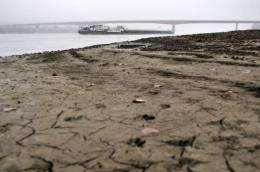
The dry banks of the Danube River are seen on December 1 near the Serbian town of Bezdan. Severe drought has hit Europe's second largest river, the Danube, turning it into a navigation nightmare for shipping companies all the way from Germany to Bulgaria.

Severe drought has hit Europe's second largest river, the Danube, turning it into a navigation nightmare for shipping companies all the way from Germany to Bulgaria.

According to Bulgaria's exploration agency, the levels of one of the continent's most significant commercial waterways dropped to near-record lows in the past month, making it barely passable at several critical points.

"There is just no water! The situation is critical not only here on the lower Danube but also upriver in Hungary, Austria, Germany," Ivan Ivanov, deputy chief of Bulgarian River Shipping (BRP), told AFP.

"We load barges far below capacity. The navigable fairway is also so tight at some points that towboats can pass only if transporting one barge at a time instead of the usual six."

"Shipping costs are soaring, I don't even want to calculate our losses," he said.

Ports have also been operating at reduced capacity, and two ferry lines between Bulgaria and Romania were "on the edge" and would have to temporarily shut if water levels dropped another 50 centimetres (20 inches), Ivanov said.

Across the Danube in Romania, river administration authorities in the southeastern port of Galati noted that "intensive dredging activities are under way to assure the minimum depth levels" for navigation.

Bucharest also feared it would have to shut one unit of its sole at Cernavoda if levels dropped further, as the reactor uses water from a Danube-Black Sea canal for cooling.

Such a shutdown already occurred in 2003 when the river level hit an all-time low, a record now less than half a metre away.
Bucharest feared it would have to shut one unit of its sole nuclear power plant at Cernavoda if levels dropped further
Enlarge

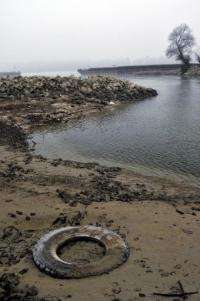
An old tyre is seen on December 1 on the banks of Danube river near the Serbian town of Bezdan. Bucharest also feared it would have to shut one unit of its sole nuclear power plant at Cernavoda if levels dropped further.

Meanwhile, Romania's state-owned Hidroelectrica company, 40 percent of whose production depends on the Danube, has said it is cutting electricity supplies.

With no on the horizon, prospects for improvement were dim as experts forecast that water levels would drop even further or stagnate at best.

The water mark was already "below low-navigation level" along a 200-kilometre (120-mile) stretch of the Danube between Bezdan on the Serbian-Hungarian border and Pancevo, near Belgrade, Serbia's hydrometeorological service said.

Only lighter ships are allowed through, as media reported that around 100 freighters coming down the Danube were already blocked at Bezdan.

Port authorities in Croatia's main Danubian town of Vukovar banned navigation for ships with a depth of over 1.3 metres, citing insufficient water levels downstream in Serbia and Bulgaria.

Slovakia's State Navigation Administration meanwhile specifically ordered ships to load less cargo.

Merchandise transport on the upper Danube in Austria and Germany was also affected following what Austria's meteorological institute ZAMG said was the driest November since records began in 1858.

Cargo shipping on the Danube was only at 25 percent of the usual volume due to the low , with cargo being diverted onto roads and rail, the Austrian waterway organisation Via Donau said.

The same was happening on the 69-kilometre stretch between the German ports of Straubing and Vilshofen -- the last free-flowing part of the Danube in Germany -- which has been completely blocked to cargo ships, with trains and trucks taking over, according to Adrian Bejan from Wuerzburg's Waterways and Shipping Directorate.

Shipping on the Rhine-Main-Danube canal linked to the North Sea also dropped severely over the past few weeks.

Meanwhile, the advance of winter is threatening a new obstacle.

"With no rainfall forecast anywhere from Germany down, the Danube's low and slow-flowing waters will freeze totally when temperatures drop low enough," BRP's Ivan Ivanov predicted.

The Bulgarian stretch of the Danube last froze in 1985.

Apart from being a key commercial waterway for Europe, the 2,860-kilometre river and its wetlands are home to unique ecosystems that have been severely damaged by human intervention such as gravel extraction, dredging and dam construction.

The environmental group WWF warned in a recent statement that the current drought was an important signal about the Danube's reduced ability to withstand extreme weather events.

(c) 2011 AFP

Filter


Move the slider to adjust rank threshold, so that you can hide some of the comments.


Display comments: newest first

omatumr
Dec 05, 2011

Rank: 2.3 / 5 (3)
The dry banks of the Danube River are seen on December 1 near the Serbian town of Bezdan.


There is always a scary picture somewhere to scare folks into believing that world leaders grasp reality. They certainly do not!

There will be no peace on Earth this holiday season unless world leaders awaken to reality and accept their total powerlessness over the forces of nature.

World leaders were frightened by the powerful nuclear force that vaporized Hiroshima in 1945 and threatened to destroy the world in a final act of mutual nuclear destruction in the Cuban Missile Crisis of 1962.

They made agreements in 1971 to save the world by uniting nations against an imaginary common enemy global climate warming:

http://noconsensu...nt-60505

BBC news from the climate change summit in Durban illustrate the irrational fears that grip the public today.

www.bbc.co.uk/new...16021217

O.K. Manuel
http://www.omatumr.com/
Pirouette
Dec 05, 2011

Rank: 1 / 5 (2)
Now wait a minute. . .according to your BBC article - "Let's have a reassessment of it by 2015." he said. "But if you don't finish in time for the ending of Kyoto Two, which is next year, 2012, then, you know, it will actually wither on the vine and that's what Canada and America wants - and one or two other rich countries.

"It's a conspiracy against the poor. It's appalling. I'm ashamed of such countries not recognising their responsibilities."

According to the Liberals in the U.S., the rich people here, BOTH Liberal and non-Liberal, are only about 1% of the population and the rest are middle-class workers, the working poor, and the poor at the bottom who are not working, never have worked and get welfare, and those who dropped out of finding a job. So how can they consider the U.S. a RICH nation with all the "poverty" going on here? This doesn't make sense. If ALL the rich leave the country, will Kyoto still say the U.S. is a rich nation? Maybe their perception is faulty.
Pirouette
Dec 05, 2011

Rank: 1 / 5 (2)
Barack Obama wants to heavily tax the rich and the private sector businesses, but most likely will NOT heavily tax rich Liberals. That's why private sector businesses have gone, and will continue to go overseas to open up shop.
Obama will see to it that the U.S. doesn't pollute any longer with fossil fuels, but he won't say anything to provoke the Chinese Communists who have surpassed the U.S. in polluting emissions. Seems like smaller countries should stop cutting down their trees and using them for firewood, and not replacing those trees. Democratic Republic of Congo has a growing desert because of all the trees they've cut and not replaced. Other countries in Africa also.
The truth is that EVERY country contributes to AGW, not just the "rich" ones. But they only want to blame certain countries and omit the "sins" of others.
Rank 5 /5 (2 votes)
Relevant PhysicsForums posts

More news stories

Land and sea species differ in climate change response: study

(Phys.org) -- Marine and terrestrial species will likely differ in their responses to climate warming, new research by Simon Fraser University and Australia’s University of Tasmania has found.

Space & Earth / Environment

created 5 hours ago | popularity 3.7 / 5 (3) | comments 5 | with audio podcast

Yale study concludes public apathy over climate change unrelated to science literacy

Are members of the public divided about climate change because they don't understand the science behind it? If Americans knew more basic science and were more proficient in technical reasoning, would public consensus match ...

Space & Earth / Environment

created 7 hours ago | popularity 4.8 / 5 (5) | comments 19 | with audio podcast

10 million years needed to recover from mass extinction

It took some 10 million years for Earth to recover from the greatest mass extinction of all time, latest research has revealed.

Space & Earth / Earth Sciences

created 7 hours ago | popularity 4 / 5 (4) | comments 1 | with audio podcast

Sophisticated simulations predict future warming

The chances of our planet being hit by a global warming of 3 degrees Celsius by 2050 is as likely as it being hit by an increase of 1.4 degrees, new research shows. Presented in the journal Nature Geoscience, the British study ...

Space & Earth / Earth Sciences

created May 22, 2012 | popularity 4.1 / 5 (10) | comments 51

Aliens don't want to eat us, says former SETI director

Alien life probably isn’t interested in having us for dinner, enslaving us or laying eggs in our bellies, according to a recent statement by former SETI director Jill Tarter.

Space & Earth / Space Exploration

created May 25, 2012 | popularity 4.4 / 5 (15) | comments 41


Stunning image of smallest possible five-ringed structure

Scientists have created and imaged the smallest possible five-ringed structure – about 100,000 times thinner than a human hair – and you'll probably recognise its shape.

'Unzipped' carbon nanotubes could help energize fuel cells, batteries

Multi-walled carbon nanotubes riddled with defects and impurities on the outside could replace some of the expensive platinum catalysts used in fuel cells and metal-air batteries, according to scientists at ...

Change in developmental timing was crucial in the evolutionary shift from dinosaurs to birds: study

At first glance, it's hard to see how a common house sparrow and a Tyrannosaurus Rex might have anything in common. After all, one is a bird that weighs less than an ounce, and the other is a dinosaur that ...

Computer model used to pinpoint prime materials for efficient carbon capture

When power plants begin capturing their carbon emissions to reduce greenhouse gases – and to most in the electric power industry, it's a question of when, not if – it will be an expensive undertaking.

T cells 'hunt' parasites like animal predators seek prey, study shows

By pairing an intimate knowledge of immune-system function with a deep understanding of statistical physics, a cross-disciplinary team at the University of Pennsylvania has arrived at a surprising finding: T cells use a movement ...

Scientists develop ultra-sensitive test that detects diseases in their earliest stages

Scientists have developed an ultra-sensitive test that should enable them to detect signs of a disease in its earliest stages, in research published today in the journal Nature Materials.