Christmas comet Lovejoy captured at Paranal Observatory
Dec 24, 2011
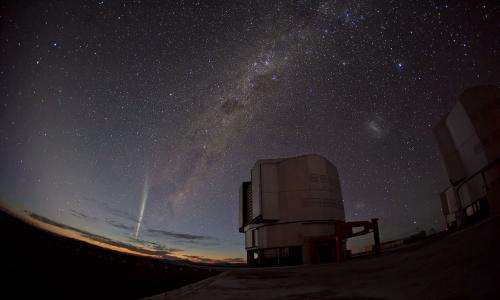
ESO optician Guillaume Blanchard captured this marvellous wide-angle photo of Comet Lovejoy just two days ago on 22 December 2011. Comet Lovejoy has been the talk of the astronomy community over the past few weeks. It was first discovered on 27 November by the Australian amateur astronomer Terry Lovejoy and was classified as a Kreutz sungrazer, with its orbit taking it very close to the Sun, passing a mere 140 000 kilometres from the Sun’s surface. Credit: G. Blanchard(eso.org/~gblancha)/ESO 

(PhysOrg.com) -- The recently discovered Comet Lovejoy has been captured in stunning photos and time-lapse video taken from ESO’s Paranal Observatory in Chile. The comet graced the southern sky after it had unexpectedly survived a close encounter with the Sun.

A new time-lapse video sequence was taken by Gabriel Brammer from ESO less than two days ago on 22 December 2011. Gabriel was finishing his shift as support astronomer at the Paranal Observatory when Comet Lovejoy rose over the horizon just before dawn.

In the words of Gabriel Brammer himself: “On the last morning of my shift I tried to try catch it on camera before sunrise. The tail of the comet was easily visible with the naked eye, and the combination of the crescent Moon, comet, Milky Way and the laser guide star was nearly as impressive to the naked eye as it appears in the long-exposure photos.”

The sequence also features the pencil-thin beam of the VLT’s Laser Guide Star set against the beautiful backdrop of the Milky Way, as astronomers conduct their last observations for the night.

ESO optician Guillaume Blanchard made a marvellous wide-angle photo of Comet Lovejoy and ESO Photo Ambassador Yuri Beletsky, captured the spectacle from Santiago de Chile. Blanchard said: "For me this comet is a Christmas present to the people who will stay at Paranal over Christmas".

This bright comet was also seen from the International Space Station in another stunning time-lapse sequence on 21 December as the crew filmed lightning on the Earth’s night side.

has been the talk of the astronomy community over the past few weeks. It was discovered on 27 November by the Australian amateur astronomer Terry Lovejoy and was classified as a Kreutz sungrazer, with its orbit taking it very close to the Sun. Just last week, the comet entered the Sun’s corona, a much-anticipated event, passing a mere 140 000 kilometres from the Sun’s surface. A close shave indeed...

The comet was expected to break up and vaporise, but instead it survived its steaming hot encounter with the Sun and re-emerged a few days later, much to everyone's surprise. It is now visible from the southern hemisphere, appearing at dawn, and features a bright tail millions of kilometres long, composed of dust particles that are being blown ahead of the by the solar wind.

Lovejoy will now continue in its highly eccentric orbit around the Sun and once again disappear into the distant Solar System. It would be interesting to know if it will actually survive to re-appear in our skies in 314 years as predicted.

Explore further: Collisions of coronal mass ejections can be super-elastic

Related Stories

Using many instruments to track a comet

Dec 13, 2011

(PhysOrg.com) -- In 16 years of data observations, the Solar Heliophysics Observatory (SOHO) -- a joint European Space Agency and NASA mission –- made an unexpected claim for fame: the sighting of new comets at an alarming ...

The great cometary show

Jan 19, 2007

Comet McNaught, the Great Comet of 2007, is no more visible for observers in the Northern Hemisphere. It does put an impressive show in the South, however, and observers in Chile, in particular at the Paranal ...

Recommended for you

Forecast for Titan: Wild weather could be ahead

15 hours ago

(Phys.org) —Saturn's moon Titan might be in for some wild weather as it heads into its spring and summer, if two new models are correct. Scientists think that as the seasons change in Titan's northern hemisphere, ...

SDO observes mid-level solar flare

16 hours ago

UPDATE 16:30 p.m. EDT: The M7-class flare was also associated with a coronal mass ejection or CME, another solar phenomenon that can send billions of tons of particles into space. While this CME was not Ea ...

NASA's IRIS mission readies for a new challenge

May 22, 2013

(Phys.org) —The time draws near. NASA is getting ready to launch a new mission, a mission to observe a largely unexplored region of the solar atmosphere that powers its dynamic million-degree outer atmosphere and drives ...

User comments : 5

Adjust slider to filter visible comments by rank

Display comments: newest first

omatumr
1 / 5 (7) Dec 24, 2011
The comet was expected to break up and vaporise, but instead it survived its steaming hot encounter with the Sun and re-emerged a few days later, much to everyone's surprise.


Thanks for the intriguing story.

Was the departing comet the same one that entered the Sun?

This reminds me of collisions of electrons with atoms that produce "secondary" electrons.

With kind regards,
Oliver K. Manuel
http://myprofile....anuelo09
Callippo
1 / 5 (2) Dec 24, 2011
What does it mean? http://sohowww.na...1024.jpg
Blakut
not rated yet Dec 25, 2011
For a second there i read "comet lovejoy observed WITH the paranal observatory". That would've been cool, if possible.
Manos
1 / 5 (2) Dec 25, 2011
I would like to know: if go back in time with a time machine is it better to correct present ,of what it may be ,or to know correctly our History
omatumr
1.6 / 5 (5) Dec 25, 2011
Merry Christmas to all!

http://chiefio.wo...nt-27918

More news stories

Bacterium from Canadian High Arctic and life on Mars

(Phys.org) —The temperature in the permafrost on Ellesmere Island in the Canadian high Arctic is nearly as cold as that of the surface of Mars. So the recent discovery by a McGill University led team of ...

Weird science: Crystals melt when they're cooled

(Phys.org) —Growing thin films out of nanoparticles in ordered, crystalline sheets, to make anything from microelectronic components to solar cells, would be a boon for materials researchers, but the physics ...

Researchers forward quest for quantum computing

Research teams from UW-Milwaukee and the University of York investigating the properties of ultra-thin films of new materials are helping bring quantum computing one step closer to reality.

Cold plasma successful against brain cancer cells

For the first time, physicists from the Max Planck Institute for Extraterrestrial Physics (MPE), biologists and physicians demonstrated the synergistic effect of cold atmospheric plasma - a partly ionized ...