To turn up the heat in chilies, just add water
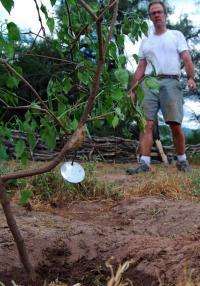
Researcher David Haak collects chili plant specimens in their native habitat in Bolivia. Credit: Carlos Manchego
Biologists have learned in recent years that wild chilies develop their trademark pungency, or heat, as a defense against a fungus that could destroy their seeds. But that doesn't explain why some chilies are hot and others are not.
New research provides an answer: Hot chilies growing in dry areas need more water to produce as many seeds as non-pungent plants, but the Fusarium fungus is less of a threat in dryer environments so chilies in those areas are less likely to turn up the heat. In wetter regions, where Fusarium thrives, wild chilies build up their reserves of spicy capsaicin in self-defense.
"Despite the reduced benefit of pungency in dry environments, hot plants still occur there, as does the deadly fungus. That suggests that the greater presence of non-pungent plants that produce substantially more seeds is the result of a fitness-based tradeoff," said David Haak, lead author of a paper describing the research published Wednesday (Dec. 21) in Proceedings of the Royal Society B.
Haak, a post-doctoral researcher at Indiana University, conducted the research as part of his doctoral work at the University of Washington. Co-authors of the paper are Leslie McGinnis of the University of Michigan, who did the work while a UW undergraduate; Douglas Levey of the University of Florida and Joshua Tewksbury, a UW biology professor who leads the research group.
The scientists examined pungency differences by comparing the proportion of pungent plants with that of non-pungent plants in 12 populations of wild chilies in southeastern Bolivia along a 185-mile line that gradually progressed from a relatively dry region to a wetter region. They conducted plant censuses in focal populations five times between 2002 and 2009, and tagged plants in each census so they could determine new seedlings the next time.
They found that, starting in the dryer northeast part of the section, 15 to 20 percent of the plants had pungent fruit, and pungency increased along the line toward the wetter southwest, where they never found a single plant that did not produce pungent fruit.
They also selected three populations of chili plants that each produced both pungent and non-pungent fruit and spanned the range of rainfall and pungency differences. They then grew seeds from those plants in the UW Botany Greenhouse to examine what affect water availability had on pungency.
The 330 plants that resulted from those seeds were grown under identical conditions until they reached their first flowering, then were separated into two groups one that received plenty of water and one that was stressed by receiving only the amount of water available to plants in the driest area of Bolivia from which seeds were taken.
The scientists found that under water-stressed conditions, non-pungent plants produced twice as many seeds as pungent plants. That suggests the pungent plants trade some level of fitness for protection from the Fusarium fungus, Haak said.
The researchers determined the pungent plants have developed a reduced efficiency in water use, so in dryer areas they produce fewer seeds and are more limited in reproduction. In wetter areas, non-pungent plants are at a reproductive disadvantage because they are much more likely to have their seeds attacked by the fungus.
"It surprised us to find that the tradeoff to produce capsaicin in pungent plants would involve this major physiological process of water-use efficiency," Haak said.
He noted that over the entire range, 90 to 95 percent of the chili fruits had some level of fungal infection, and pungent plants were better able to defend themselves.
Provided by
University of Washington
-
From lemons to lemonade: Reaction uses carbon dioxide to make carbon-based semiconductor,
32 comments
-
Thioridazine kills cancer stem cells in human while avoiding toxic side-effects of conventional cancer treatments,
3 comments
-
SpaceX private rocket blasts off for space station (Update),
42 comments
-
Climate scientists say they have solved riddle of rising sea,
31 comments
-
SpaceX capsule has 'new car' smell, astronauts say (Update),
4 comments
-
What would stain as translucent on light-coloured fabric?
May 26, 2012
-
How do I identify different bacteria on culture plates?
May 26, 2012
-
Why Do Dogs do Strange things...
May 25, 2012
-
What does exophillic and endophillic mean in terms of mosquito and their control?
May 24, 2012
-
Semen stains glows under black lights (uv light)?
May 23, 2012
-
Question on Human Chromosome 2
May 23, 2012
- More from Physics Forums - Biology
More news stories
Manufacturing genes to attack flu virus
An international research team has manufactured a new protein that can combat deadly flu epidemics.
7 hours ago |
not rated yet |
0
|
Scientist: Evolution debate will soon be history
(AP) -- Richard Leakey predicts skepticism over evolution will soon be history. Not that the avowed atheist has any doubts himself.
May 26, 2012 |
3.5 / 5 (20) |
95
More plant species responding to global warming than previously thought
(Phys.org) -- Far more wild plant species may be responding to global warming than previous large-scale estimates have suggested.
May 22, 2012 |
4.6 / 5 (14) |
18
|
For monogamous sparrows, it doesn't pay to stray (but they do it anyway)
It's quite common for a female song sparrow to stray from her breeding partner and mate with the male next door, but a new study shows that sleeping around can be costly.
May 22, 2012 |
5 / 5 (2) |
8
|
Thousands of shellfish found dead in Peru
Thousands of crustaceans were found dead off the coast of Lima following the mystery mass death of dolphins and pelicans, the Peruvian Navy said Friday.
May 26, 2012 |
4.7 / 5 (7) |
7
Stunning image of smallest possible five-ringed structure
Scientists have created and imaged the smallest possible five-ringed structure about 100,000 times thinner than a human hair and you'll probably recognise its shape.
'Unzipped' carbon nanotubes could help energize fuel cells, batteries
Multi-walled carbon nanotubes riddled with defects and impurities on the outside could replace some of the expensive platinum catalysts used in fuel cells and metal-air batteries, according to scientists at ...
Change in developmental timing was crucial in the evolutionary shift from dinosaurs to birds: study
At first glance, it's hard to see how a common house sparrow and a Tyrannosaurus Rex might have anything in common. After all, one is a bird that weighs less than an ounce, and the other is a dinosaur that ...
Computer model used to pinpoint prime materials for efficient carbon capture
When power plants begin capturing their carbon emissions to reduce greenhouse gases and to most in the electric power industry, it's a question of when, not if it will be an expensive undertaking.
T cells 'hunt' parasites like animal predators seek prey, study shows
By pairing an intimate knowledge of immune-system function with a deep understanding of statistical physics, a cross-disciplinary team at the University of Pennsylvania has arrived at a surprising finding: T cells use a movement ...
Land and sea species differ in climate change response: study
(Phys.org) -- Marine and terrestrial species will likely differ in their responses to climate warming, new research by Simon Fraser University and Australia’s University of Tasmania has found.
Dec 20, 2011
Rank: not rated yet
Dec 21, 2011
Rank: not rated yet
Dec 21, 2011
Rank: not rated yet