Chemistry trick renews hope against killer diseases
Dec 28, 2011
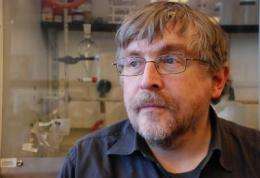
As infections such as tuberculosis have become immune to an ever widening range of antibiotics, doctors have looked on helplessly. Now a chemist at the University of Copenhagen has pioneered a novel way to battle multidrug resistant bacteria. By tweaking a well known psychoactive drug he revitalizes worn-out drugs like sulpha and penicillin. Credit: Photo: Jes Andersen/University of Copenhagen

As infections such as tuberculosis have become immune to an ever widening range of antibiotics doctors have looked on helplessly.

Now a Danish chemist has pioneered a novel way to battle multidrug . By tweaking a well known psychoactive drug he revitalizes worn-out drugs like sulpha and penicillin.

Chemist Jorn Bolstad Christensen of the University of Copenhagen has just patented the use of medication Thioridazin in boosting the effect of antibiotics. Christensen is an associate professor at the Department of Chemistry, University of Copenhagen, and in the lab he started investigating how the schizophrenia drug might bother but not humans.

"Thioridazin blocks the capacity of bacteria to cleanse themselves of antibiotics. We knew that before starting. But I wanted to remove the action of the drug in the brain so that mortally ill patients wouldn't have to contend with psychoactive effects as a part of their cure," explains Christensen, who none the less had to come to terms with a much bigger threat as well.

Bacteria such as those responsible for tuberculosis, and enterococcus get rid of using their so called efflux-pump. A mechanism which simply pumps the active substance out of the cell before it has an opportunity to do harm. A substance which blocks the pump should ensure that any antibiotic stays inside the bacteria long enough to kill it. There's just one tiny problem. have efflux pumps as well. And we wouldn't want these blocked.

"The task was to find a substance that will kill bacteria, but not the patients taking the cure. Thioridazin was a good candidate because it's been in use for decades. We could be pretty certain that it wouldn't have any serious side effects," says professor Christensen, who predicts testing the new drug in humans within just a year, as it's already been approved for other medical uses.

Though the risk of blocking the efflux pump of human cells appeared minimal Professor Christensen still needed to minimize the psychoactive effects of the . This was where his chemical expertise became indispensable. Chemically Thioridazin consists of two half molecules which are perfect mirror images. One of these mirror- or isomeric forms affects the brain less than the other, so the question was whether bacteria would know the difference.

Doctors and researchers Jette Kristiansen and Oliver Hendricks of Southern University Denmark who are co-holders of the patent have conducted microbiological trials proving that the efflux pump of bacteria stayed blocked regardless of which isomer was used. These results open up a brand new method for combating problems of multidrug resistance.

Explore further: Attacking MRSA with metals from antibacterial clays

Provided by University of Copenhagen

5 /5 (6 votes)
add to favorites email to friend print save as pdf

Related Stories

New compound defeats drug-resistant bacteria

Nov 28, 2011

It's no wonder that medicine's effort to combat bacterial infections is often described as an arms race. When new drugs are developed to combat infections, the bacterial target invariably comes up with a deterrent.

Recommended for you

Attacking MRSA with metals from antibacterial clays

May 17, 2013

In the race to protect society from infectious microbes, the bugs are outrunning us. The need for new therapeutic agents is acute, given the emergence of novel pathogens as well as old foes bearing heightened antibiotic resistance.

Keeping fruit, vegetables and cut flowers fresh longer

May 15, 2013

New technology offers the promise of reducing billions of dollars of losses that occur each year from the silent, invisible killer of fruits, vegetables and cut flowers—a gas whose effects are familiar to everyone who has ...

Why don't beetles freeze in the winter?

May 14, 2013

For 37 years, Queen's University Biochemistry professor Peter Davies has been unraveling the mystery of why some organisms including insects and fish don't freeze in the winter. His research into insect antifreeze protein ...

The molecular basis of strawberry aroma

May 13, 2013

You know that summer is here when juicy red strawberries start to appear on the shelves. In Germany, this seasonal fruit has never been more popular: on average 3.5 kilos per head were consumed in 2012—a ...

A new dimension for 3-D protein structures

May 13, 2013

(Phys.org) —3D structures of biological molecules like proteins directly affect the way they behave in our bodies. EPFL scientists have developed a new infrared-UV laser method to more accurately determine ...

User comments : 1

Adjust slider to filter visible comments by rank

Display comments: newest first

Osiris1
1 / 5 (1) Dec 29, 2011
Maybe also why 'mental cases' did not seem to get sick or stay sick often.

More news stories

Attacking MRSA with metals from antibacterial clays

In the race to protect society from infectious microbes, the bugs are outrunning us. The need for new therapeutic agents is acute, given the emergence of novel pathogens as well as old foes bearing heightened antibiotic resistance.

Beautiful 'flowers' self-assemble in a beaker

By simply manipulating chemical gradients in a beaker of fluid, materials scientists at Harvard have found that they can control the growth behavior of crystals to create precisely tailored structures—such ...

Making gold green: New non-toxic method for mining gold

Northwestern University scientists have struck gold in the laboratory. They have discovered an inexpensive and environmentally benign method that uses simple cornstarch—instead of cyanide—to isolate gold from raw materials ...

Heat-related deaths in Manhattan projected to rise

Residents of Manhattan will not just sweat harder from rising temperatures in the future, says a new study; many may die. Researchers say deaths linked to warming climate may rise some 20 percent by the 2020s, ...

Kinks and curves at the nanoscale

One of the basic principles of nanotechnology is that when you make things extremely small—one nanometer is about five atoms wide, 100,000 times smaller than the diameter of a human hair—they are going ...

Honeybees trained in Croatia to find land mines

(AP)—Mirjana Filipovic is still haunted by the land mine blast that killed her boyfriend and blew off her left leg while on a fishing trip nearly a decade ago. It happened in a field that was supposedly ...