Bobsled runs -- fast and yet safe
Dec 01, 2011
Bobsled runs -- fast and yet safe
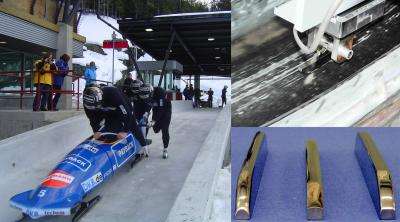
The friction levels of runners can now be measured accurately: top right, the measuring setup with runner and sensor in the ice channel; below right, various types of runner: (left to right) bob, skeleton and luge. Credit: Frauenhofer IWM

Lightning fast, the sled bolts down the icy run. Will the team make it to the finish faster than their competitors? The tension in the crowd depends partly on the run itself: the faster the sleds can travel on the run, the more thrilling the race. But the track mustn't be too fast: the crew still needs to be able to reach the bottom safely. So engineers have to calculate and simulate exactly how fast a sled can travel on specific sections of the track. The calculations are based on the friction levels between the runners and the ice. Up to now, the problem has been the difficulty of measuring these levels at such high speeds, and the data collected have been rather far from reality. This meant that the speed of the sleds was often estimated too high or too low, which could lead to accidents.

In future tracks are set to become safer. Researchers at the Fraunhofer Institute for IWM at the Microtribology Center µTC in Pfinztal have now developed a method of measuring the friction levels accurately. In so doing, they are able to provide their colleagues from Gurgel+Partner, consulting engineers responsible for design and construction of the bobsled track for the 2014 Winter Olympics in Sochi, with a solid basis for their calculations. "This measuring device allows us to ascertain the precise level of friction between the sled and the at high speeds – from which we can calculate the maximum speed a team can reach," explains Prof. Dr. Matthias Scherge, business unit manager at the IWM. Our "bobsled track" is in fact a large drum, similar to that of a washing machine, which is 3.8 meters in diameter and open on one side, situated in a bunker that has been chilled to -4°C. On the inside of the drum is a layer of ice, on which the test slide. A hydraulic cylinder presses each runner to the ice, simulating the weight of the sled and the crew. Whenever the drum rotates, the ice moves out from under the runner, slightly displacing both it and the attached friction force sensor. So instead of remaining at the lowest point, the runner is carried along a little by the rotating drum. Just how far depends on the amount of friction between the runner and the ice.

In their experiments with this apparatus and with other test rigs, the researchers take into account numerous factors, such as the nature of the ice itself. Ice at Whistler ski resort in Canada, for example, has different friction qualities than ice in Krasnaya Polyana near Sochi. Atmospheric humidity is significantly higher at Whistler because of its proximity to the Pacific, so ice accumulates faster there. The scientists can adjust the climatic conditions in the lab accordingly. They are also looking into the effect on runners of having a good finish. To what degree does a professional finish affect the speed of a bobsled weighing up to 630 kilograms? Researchers also recreate the steering movements of the racing vehicle: the runners on the glide body can be set at an angle to simulate cornering. The minimal level – which is to say the fastest possible speed the sled can achieve on any particular track under various ice conditions, providing the team does everything right – is taken by Gurgel+Partner engineers as the basis for their calculations. In the meantime, construction is underway in Sochi.

Explore further: Alaska volcano shoots ash 15,000 feet into the air

add to favorites email to friend print save as pdf

Related Stories

In search of speed

Jan 08, 2010

In ski sports, it's often only a second that separates the winners from the losers. Using equipment made of the right materials can therefore make all the difference. Researchers are simulating the gliding ...

Winter Olympics Science Notes: Skeleton

Feb 23, 2010

Shake your head as hard as you can for about one minute. That's how aerospace engineer Timothy Wei describes the sport of skeleton. And by the way, within that minute, athletes also travel head-first around ...

Greenland and Antarctic ice sheet melting, rate unknown

Feb 16, 2009

The Greenland and Antarctica ice sheets are melting, but the amounts that will melt and the time it will take are still unknown, according to Richard Alley, Evan Pugh professor of geosciences, Penn State.

Smarter cars are gaining traction (w/ Video)

Dec 21, 2009

(PhysOrg.com) -- Lives can depend on a vehicle's moment-by-moment traction. New European technology promises to make cars as good as experienced, alert drivers at sensing and adjusting to wet, snowy or icy ...

Recommended for you

Alaska volcano shoots ash 15,000 feet into the air

12 hours ago

(AP)—One of Alaska's most restless volcanoes has shot an ash cloud 15,000 feet into the air in an ongoing eruption that has drawn attention from a nearby community but isn't expected to threaten air traffic.

NASA sees Cyclone Mahasen hit Bangladesh

23 hours ago

NASA's Tropical Rainfall Measuring Mission satellite known as TRMM measured Cyclone Mahasen's rainfall rates from space as it made landfall on May 16. Mahasen has since dissipated over eastern India.

Rapid climate change ruled out ice age trees

May 17, 2013

Short, sharp fluctuations in the Earth's climate throughout the last ice age may have stopped trees from getting a foothold in Europe and northern Asia, scientists say.

Earth's iron core is surprisingly weak, researchers say

May 17, 2013

The massive ball of iron sitting at the center of Earth is not quite as "rock-solid" as has been thought, say two Stanford mineral physicists. By conducting experiments that simulate the immense pressures deep in the planet's ...

User comments : 1

Adjust slider to filter visible comments by rank

Display comments: newest first

Vendicar_Decarian
not rated yet Dec 01, 2011
Bobsled Nuns? What the hell are Bobsled Nuns?

More news stories

Galaxy's Ring of Fire

Johnny Cash may have preferred this galaxy's burning ring of fire to the one he sang about falling into in his popular song. The "starburst ring" seen at center in red and yellow hues is not the product of ...

Alaska volcano shoots ash 15,000 feet into the air

(AP)—One of Alaska's most restless volcanoes has shot an ash cloud 15,000 feet into the air in an ongoing eruption that has drawn attention from a nearby community but isn't expected to threaten air traffic.

Chinese, Indian airlines face EU pollution fines

Eight Chinese and two Indian airlines face fines of up to several million euros for not paying for their greenhouse gas emissions during flights within the bloc, the European Commission said on Friday.

Morocco to harness the wind in energy hunt

Morocco is ploughing ahead with a programme to boost wind energy production, particularly in the southern Tarfaya region, where Africa's largest wind farm is set to open in 2014.

US psychiatry gets makeover in new manual

The latest makeover to a massive psychiatric tome honored by some, reviled by others and even called the "Bible" of mental disorders is being released Saturday with a host of new changes.

New case of SARS-like virus in Saudi: ministry

A new case of the deadly coronavirus has been detected in Saudi Arabia where 15 people have already died after contracting it, the health ministry announced on Saturday on its Internet website.