Biologist discovers new and wider varieties of frog species in amazon basin than previously recorded
December 1, 2011 By Emily Narvaes Wilmsen
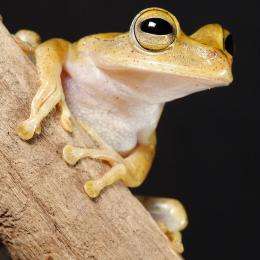
Tree frog discovered by CSU team. Credit: Santiago Ron
The diversity of frogs in the Amazon Basin is much greater than previously recorded, according to a new paper by Colorado State University and Ecuadorian biologists that could lead to greater understanding of how to save the frogs from extinction.
Chris Funk, assistant professor in the Department of Biology at Colorado State, and his team found a diversity of one- to two-inch-long tree frogs and toadlets that was anywhere from 150 percent to 350 percent greater than originally estimated, according to the paper published today in Proceedings of the Royal Society B. Funk conducted the study with Marcel Caminer and Santiago R. Ron, his counterparts at the Pontifica Universidad Católica del Ecuador.
The scientists sampled specimens in six countries within the Amazon Basin but focused their research in Ecuador. They found an estimated 12 new species. More significant, Funk said, is the percentage increase of new species found using DNA sequences and recordings of frog calls to more accurately identify species.
And if the results of the study are applied to all amphibians in the Amazon, as many as 1,900 new species could be unveiled, which is significant given that amphibians are one of the most threatened groups of animals on Earth, Funk said.
One of the greatest challenges for biodiversity conservation is a poor understanding of species diversity, Funk said. Although the Amazon Basin is already recognized as a global center of biodiversity, we provide new evidence that its diversity is still vastly underestimated. These species have been around for millions of years, but were just uncovering them now because we have new technology to do that.
This video is not supported by your browser at this time.
The team uncovered new species by collecting DNA, measuring physical size and shape, and recording and analyzing frog calls. Differences in calls were more pronounced than size and shape, the study found.An increase in diversity in species doesnt equate to less concern for the welfare of amphibians, Funk said. In fact, it could be the opposite: Each frog species has a small range and one event such as a natural or manmade disaster could wipe out an entire species.
Still, the research gives scientists more information about mapping the patterns of diverse frog species so they can begin to understand how to protect them from extinction.
Given that frogs and other vertebrates are relatively well-studied, there may be even higher levels of undiscovered biodiversity in other understudied taxonomic groups like insects and fungi, Funk said. While the Amazon has one of the most species-rich amphibian populations in the world, much is still unknown about the diversity of species there. This is a pressing issue with roughly 41 percent of amphibian species classified as globally threatened with extinction. With this study, were showing that, with improved species sampling, that percentage is almost certainly higher worldwide.
Provided by Colorado State University
-
From lemons to lemonade: Reaction uses carbon dioxide to make carbon-based semiconductor,
32 comments
-
Thioridazine kills cancer stem cells in human while avoiding toxic side-effects of conventional cancer treatments,
3 comments
-
SpaceX private rocket blasts off for space station (Update),
42 comments
-
Climate scientists say they have solved riddle of rising sea,
31 comments
-
SpaceX capsule has 'new car' smell, astronauts say (Update),
4 comments
-
What would stain as translucent on light-coloured fabric?
May 26, 2012
-
How do I identify different bacteria on culture plates?
May 26, 2012
-
Why Do Dogs do Strange things...
May 25, 2012
-
What does exophillic and endophillic mean in terms of mosquito and their control?
May 24, 2012
-
Semen stains glows under black lights (uv light)?
May 23, 2012
-
Question on Human Chromosome 2
May 23, 2012
- More from Physics Forums - Biology
More news stories
Manufacturing genes to attack flu virus
An international research team has manufactured a new protein that can combat deadly flu epidemics.
6 hours ago |
not rated yet |
0
|
Scientist: Evolution debate will soon be history
(AP) -- Richard Leakey predicts skepticism over evolution will soon be history. Not that the avowed atheist has any doubts himself.
May 26, 2012 |
3.5 / 5 (20) |
91
More plant species responding to global warming than previously thought
(Phys.org) -- Far more wild plant species may be responding to global warming than previous large-scale estimates have suggested.
May 22, 2012 |
4.6 / 5 (14) |
18
|
For monogamous sparrows, it doesn't pay to stray (but they do it anyway)
It's quite common for a female song sparrow to stray from her breeding partner and mate with the male next door, but a new study shows that sleeping around can be costly.
May 22, 2012 |
5 / 5 (2) |
8
|
Thousands of shellfish found dead in Peru
Thousands of crustaceans were found dead off the coast of Lima following the mystery mass death of dolphins and pelicans, the Peruvian Navy said Friday.
May 26, 2012 |
4.7 / 5 (7) |
7
Stunning image of smallest possible five-ringed structure
Scientists have created and imaged the smallest possible five-ringed structure about 100,000 times thinner than a human hair and you'll probably recognise its shape.
'Unzipped' carbon nanotubes could help energize fuel cells, batteries
Multi-walled carbon nanotubes riddled with defects and impurities on the outside could replace some of the expensive platinum catalysts used in fuel cells and metal-air batteries, according to scientists at ...
Change in developmental timing was crucial in the evolutionary shift from dinosaurs to birds: study
At first glance, it's hard to see how a common house sparrow and a Tyrannosaurus Rex might have anything in common. After all, one is a bird that weighs less than an ounce, and the other is a dinosaur that ...
Computer model used to pinpoint prime materials for efficient carbon capture
When power plants begin capturing their carbon emissions to reduce greenhouse gases and to most in the electric power industry, it's a question of when, not if it will be an expensive undertaking.
T cells 'hunt' parasites like animal predators seek prey, study shows
By pairing an intimate knowledge of immune-system function with a deep understanding of statistical physics, a cross-disciplinary team at the University of Pennsylvania has arrived at a surprising finding: T cells use a movement ...
Land and sea species differ in climate change response: study
(Phys.org) -- Marine and terrestrial species will likely differ in their responses to climate warming, new research by Simon Fraser University and Australia’s University of Tasmania has found.