Big quakes no more likely than in past: study
Dec 19, 2011
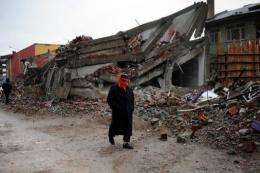
A homeless survivor walks by a collapsed building after an earthquake in Ercis, Turkey, in October 2011. Massive earthquakes are no more likely today than they were a century ago, despite an apparent rise in recent years of the devastating temblors, US researchers said on Monday.

Massive earthquakes are no more likely today than they were a century ago, despite an apparent rise of the devastating temblors in recent years, US researchers said on Monday.

The deadly 9.0 earthquake this year in Japan, an 8.8 in Chile last year and the 2004 Sumatra-Andaman earthquake that registered 9.0 on the moment magnitude scale have raised alarm in some science and media circles that such events may be linked.

But researchers at the University of California went back over the world's earthquake records dating back to 1900 and found over time there was no statistically significant rise in the number of big quakes 7.0 and higher.

"One has to be careful, because humans have a tendency to see patterns in random sequences," lead author Peter Shearer of the UC Berkeley Department of Statistics told AFP.

"So what we wanted to do here was apply to see whether you could say it wasn't just a random sequence of events," said Shearer, whose study appears in the .

"Those tests showed that you can't say that it is not random; that is, there is not a statistically significant degree of the clustering of events," he said.

Even though there is "a disproportionate number of very large 8.5 earthquakes between 1950 and 1965," there were uncommonly fewer of these during a much longer period afterward from 1965 to 2004.

And although there has been a more frequent rate of 8.0 and larger quakes since 2004, with the last five years in particular at a record high, "there have been rates nearly as high in the past," said the study.

The researchers also looked for any clues from the Earth's crust that could explain why or how big quakes might be linked.

"And the conclusion was no, there isn't a likely physical cause that would link for example a large in South America to one in Japan," Shearer told AFP.

"The events are just too far away for it to be very likely that there is a physical link between them."

Taken together, the two approaches "suggest that the global risk of large earthquakes is no higher today than it has been in the past," concluded the study.

The findings are in line with a study in Nature Geoscience earlier this year that found the regional hazard of larger earthquakes is increased after a main shock, but the global hazard is not.

That study countered an earlier 2009 paper in Nature that suggested seismic waves might have an effect on distant fault lines, potentially increasing the risk of earthquakes far away.

Explore further: Astonishing hi-resolution satellite views of the destruction from the Moore, Oklahoma tornado

More information: The global risk of big earthquakes has not recently increased, by Peter M. Shearer and Philip B. Stark, PNAS, 2011.

add to favorites email to friend print save as pdf

Related Stories

Are we living in an age of giant quakes?

Apr 08, 2011

Searching for patterns in the occurrence of large magnitude earthquakes after a succession of large tremors -- surpassed by the recent magnitude-9.0 quake in Japan -- has researchers wondering if the amount ...

No long-distance risks from mega-quakes: study

Mar 27, 2011

Monster earthquakes like the 9.0-magnitude event that occurred off Japan on March 11 are unlikely to trigger a large quake in distant regions of the world, according to a study published on Sunday.

Large Himalaya earthquakes may occur sooner than expected

Dec 07, 2005

While the rupture zones of recent major earthquakes are immune to similar-sized earthquakes for hundreds of years, they could be vulnerable to even bigger destructive temblors sooner than scientists suspect, according to ...

Not more quakes, just more people in quake zones

Mar 09, 2010

First the ground shook in Haiti, then Chile and now Turkey. The earthquakes keep coming hard and fast this year, causing people to wonder if something sinister is happening underfoot. It's not.

Recommended for you

Strong earthquake at exceptional depth

May 24, 2013

This morning at 05:45 CEST, the earth trembled beneath the Okhotsk Sea in the Pacific Northwest. The quake, with a magnitude of 8.2, took place at an exceptional depth of 605 kilometers. Because of the great ...

Marine forecasting on the horizon for Indian Ocean Rim

May 24, 2013

Nearly all of the member countries of the Indian Ocean Rim Association for Regional Cooperation (IOR-ARC) will attend the week-long workshop to further cooperation and understanding on international ocean ...

Russia evacuates drifting Arctic research station

May 23, 2013

Russia has ordered the urgent evacuation of the 16-strong crew of a drifting Arctic research station after ice floe that hosts the floating laboratory began to disintegrate, officials said Thursday.

User comments : 6

Adjust slider to filter visible comments by rank

Display comments: newest first

Husky
3 / 5 (4) Dec 19, 2011
with the present populationsize, we are bound to find ourselves living in disasterprone areas that used to be uninhabitat or had a sparse population and no internet to upload the movie to youtube.
Callippo
2.3 / 5 (3) Dec 19, 2011
In these studies the intensity of geovolcanic activity increases instead. http://nujournal....Rise.pdf http://www.market...9983.htm I tend to believe in these trends, as it supports my theory about geothermal origin of global warming. After all, the switching of geomagnetic poles is connected to circulation of matter inside of Earth core and if it reverses, it must have some impact to the Earth mantle.
verkle
1 / 5 (2) Dec 19, 2011
Callippo, the article that you point to is in direct contradiction to the point of this article. It would be intereseting to see the same energy graph of earthquakes for years prior to 1974 as well.
Callippo
1 / 5 (1) Dec 19, 2011
Callippo, the article that you point to is in direct contradiction to the point of this article. It would be interesting to see the same energy graph of earthquakes for years prior to 1974 as well.

It's difficult to say, because the more intensive geovolcanic activity could actually lead to weaker, but much faster earthquakes, because the friction tension in Earth mantle is released more often and as such in more reversible way. The total energy of quakes is what counts here. The less intensive earthquakes were missed easily at the beginning of the last century because of lack of dense seismograph network and central evidence of quakes. The less dense network of seismographs in history could lead to the detection of weaker signal, because the centers of quakes were more distant from seismographs in average.
Shifty0x88
5 / 5 (1) Dec 19, 2011
So the fact that there was a east-coast quake, though it was minor here in New Jersey, is what coincidence? Or just the result of a build up that would have been at least 24 years in the making? HHhhhmmmm
MarkyMark
not rated yet Dec 20, 2011
So the fact that there was a east-coast quake, though it was minor here in New Jersey, is what coincidence? Or just the result of a build up that would have been at least 24 years in the making? HHhhhmmmm

Yes it probably was coincidence.

More news stories

Galaxies fed by funnels of fuel

(Phys.org) —Computer simulations of galaxies growing over billions of years have revealed a likely scenario for how they feed: a cosmic version of swirly straws.

Century-old science helps confirm global warming

(Phys.org) —Ocean measurements taken more than 135 years ago during the scientific expedition of HMS Challenger have provided further confirmation of human-produced global warming over the past century.

Heart failure accelerates male 'menopause'

Heart failure accelerates the aging process and brings on early andropausal syndrome (AS), according to research presented today at the Heart Failure Congress 2013. AS, also referred to as male 'menopause', was four times ...