Award-winning energy harvester brings practical applications closer
December 1, 2011 by Lisa Zyga report

HYPEHT energy harvester

Enlarge

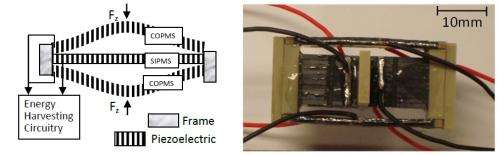
(Left) A diagram of the piezoelectric harvester with one straight inner piezoelectric multilayer stack (SIPMS) and two curved outer piezoelectric multilayer stacks (COPMSs). (Right) A photo of the first piezoelectric harvester prototype. Image credit: Tian Bing Xu, et al.

(PhysOrg.com) -- Although the idea of harvesting ambient energy from the environment and using it to generate electricity is alluring, most of the technology so far is capable of generating only very small amounts of power - on the order of microwatts to a few milliwatts with very low conversion efficiency. But a new piezoelectric energy-harvesting transducer shows that the technology is significantly improving. Researchers have predicted that 1-3 watts can be generated from a person walking when wearing a pair of shoes integrated with the new energy harvester, which is enough to power a soldier’s portable communication devices on the battlefield, among other applications.

The piezoelectric energy-harvesting was developed by a team of researchers led by Dr. Tian Bing Xu from the National Institute of Aerospace in Hampton, Virginia, in collaboration with NASA Langley Research Center, North Carolina State University, Stony Brook University, and TRS Technologies. The hybrid device combines two types of piezoelectric multilayer elements (one straight inner element sandwiched between two curved outer elements) with synergistically integrated force magnification, leading to advantages in several areas. Most notably, the transducer produces 19 times more electrical energy than current top piezoelectric transducers, and up to 1,000 times more electrical energy than a regular piezoelectric beam. Also, while the best piezoelectric transducers have mechanical-to-electrical conversion efficiencies of less than 7%, the new transducer achieves an efficiency of 26%.

These improvements recently resulted in the new piezoelectric harvester winning the award for Best Technical Development of an Energy Harvesting Device at the conference of Energy Harvesting and Storage USA 2011, in Boston, MA, on November 15-16, 2011. This category was judged on which organization had made the most significant technical achievement in energy harvesting over the past 18 months. The awards are part of the IDTechEx annual conference of Energy Harvesting and Storage USA, which was attended by over 360 people from 16 countries and featured 40 exhibitors.

The researchers have described the new piezoelectric harvester in more detail in a paper that is currently under NASA internal review. In a short description available on the website of Lei Zuo, coauthor and a professor at the State University of New York at Stony Brook, the researchers highlight a few important features that contribute to the device’s superior performance. For one, the curved outer piezoelectric elements are relatively soft and bendable, resulting in more deformation (and absorbing greater mechanical energy) under a given applied force. The device also does a better job of coupling this mechanical energy into the piezoelectric materials since minimal non-piezoelectric materials are used. Another advantageous characteristic is that, when a force is applied vertically onto the device, the forces of both the straight and curved elements are amplified to the sides. This design feature enables the device to generate 2-3 orders of magnitude more electric charges under a given amount of vibration.

“As we mentioned in the pending paper, the critical challenge for piezoelectric energy harvesting is how to harvest electrical power on the order of tens of milliwatts to several , which is good enough for powering most portable devices, from any kinds of vibration and motion at any ranges of vibration frequencies (off-resonance mode harvesting technology is needed),” Xu told PhysOrg.com. “The new piezoelectric transducer addresses several critical issues from energy absorption, coupling, and to overcome those challenges.”

In the future, the researchers hope that the new piezoelectric harvesters will be able to harvest enough energy to power different types of portable devices from the environment. In addition to being used in shoes, the harvesters could have applications in infrastructure health monitoring systems and sensor networks. Although the transducer works best when harvesting vibrations at a certain resonance, its high efficiency enables it to still use off-resonant vibrations for low-power devices, such as some sensors.

energy harvesting is a multidisciplinary issue to be addressed from the considerations of mechanical engineering, electrical engineering, material science, and system engineering,” Xu said. “For each individual mechanical vibration or motion resource, a specific device is designed to get an optimized electrical energy output. Our team is confident that we can move the technology into a new era.”

© 2011 PhysOrg.com

Filter


Move the slider to adjust rank threshold, so that you can hide some of the comments.


Display comments: newest first

Isaacsname
Dec 01, 2011

Rank: 5 / 5 (4)
I've been conjecturing this for years, it's nice to see it finally coming to fruition. Good thinking on the design.

I'm still kind of surprised we don't hear more about piezoelectric tires.
eigenbasis
Dec 01, 2011

Rank: 5 / 5 (1)
I wonder what the potential lifetime of a device like this is. Also, it makes a big difference if the measured power is peak output or RMS output. I'm assuming for article purposes that this is reporting the peak power output, anybody know?
rawa1
Dec 01, 2011

Rank: 1.4 / 5 (5)
Whereas the shoe manufacturers struggle to produce most effective shoes, the others are developing devices like this one. The energy harvested usually comes with increase of physical effort and discomfort as a price. It's much more effective to develop little cold fusion device integrated into batteries, than to waste the money and materials into development of tiny energy harvesters. The price of energy harvested will be always higher, than the price of the whole device, not to say about costs and complications with power conducting wires and similar stuff.
antonima
Dec 01, 2011

Rank: 4.3 / 5 (3)
I've been conjecturing this for years, it's nice to see it finally coming to fruition. Good thinking on the design.

I'm still kind of surprised we don't hear more about piezoelectric tires.


I think the reason for this is that it would ultimately draw energy from the car's motor.
801
Dec 01, 2011

Rank: 5 / 5 (4)
How about a piezoelectric device of larger size attached to the top of the shock tower ( or suspension) of an automobile. Such a device could assist regenerative braking for battery charging.
Isaacsname
Dec 01, 2011

Rank: 5 / 5 (1)
You mean if they were integrated into electric vehicles ?

I'm thinking more along the lines of something that is a retrofit for most cars currently on the road. I've seen patents for them, for at least a year or two.
Deadbolt
Dec 01, 2011

Rank: 3.7 / 5 (3)
If you were a soldier using this to power your radio, would you be stomping up and down constantly to get it to work?
pokerdice1
Dec 01, 2011

Rank: not rated yet
lol deadbolt!
StarGazer2011
Dec 01, 2011

Rank: 1 / 5 (1)
whats it cost?
NotAsleep
Dec 02, 2011

Rank: 5 / 5 (1)
Years ago, a club in LA opened that was powered by the pounding of people's feet while dancing. Here's an article on one in the UK:

http://www.dailym...ors.html

Time to integrate this higher-efficiency piezoelectric into our floors?

@ Rawa, this would not make running less efficient... at least not noticably so. The energy of walking/running normally leaves the shoes as heat, whether through the shoe itself or through the ground. This inevitably saves that heat and converts it into electricity
CHollman82
Dec 02, 2011

Rank: 2 / 5 (8)
Whereas the shoe manufacturers struggle to produce most effective shoes, the others are developing devices like this one. The energy harvested usually comes with increase of physical effort and discomfort as a price. It's much more effective to develop little cold fusion device integrated into batteries, than to waste the money and materials into development of tiny energy harvesters. The price of energy harvested will be always higher, than the price of the whole device, not to say about costs and complications with power conducting wires and similar stuff.


Are you nuts? The energy harvested would have existed anyway, it just would have been dissipated differently (heat, sound, etc)
fmfbrestel
Dec 03, 2011

Rank: 5 / 5 (6)
Are you nuts? The energy harvested would have existed anyway, it just would have been dissipated differently (heat, sound, etc)


Yes, Rawa is nuts. His sole retort to all things electrical is "cold fusion!!!!!!!!" ignore him
Rank 5 /5 (5 votes)
Relevant PhysicsForums posts

More news stories

Browser wars flare in mobile space

The browser wars are heating up again, but this time the fight is for dominance of the mobile Internet.

Technology / Software

created 14 hours ago | popularity 5 / 5 (2) | comments 3

Probability of contamination from severe nuclear reactor accidents is higher than expected: study

Catastrophic nuclear accidents such as the core meltdowns in Chernobyl and Fukushima are more likely to happen than previously assumed. Based on the operating hours of all civil nuclear reactors and the number ...

Technology / Energy & Green Tech

created May 22, 2012 | popularity 3.6 / 5 (25) | comments 56 | with audio podcast

HyperSolar shows dirty water no barrier to power world

(Phys.org) -- The Santa Barbara, California, company, HyperSolar, is set to transparently share the ups and downs of its research experiences toward the company’s ultimate vision, successfully producing ...

Technology / Energy & Green Tech

created May 24, 2012 | popularity 4.8 / 5 (16) | comments 17 | with audio podcast report

SpotterRF debuts Radar Backpack Kit (w/ Video)

(Phys.org) -- SpotterRF has announced a special radar backpack kit designed to enhance situational awareness for soldiers on the ground. The company says its special radar is designed for warfighters as part ...

Technology / Hi Tech & Innovation

created May 26, 2012 | popularity 5 / 5 (5) | comments 13 | with audio podcast report

Tesla to launch electric sedan in US on June 22

Tesla Motors said Tuesday it would begin deliveries of "the world's first premium electric sedan" on June 22, slightly ahead of schedule.

Technology / Energy & Green Tech

created May 22, 2012 | popularity 4.5 / 5 (12) | comments 18


Stunning image of smallest possible five-ringed structure

Scientists have created and imaged the smallest possible five-ringed structure – about 100,000 times thinner than a human hair – and you'll probably recognise its shape.

'Unzipped' carbon nanotubes could help energize fuel cells, batteries

Multi-walled carbon nanotubes riddled with defects and impurities on the outside could replace some of the expensive platinum catalysts used in fuel cells and metal-air batteries, according to scientists at ...

Change in developmental timing was crucial in the evolutionary shift from dinosaurs to birds: study

At first glance, it's hard to see how a common house sparrow and a Tyrannosaurus Rex might have anything in common. After all, one is a bird that weighs less than an ounce, and the other is a dinosaur that ...

Computer model used to pinpoint prime materials for efficient carbon capture

When power plants begin capturing their carbon emissions to reduce greenhouse gases – and to most in the electric power industry, it's a question of when, not if – it will be an expensive undertaking.

T cells 'hunt' parasites like animal predators seek prey, study shows

By pairing an intimate knowledge of immune-system function with a deep understanding of statistical physics, a cross-disciplinary team at the University of Pennsylvania has arrived at a surprising finding: T cells use a movement ...

Land and sea species differ in climate change response: study

(Phys.org) -- Marine and terrestrial species will likely differ in their responses to climate warming, new research by Simon Fraser University and Australia’s University of Tasmania has found.