Air pollution results from sugarcane ethanol production
December 16, 2011 By James Leonard
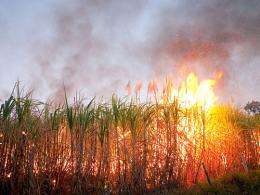
(PhysOrg.com) -- The burning of sugarcane fields prior to harvest for ethanol production can create air pollution that detracts from the biofuel's overall sustainability, according to research published recently by a team of researchers led by scientists at the University of California, Merced.
UC Merced graduate student Chi-Chung Tsao was the lead author on the paper and was aided in the study by UC Merced professors Elliott Campbell and Yihsu Chen. The study published online this week in the Nature Climate Change journal focused on Brazil, the world's top producer of sugarcane ethanol and a possible source for U.S. imports of the alternative fuel.
"There is a big strategic decision our country and others are making, in whether to develop a domestic biofuels industry or import relatively inexpensive biofuels from developing countries," Campbell said. "Our study shows that importing biofuels could result in human health and environmental problems in the regions where they are cultivated." Download a PDF of the study.
Ethanol is seen as an alternative to fossil fuels, which emit greenhouse gasses when used and are a major contributor to air pollution and climate change. But despite some governments encouraging farmers to reduce field burning which is done in part to protect farmworkers by removing sharp leaves and harmful animals more than half of sugarcane croplands in Brazil continue to be burned.
That leads to a reduction in air quality that can offset the benefits of ethanol over petroleum fuels that emit more greenhouse gases during their use, something Campbell said the U.S. should consider when determining whether to import inexpensive ethanol from Brazil or continuing to invest in domestic corn ethanol production.
"Unlike petroleum production, the potential to produce biofuels is relatively evenly distributed across many countries, and this is a big plus from an energy security perspective," Campbell said. "However, agriculture practices in some regions result in biofuels that lead to even more intense air pollution than petroleum."
Satellites are currently used to measure air pollution in Brazil, but the study shows actual pollution caused by sugarcane field burning could be four times greater than satellite estimates. The researchers believe this is due to the relatively small scale of individual fires.
Provided by University of California
-
From lemons to lemonade: Reaction uses carbon dioxide to make carbon-based semiconductor,
32 comments
-
Thioridazine kills cancer stem cells in human while avoiding toxic side-effects of conventional cancer treatments,
3 comments
-
SpaceX private rocket blasts off for space station (Update),
42 comments
-
Climate scientists say they have solved riddle of rising sea,
31 comments
-
SpaceX capsule has 'new car' smell, astronauts say (Update),
4 comments
-
Hypothetical desert earth
21 hours ago
-
More human population = greater mass?
May 25, 2012
-
Conversion from aircraft bearing to normal degrees
May 23, 2012
-
Interpretation/Analysis of the Lab results(HEPA filter)
May 22, 2012
-
Has anyone here attended the The Urbino Summer School in Paleoclimatology?
May 22, 2012
-
Earthquakes: Mag 6 N. Italy and Mag 5.6 W. Bulgaria
May 21, 2012
- More from Physics Forums - Earth
More news stories
Land and sea species differ in climate change response: study
(Phys.org) -- Marine and terrestrial species will likely differ in their responses to climate warming, new research by Simon Fraser University and Australia’s University of Tasmania has found.
4 hours ago |
3.7 / 5 (3) |
5
|
Yale study concludes public apathy over climate change unrelated to science literacy
Are members of the public divided about climate change because they don't understand the science behind it? If Americans knew more basic science and were more proficient in technical reasoning, would public consensus match ...
6 hours ago |
4.8 / 5 (5) |
12
|
10 million years needed to recover from mass extinction
It took some 10 million years for Earth to recover from the greatest mass extinction of all time, latest research has revealed.
Space & Earth / Earth Sciences
6 hours ago |
5 / 5 (3) |
1
|
Sophisticated simulations predict future warming
The chances of our planet being hit by a global warming of 3 degrees Celsius by 2050 is as likely as it being hit by an increase of 1.4 degrees, new research shows. Presented in the journal Nature Geoscience, the British study ...
Space & Earth / Earth Sciences
May 22, 2012 |
4.4 / 5 (9) |
51
Aliens don't want to eat us, says former SETI director
Alien life probably isnt interested in having us for dinner, enslaving us or laying eggs in our bellies, according to a recent statement by former SETI director Jill Tarter.
Space & Earth / Space Exploration
May 25, 2012 |
4.4 / 5 (15) |
41
Stunning image of smallest possible five-ringed structure
Scientists have created and imaged the smallest possible five-ringed structure about 100,000 times thinner than a human hair and you'll probably recognise its shape.
'Unzipped' carbon nanotubes could help energize fuel cells, batteries
Multi-walled carbon nanotubes riddled with defects and impurities on the outside could replace some of the expensive platinum catalysts used in fuel cells and metal-air batteries, according to scientists at ...
Change in developmental timing was crucial in the evolutionary shift from dinosaurs to birds: study
At first glance, it's hard to see how a common house sparrow and a Tyrannosaurus Rex might have anything in common. After all, one is a bird that weighs less than an ounce, and the other is a dinosaur that ...
Computer model used to pinpoint prime materials for efficient carbon capture
When power plants begin capturing their carbon emissions to reduce greenhouse gases and to most in the electric power industry, it's a question of when, not if it will be an expensive undertaking.
T cells 'hunt' parasites like animal predators seek prey, study shows
By pairing an intimate knowledge of immune-system function with a deep understanding of statistical physics, a cross-disciplinary team at the University of Pennsylvania has arrived at a surprising finding: T cells use a movement ...
Scientists develop ultra-sensitive test that detects diseases in their earliest stages
Scientists have developed an ultra-sensitive test that should enable them to detect signs of a disease in its earliest stages, in research published today in the journal Nature Materials.
Dec 16, 2011
Rank: 1 / 5 (2)
Dec 16, 2011
Rank: 1 / 5 (8)
1. http://dl.dropbox...asks.pdf
2. http://joannenova...idation/
Dec 16, 2011
Rank: 1.8 / 5 (16)
Wind turbines are bird and bat slaughterers.
Solar Panel are filthy to make and "rot" becoming less efficient every day.
Biofuels produce more CO2.
Dec 16, 2011
Rank: 2.7 / 5 (7)
And how is this a "green" solution? And whoever called it as such?
Dec 16, 2011
Rank: 1.3 / 5 (7)
Dec 16, 2011
Rank: 1.5 / 5 (8)
yah think yer being a tad extremist?
So, they pay for themselves several times over in their lifetimes with respect to Coal or other fossil fuels.
True.
I had thought of a way to capture solar energy in a closed water cycle, like a nuclear reactor, by using a combination of vaccuum tube technology and turbines.
To avoid losing the water, which could be taxing on local ecology, what I did is envisage piping the steam to an elevated holding tank.
Since the steam isn't free to escape, it will be less efficient than ordinary boilers, however, the water will condense in the elevated holding tank.
From there, it is allowed to pass through another turbine as it would in a hydro plant, falling back down into the vaccuum tubes of the solar heater.
Dec 16, 2011
Rank: 1 / 5 (6)
It's so simple it's pathetic.
In winter, just use black curtains.
sunlight comes through the windows and is absorbed almost 100% of the visible spectra, and then infrared can't leave the windows.
I never see anyone doing this, but essentially, it's a forced air heater without the lawn ornament or the roof ornament, and costs about 1/20th the price.
Your window is maybe 3ft by 5ft, and typically has white blinds or white curtains in it. Black would basicly make a 1000 Watts difference PER WINDOW in net gain of heat, which is similar to one of those electric floor heaters!!
In summer, use white curtains.
Dec 16, 2011
Rank: 2.3 / 5 (3)
Dec 17, 2011
Rank: 5 / 5 (3)
So you know wind turbines dont kill bats as bats can easilly see them.
Dec 17, 2011
Rank: 3.7 / 5 (3)
And birds can also see them with a simple paint job by creating patterns on the blades.
Dec 19, 2011
Rank: 1 / 5 (5)
The 86 huge turbines on Wolfe Island, just outside Kingston, Ont., began to produce power about a year ago, and an on-going count of bird and bats that have been killed by the blades has been conducted since then.
A consultants report covering the period between July and December of 2009 was released recently, indicating that 602 birds and 1,270 bats were killed by the turbines over that stretch. "
http://www.theglo...1598597/
Dec 19, 2011
Rank: 1 / 5 (5)