New process could advance use of healthy cells or stem cells to treat disease
Dec 21, 2011
New process could advance use of healthy cells or stem cells to treat disease

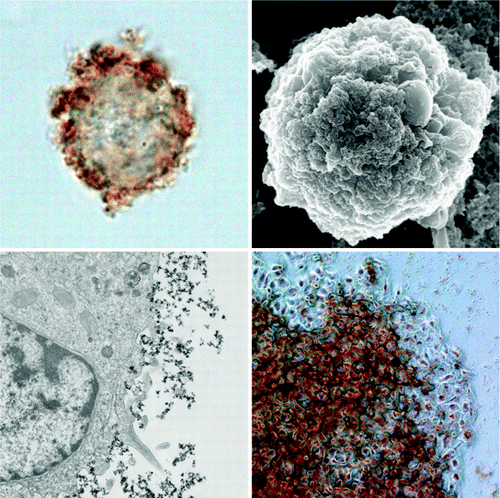
In a discovery that may help speed use of "cell therapy" — with normal cells or stem cells infused into the body to treat disease — scientists are reporting development of a way to deliver therapeutic human cells to diseased areas within the body using a simple magnetic effect. Their report appears in ACS' journal Langmuir.

Rawil Fakhrullin and colleagues explain that aims to replace damaged or diseased in the human body with normal cells or . To do so, medical personnel need a way to target these cells to diseased organs or tissues. So-called superparamagnetic iron oxide nanoparticles (SPIONs), attached to therapeutic cells, show promise. Magnetic devices could be used to move such cells to diseased areas of the body. But current ways of attaching SPIONs to therapeutic cells are difficult to use and may damage the therapeutic cells. So the researchers set out to develop a better process for attaching SPIONs to human cells.

They describe a new process for making "stabilized" SPIONs in the laboratory and successful attachment of these magnetic nanoparticles to the outside of human cells. They found that the SPIONs were not toxic to cells, and they moved in response to a magnet. "Our current results, as we believe, will inspire scientists to apply the simple and direct technique reported here in tissue engineering and cell-based therapies," say the researchers.

Explore further: Scientists offer first definitive proof of bacteria-feeding behavior in green algae

More information: A Direct Technique for Magnetic Functionalization of Living Human Cells, Langmuir, 2011, 27 (23), pp 14386–14393. DOI: 10.1021/la203839v

Abstract
Functionalized living cells are regarded as effective tools in directed cell delivery and tissue engineering. Here we report the facile functionalization of viable isolated HeLa cells with superparamagnetic cationic nanoparticles via a single-step biocompatible process. Nanoparticles are localized on the cellular membranes and do not penetrate into the cytoplasm. The magnetically responsive cells are viable and able to colonize and grow on substrates. Magnetically facilitated microorganization of functionalized cells into viable living clusters is demonstrated. We believe that the technique described here may find a number of potential applications in cell-based therapies and in development of whole-cell biosensors.

add to favorites email to friend print save as pdf

Related Stories

Stem cells reverse disease in a model of Parkinson's disease

May 16, 2011

In a new study to be published in the Journal of Clinical Investigation, researchers compared the ability of cells derived from different types of human stem cell to reverse disease in a rat model of Parkinson disease and id ...

Using living cells as an 'invisibility cloak'

Jun 15, 2011

The quest for better ways of encapsulating medicine so that it can reach diseased parts of the body has led scientists to harness -- for the first time -- living human cells to produce natural capsules with ...

Sniffing out a new source of stem cells

Jun 13, 2011

A team of researchers, led by Emmanuel Nivet, now at the Salk Institute for Biological Studies, La Jolla, has generated data in mice that suggest that adult stem cells from immune system tissue in the smell-sensing region ...

Cells derived from different stem cells: Same or different?

May 02, 2011

There are two types of stem cell considered promising sources of cells for regenerative therapies: ES and iPS cells. Recent data indicate these cells are molecularly different, raising the possibility that cells derived from ...

Stem cells as cancer therapy

Dec 26, 2006

It is widely hoped that neural stem cells will eventually be useful for replacing nerves damaged by degenerative diseases like Alzheimer disease and multiple sclerosis. But there may also be another use for such stem cells--delivering ...

Recommended for you

Researcher admits mistakes in stem cell study

3 hours ago

A blockbuster study in which US researchers reported that they had turned human skin cells into embryonic stem cells contained errors, its lead author has acknowledged. ...

Scientists discover how rapamycin slows cell growth

4 hours ago

University of Montreal researchers have discovered a novel molecular mechanism that can potentially slow the progression of some cancers and other diseases of abnormal growth. In the May 23 edition of the prestigious journal ...

Unlocking secrets of cell reproduction

13 hours ago

Research published in Open Biology today identifies, for the first time, nearly all the genes required for reproduction of a cell in a living organism.

What the smallest infectious agents reveal about evolution

May 22, 2013

Radically different viruses share genes and are likely to share ancestry, according to research published in BioMed Central's open access journal Virology Journal this week. The comprehensive phylogenomic analysis compar ...

User comments : 0

More news stories

White tiger mystery solved

White tigers today are only seen in zoos, but they belong in nature, say researchers reporting new evidence about what makes those tigers white. Their spectacular white coats are produced by a single change ...

Controlling mood through the motions of mitochondria

(Medical Xpress)—Regulating the distribution of power in neurons is done by a system that makes the national electric grid look simple by comparison. Each neuron has several thousand mitochondria confined ...