Weird world of water gets a little weirder with a new anomaly
Strange, stranger, strangest! To the weird nature of one of the simplest chemical compounds -- the stuff so familiar that even non-scientists know its chemical formula -- add another odd twist. Scientists are reporting that good old H2O, when chilled below the freezing point, can shift into a new type of liquid. The report appears in ACS' Journal of Physical Chemistry B.
Pradeep Kumar and H. Eugene Stanley explain that water is one weird substance, exhibiting more than 80 unusual properties, by one count, including some that scientists still struggle to understand. For example, water can exist in all three states of matter (solid, liquid,gas) at the same time. And the forces at its surface enable insects to walk on water and water to rise up from the roots into the leaves of trees and other plants. In another strange turn, scientists have proposed that water can go from being one type of liquid into another in a so-called "liquid-liquid" phase transition, but it is impossible to test this with today's laboratory equipment because these things happen so fast. That's why Kumar and Stanley used computer simulations to check it out.
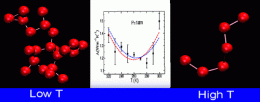
They found that when they chilled liquid water in their simulation, its propensity to conduct heat decreases, as expected for an ordinary liquid. But, when they lowered the temperature to about 54 degrees below zero Fahrenheit, the liquid water started to conduct heat even better in the simulation. Their studies suggest that below this temperature, liquid water undergoes sharp but continuous structural changes whereas the local structure of liquid becomes extremely ordered -- very much like ice. These structural changes in liquid water lead to increase of heat conduction at lower temperatures. The researchers say that this surprising result supports the idea that water has a liquid-liquid phase transition.
More information: Thermal Conductivity Minimum: A New Water Anomaly, J. Phys. Chem. B, Article ASAP. DOI: 10.1021/jp2051867
Abstract
We investigate the thermal conductivity of liquid water using computer simulations of the TIP5P model of water. Our simulations show that, in addition to the maximum at high temperatures at constant pressure that it exhibits in experiments, the thermal conductivity also displays a minimum at low temperatures. We find that the temperature of minimum thermal conductivity in supercooled liquid water coincides with the temperature of maximum specific heat. We discuss our results in the context of structural changes in liquid water at low temperatures.
Journal reference:
Journal of Physical Chemistry B
Provided by
American Chemical Society
-
From lemons to lemonade: Reaction uses carbon dioxide to make carbon-based semiconductor,
32 comments
-
Thioridazine kills cancer stem cells in human while avoiding toxic side-effects of conventional cancer treatments,
3 comments
-
SpaceX private rocket blasts off for space station (Update),
42 comments
-
Climate scientists say they have solved riddle of rising sea,
31 comments
-
SpaceX capsule has 'new car' smell, astronauts say (Update),
4 comments
-
How to find the concentration of nucleic acid solution using optical density?
25 minutes ago
-
How do I turn sodium acetate trihydrate into sodium acetate anhydrous and vice versa?
53 minutes ago
-
Calculating partial pressures Pa and Pw
3 hours ago
-
Gibbs Free Energy Change/Entropy
13 hours ago
-
What's the rule to covalent character
14 hours ago
-
Schwartz reagent-- NMR/MS/IR
May 26, 2012
- More from Physics Forums - Chemistry
More news stories
Computer model used to pinpoint prime materials for efficient carbon capture
When power plants begin capturing their carbon emissions to reduce greenhouse gases and to most in the electric power industry, it's a question of when, not if it will be an expensive undertaking.
6 hours ago |
not rated yet |
0
|
Scientists develop ultra-sensitive test that detects diseases in their earliest stages
Scientists have developed an ultra-sensitive test that should enable them to detect signs of a disease in its earliest stages, in research published today in the journal Nature Materials.
Chemistry / Analytical Chemistry
6 hours ago |
not rated yet |
0
|
New CO2-removing catalyst can take the heat
(Phys.org) -- The current method of removing the greenhouse gas carbon dioxide (CO2) from the flues of coal-fired power plants uses so much energy that no one bothers to use it. So says Roger Aines, principal ...
May 24, 2012 |
5 / 5 (9) |
11
|
High-speed method to aid search for solar energy storage catalysts
Eons ago, nature solved the problem of converting solar energy to fuels by inventing the process of photosynthesis.
May 25, 2012 |
5 / 5 (3) |
4
|
Researchers demonstrate possible primitive mechanism of chemical info self-replication
(Phys.org) -- When scientists think about the replication of information in chemistry, they usually have in mind something akin to what happens in living organisms when DNA gets copied: a double-stranded molecule ...
May 25, 2012 |
5 / 5 (4) |
2
|
Stunning image of smallest possible five-ringed structure
Scientists have created and imaged the smallest possible five-ringed structure about 100,000 times thinner than a human hair and you'll probably recognise its shape.
'Unzipped' carbon nanotubes could help energize fuel cells, batteries
Multi-walled carbon nanotubes riddled with defects and impurities on the outside could replace some of the expensive platinum catalysts used in fuel cells and metal-air batteries, according to scientists at ...
Change in developmental timing was crucial in the evolutionary shift from dinosaurs to birds: study
At first glance, it's hard to see how a common house sparrow and a Tyrannosaurus Rex might have anything in common. After all, one is a bird that weighs less than an ounce, and the other is a dinosaur that ...
T cells 'hunt' parasites like animal predators seek prey, study shows
By pairing an intimate knowledge of immune-system function with a deep understanding of statistical physics, a cross-disciplinary team at the University of Pennsylvania has arrived at a surprising finding: T cells use a movement ...
Land and sea species differ in climate change response: study
(Phys.org) -- Marine and terrestrial species will likely differ in their responses to climate warming, new research by Simon Fraser University and Australia’s University of Tasmania has found.
Yale study concludes public apathy over climate change unrelated to science literacy
Are members of the public divided about climate change because they don't understand the science behind it? If Americans knew more basic science and were more proficient in technical reasoning, would public consensus match ...
Nov 09, 2011
Rank: 4.8 / 5 (5)
Nov 09, 2011
Rank: 2.3 / 5 (9)
The transition from solid to liquid to gas is an alteration of the inherent order of water (from ordered to chaotic). Water's dipolar force can, in other words, be disrupted by random thermal forces. But, this is a conceptual explanation; the details are clearly more detailed and complicated.
Water is quickly becoming a controversial subject. This means that wikipedia is irrelevant to the discussion, as wikipedia only portrays one side of all controversies -- the conventional side.
Nov 09, 2011
Rank: not rated yet
Nov 09, 2011
Rank: 1 / 5 (1)
Nov 09, 2011
Rank: not rated yet
Nov 10, 2011
Rank: not rated yet
Can liquid water exist at this temperature? I thought water froze at about 0C regardless of pressure.
Nov 10, 2011
Rank: not rated yet
Nov 14, 2011
Rank: not rated yet
Todd J. Tocco