New views of the cosmos
November 2, 2011 By Peter Reuell
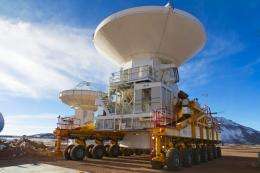
An antenna is installed at the Atacama Large Millimeter/submillimeter Array (ALMA) in Chile. The 12-meter diameter antenna is one of 16 that will be used in the observatory’s first round of scientific observations. Credit: ALMA (ESO/NAOJ/NRAO)/S. Rossi (ESO)
Though it wont be completed until 2013, the Atacama Large Millimeter/submillimeter Array (ALMA), a radio telescope observatory under construction in northern Chile, is already the most powerful and complex such facility ever built, and four astronomers from the Harvard-Smithsonian Center for Astrophysics (CfA) are among the first in line to use it.
David Wilner and Sean M. Andrews, both lecturers on astronomy, and Harvard College Observatory associates Chunhua Qi and Arielle Moullet were selected from nearly 1,000 researchers worldwide who were competing to use the observatory. Their plans for their time on the telescope range from searching the dust cloud surrounding nearby stars for hints at how planets are formed, to conducting the most in-depth analysis yet of the volcanic activity on Jupiters innermost moon.
Its very exciting, Wilner said of being among the first to use ALMA. I really cant express how fortunate I feel to be able to use this kind of facility. All we are doing is pursuing knowledge, and its a privilege to be able to do that. Its amazing.
When completed, ALMA will easily be the largest observatory of its kind on the globe. Current plans call for the installation of 66 antennas 54 with 12-meter diameter dishes and 12 smaller, 7-meter dishes which can be arranged up to 10 miles apart. For the first round of research, however, astronomers will only use 16 of the arrays antennas. Despite being less than a quarter of ALMAs planned size, the facility will still be the most powerful radio observatory.
Wilner, Andrews, and Qi plan to use the observatory to examine clouds of gas and dust that surround nearby stars.
Wilners work will focus on a narrow portion of the dust belt that surrounds AU Microscopii, a star 33 light-years away, and how the dust is replenished. Studies suggest the dust is the product of collisions between larger bodies some possibly as large as planets that are too dim to be seen with other instruments. By studying the dust, Wilner hopes to uncover evidence of those larger bodies.
The theory is that there are larger bodies that we cant see, which range up to even the size of planets, and as they collide they produce dust, Wilner said. So we can use the dust we can see as a tracer of those larger bodies.
Andrews is hoping to spot the telltale signs of how planets are formed by comparing images of the gas and dust around a pair of stars called V4046 Sgr. Current theory of planetary formation posits that, as dust grains orbit a star, they collide and begin to stick together, growing into larger bodies. Those larger bodies then drift inward, closer to the stars they orbit. The expectation is that observations made at ALMA will show that the dust disk is more compact than previously believed, suggesting that larger particles are concentrated closer to the stars.
It is extremely exciting to use a revolutionary instrument like ALMA at this first opportunity for science observations, Andrews said. I have very high expectations that in the coming years ALMA will fundamentally advance our study of the disks around young stars and their many complex roles in the process of planet formation.
Qis work with ALMA will focus on the gas in the proto-planetary disk surrounding the star TW Hydrae, particularly the molecular gas near the disk mid-plane, where the bulk of the disk mass is located. Studying the gas in the mid-plane of such disks is complicated by the fact that most telescopes are limited by lacking probes to this extreme low temperature and high density area.
By taking advantage of ALMAs unprecedented power and sensitivity to search for signs of specific hydrogen isotopes, Qi hopes to shed new light on the gas kinematics and ionization in the mid-plane of the disks.
No other telescopes can achieve comparable sensitivity and resolution, he said. I cant imagine how many hidden secrets can be revealed once ALMA unfolds its full, enormous observational potential. I am thrilled to be among the first to use the ALMA Observatory.
Of the four projects, only Moullets is not focused on the gas and dust surrounding stars. Instead, her project would train ALMAs antennas on Io, the innermost moon of Jupiter, to better understand aspects of its atmosphere.
While astronomers know Ios thin atmosphere is largely composed of sulfur dioxide, Moullet hopes to identify where and how the atmospheric sulfur monoxide and sulfur dioxide are replenished, and whether other gases, such as silicon monoxide, carbon monoxide or even gaseous table salt, are present in the atmosphere. Identifying those other gases, she said, is particularly important as a way to characterize the volcanic activity on Io as being silicate- or sulfur-based. Other observations will make the most accurate measurement to date of the wind speeds in the moons thin atmosphere.
Wilner predicted that the level of excitement and the pace of discovery will only increase as ALMA comes closer to its ultimate site.
Its taken a long time for ALMA to reach this point, Wilner said. Its a scale that were not used to in radio astronomy.
Its power is one or two orders of magnitude greater than what exists today.
This story is published courtesy of the Harvard Gazette, Harvard Universitys official newspaper. For additional university news, visit Harvard.edu.
Provided by
Harvard University
-
From lemons to lemonade: Reaction uses carbon dioxide to make carbon-based semiconductor,
32 comments
-
Thioridazine kills cancer stem cells in human while avoiding toxic side-effects of conventional cancer treatments,
3 comments
-
SpaceX private rocket blasts off for space station (Update),
42 comments
-
Climate scientists say they have solved riddle of rising sea,
31 comments
-
SpaceX capsule has 'new car' smell, astronauts say (Update),
4 comments
-
Distance of planets from stars and revolution
5 hours ago
-
revamping general concept and cosmological principle
May 25, 2012
-
Transiting Exoplanet Light Curve
May 25, 2012
-
Math behind Theoretical Physics
May 24, 2012
-
Do we know whats at the center of galaxies yet?
May 23, 2012
-
Structure of the Milky Way?
May 20, 2012
- More from Physics Forums - General Astronomy
More news stories
Land and sea species differ in climate change response: study
(Phys.org) -- Marine and terrestrial species will likely differ in their responses to climate warming, new research by Simon Fraser University and Australia’s University of Tasmania has found.
3 hours ago |
3.7 / 5 (3) |
2
|
Yale study concludes public apathy over climate change unrelated to science literacy
Are members of the public divided about climate change because they don't understand the science behind it? If Americans knew more basic science and were more proficient in technical reasoning, would public consensus match ...
5 hours ago |
4.8 / 5 (4) |
11
|
10 million years needed to recover from mass extinction
It took some 10 million years for Earth to recover from the greatest mass extinction of all time, latest research has revealed.
Space & Earth / Earth Sciences
5 hours ago |
5 / 5 (3) |
1
|
Sophisticated simulations predict future warming
The chances of our planet being hit by a global warming of 3 degrees Celsius by 2050 is as likely as it being hit by an increase of 1.4 degrees, new research shows. Presented in the journal Nature Geoscience, the British study ...
Space & Earth / Earth Sciences
May 22, 2012 |
4.4 / 5 (9) |
51
Aliens don't want to eat us, says former SETI director
Alien life probably isnt interested in having us for dinner, enslaving us or laying eggs in our bellies, according to a recent statement by former SETI director Jill Tarter.
Space & Earth / Space Exploration
May 25, 2012 |
4.4 / 5 (14) |
40
Nvidia trumpets Tegra 3 phone design wins for 2012
(Phys.org) -- Nvidias competitive war paint has a name, Tegra 3. On the heels of Nvidia announcements about lowering costs of its Tegra 3 processors and Nvidia-enabled tablets running Android Ice Cream ...
'Unzipped' carbon nanotubes could help energize fuel cells, batteries
Multi-walled carbon nanotubes riddled with defects and impurities on the outside could replace some of the expensive platinum catalysts used in fuel cells and metal-air batteries, according to scientists at ...
T cells 'hunt' parasites like animal predators seek prey, study shows
By pairing an intimate knowledge of immune-system function with a deep understanding of statistical physics, a cross-disciplinary team at the University of Pennsylvania has arrived at a surprising finding: T cells use a movement ...
Computer model used to pinpoint prime materials for efficient carbon capture
When power plants begin capturing their carbon emissions to reduce greenhouse gases and to most in the electric power industry, it's a question of when, not if it will be an expensive undertaking.
Change in developmental timing was crucial in the evolutionary shift from dinosaurs to birds: study
At first glance, it's hard to see how a common house sparrow and a Tyrannosaurus Rex might have anything in common. After all, one is a bird that weighs less than an ounce, and the other is a dinosaur that ...
Scientist: Evolution debate will soon be history
(AP) -- Richard Leakey predicts skepticism over evolution will soon be history. Not that the avowed atheist has any doubts himself.
Nov 02, 2011
Rank: 1.1 / 5 (11)
This theory is just a lot of hot gas - pun intended.
It should be quite clear from the physics and mechanics of the solar components that [rocky] planets have to form quickly [within hours] and under high pressure otherwise they would not be able to persist in the forms they are found.
As for the gaseous planets - they too need to form quickly, in the order of hours, especially given their high angular momentum relative to the sun.
Anyway, that's my uneducated and ill-informed guesses. Your mileage may vary.
Nov 02, 2011
Rank: 5 / 5 (5)
or
Which is it Kev? Who do you think is going to read this and rank your admittedly wild ramblings above published science? I suggest you get informed and educated on the science then get back to us with your opinions.
Nov 02, 2011
Rank: 5 / 5 (4)
My religion is just a lot of hot gas - pun intended.
It should be quite clear from the physics and mechanics of the ignorant goat herders, [rickety] ideologies have to form quickly [within hours] and under high establishmentarian pressure, otherwise they would not be able to persist in the religious forms they are found.
As for the gaseous priests' dogma - it too needs to form quickly, in the order of hours, especially given their high immoral momentum relative to humanistic ethics.
Anyway, those are your uneducated and ill-informed guesses - that goes without saying. Your milage is always the same.