UC chemistry research looks to turn food waste into fuel
November 9, 2011

UC Chemistry Research Looks to Turn Food Waste into Fuel

Enlarge

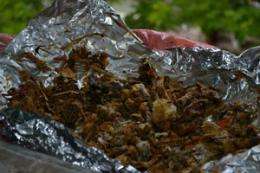
Food waste was sun-dried for extraction purposes.

Three Department of Chemistry undergraduate researchers recently spent time at the Ho Chi Minh City (HCMC) University of Science, in Vietnam, working on ways to turn food waste into biodiesel fuel. Cody Nubel, Megan McCallister and Zachary Herrmann joined Professor Allan Pinhas and graduate researchers, Amos Doepke and Chau Phung, on a joint research project with Lawrence Pratt of Fisk University.

The project, “Biodiesel from ,” focuses on the potential to produce biodiesel from extracted from garbage. With the depletion of oil reserves, research into alternative fuels has exploded, especially in the area of renewable resources such as garbage and food waste. One particular resource, brown grease from food waste, has yet to realize its full potential, but thanks to the efforts of University of Cincinnati chemistry researchers, the project is finding ways to optimize this resource.

One of the goals of the project was to determine the amount of usable oil that can be obtained from food waste. To do this, the researchers collected food waste—by hand— from an HCMC University of Science student canteen as well as a private residence. Samples of the food waste were then either sun-dried or dried in an oven—a process Nubel describes as “extremely dirty and smelly”—and then ground up and loaded into a homemade extraction thimble bag so that oils contained in the food could be extracted through a Soxhlet extraction.

It was during the extraction process that Nubel made an important discovery. “During this step I determined a much more efficient way of pulling remnants of oil from the bag by using the suction formed from the extractor.”

McCallister, who also helped with the food waste collection, sample preparation and oil extraction, adds that after the extraction, “we converted the oil into biofuel through an acid-based reaction.”

Part of the conversion process requires that the extracted oil be degummed to further purify it. “During the degumming process we realized that layer separation is best completed through centrifuge rather than other conventional methods because it’s both higher yielding and much quicker—by about 24 hours,” says Nubel.

From there, the oil was converted to biodiesel fuel by using a solvent, which required the researchers to determine the correct amount of solvent to add per time and heat in order to yield the highest amount of fuel.

Despite the complexity of the process—and the sometimes unseemly conditions—the results were worth the effort. “This job may have easily qualified for Mike Rowe’s show, ‘Dirty Jobs,’ but the experiment was a success and the results are awaiting publication,” says Nubel.

Herrmann also worked on the project, though in a slightly different area. He worked on taking vegetation found in Vietnam and extracting compounds from them. In a process similar to the Soxhlet extraction, Herrmann used column chromatography, which meant he also had to grind up the plants so that compounds could be extracted. “My job was to run these columns and attempt to purify one compound from thousands. We did manage to separate one compound from the plant we worked on and it was the first time that the compound had been extracted from that plant,” he says.

Not only was the research project a success, but so were the researchers themselves. Pinhas says, “What I was told in Vietnam is that the group of students from UC was the best group of students that ever participated in this program with chemists in Vietnam.”

Provided by University of Cincinnati search and more info website


Rank not rated yet
Relevant PhysicsForums posts
  • Calculating partial pressures Pa and Pw
    created2 hours ago
  • Gibbs Free Energy Change/Entropy
    created12 hours ago
  • What's the rule to covalent character
    created13 hours ago
  • Schwartz reagent-- NMR/MS/IR
    createdMay 26, 2012
  • High school chemistry EEI
    createdMay 25, 2012
  • oxidation of I- by KMnO4
    createdMay 25, 2012
  • More from Physics Forums - Chemistry

More news stories

Computer model used to pinpoint prime materials for efficient carbon capture

When power plants begin capturing their carbon emissions to reduce greenhouse gases – and to most in the electric power industry, it's a question of when, not if – it will be an expensive undertaking.

Chemistry / Materials Science

created 5 hours ago | popularity not rated yet | comments 0 | with audio podcast

Scientists develop ultra-sensitive test that detects diseases in their earliest stages

Scientists have developed an ultra-sensitive test that should enable them to detect signs of a disease in its earliest stages, in research published today in the journal Nature Materials.

Chemistry / Analytical Chemistry

created 5 hours ago | popularity not rated yet | comments 0 | with audio podcast

New CO2-removing catalyst can take the heat

(Phys.org) -- The current method of removing the greenhouse gas carbon dioxide (CO2) from the flues of coal-fired power plants uses so much energy that no one bothers to use it. So says Roger Aines, principal ...

Chemistry / Materials Science

created May 24, 2012 | popularity 5 / 5 (9) | comments 11 | with audio podcast

High-speed method to aid search for solar energy storage catalysts

Eons ago, nature solved the problem of converting solar energy to fuels by inventing the process of photosynthesis.

Chemistry / Materials Science

created May 25, 2012 | popularity 5 / 5 (3) | comments 4 | with audio podcast

Researchers demonstrate possible primitive mechanism of chemical info self-replication

(Phys.org) -- When scientists think about the replication of information in chemistry, they usually have in mind something akin to what happens in living organisms when DNA gets copied: a double-stranded molecule ...

Chemistry / Materials Science

created May 25, 2012 | popularity 5 / 5 (4) | comments 2 | with audio podcast


'Unzipped' carbon nanotubes could help energize fuel cells, batteries

Multi-walled carbon nanotubes riddled with defects and impurities on the outside could replace some of the expensive platinum catalysts used in fuel cells and metal-air batteries, according to scientists at ...

Change in developmental timing was crucial in the evolutionary shift from dinosaurs to birds: study

At first glance, it's hard to see how a common house sparrow and a Tyrannosaurus Rex might have anything in common. After all, one is a bird that weighs less than an ounce, and the other is a dinosaur that ...

T cells 'hunt' parasites like animal predators seek prey, study shows

By pairing an intimate knowledge of immune-system function with a deep understanding of statistical physics, a cross-disciplinary team at the University of Pennsylvania has arrived at a surprising finding: T cells use a movement ...

Land and sea species differ in climate change response: study

(Phys.org) -- Marine and terrestrial species will likely differ in their responses to climate warming, new research by Simon Fraser University and Australia’s University of Tasmania has found.

Yale study concludes public apathy over climate change unrelated to science literacy

Are members of the public divided about climate change because they don't understand the science behind it? If Americans knew more basic science and were more proficient in technical reasoning, would public consensus match ...

10 million years needed to recover from mass extinction

It took some 10 million years for Earth to recover from the greatest mass extinction of all time, latest research has revealed.