TRMM Satellite sees Tropical Storm Keila form in the Arabian Sea
Nov 02, 2011
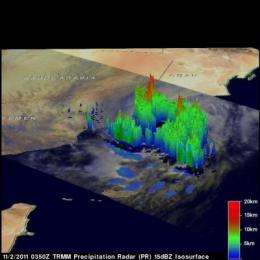
This 3-D image from the TRMM satellite was captured on Nov. 2, 2011 at 0350 UTC (11:50 p.m. EDT, Nov. 1). Thunderstorms within Keila were reaching to heights of almost 17km (~10.6 miles). Credit: Credit: SSAI/NASA, Hal Pierce

The TRMM satellite passed directly above a recently formed tropical cyclone in the Arabian Sea on November 2, 2011 at 0350 UTC (11:50 p.m. EDT, Nov. 1). An analysis of rainfall was done using TRMM's Microwave Imager (TMI) and Precipitation Radar (PR) instruments. TRMM data showed that rainfall rates with tropical storm Keila ranged from light to moderate along the south-eastern coast of Oman. Moderate to heavy rainfall was revealed to be spiraling into Keila's center of circulation in the Arabian Sea near the southeastern coast of Oman.

TRMM Precipitation Radar data was used to create a 3-D vertical structure of Tropical Storm Keila. It showed that a few towers near Keila's center were reaching heights of about 13 km (~8.1 miles). Powerful storms were shown in a large feeder band converging into Kelia from the Arabian Sea.

At 1500 UTC (11 a.m. EDT) today, Nov. 2, Tropical Storm Keila had near 35 knots (40 mph). Keila's center was over the Yemen coast and about 630 nautical miles northeast of Aden, Yemen. It was near 17.0 North and 54.9 East. Although Keila was moving at 5 knots (6 mph) to the northeast, a building mid-level ridge (elongated area) of high pressure is building to the north of the storm, and will re-route it to the west-southwest.

Also this morning, infrared data from the Atmospheric Infrared Sounder (AIRS) on NASA's Aqua satellite saw a burst of convection (developing thunderstorms) around the center of circulation and a band of thunderstorms to the south of the center.

Keila is expected to weaken a little as it continues to interact with the coastline, but slowly intensify tomorrow or Friday because of warm .

Keila made landfall early today (Nov. 2) in Oman, and is forecast to track to the west-southwest along the Oman and Yemen coastlines.

Explore further: Long-term warming, short-term variability: Why climate change is still an issue

add to favorites email to friend print save as pdf

Related Stories

NASA caught Tropical Storm Rina forming, strengthening

Oct 24, 2011

NASA's Tropical Rainfall Measuring Mission satellite called "TRMM" and NASA's Aqua satellite captured radar and temperature data that showed Tropical Storm Rina forming in the western Caribbean Sea yesterday. ...

Recommended for you

NASA's BARREL mission launches 20 balloons

10 hours ago

(Phys.org) —In Antarctica in January, 2013 – the summer at the South Pole – scientists released 20 balloons, each eight stories tall, into the air to help answer an enduring space weather question: ...

Power of US tornado dwarfs Hiroshima bomb

11 hours ago

Wind, humidity and rainfall combined precisely to create Monday's massive killer tornado in Oklahoma. The awesome amount of energy released dwarfed the power of the atomic bomb that leveled Hiroshima.

Origins of human culture linked to rapid climate change

17 hours ago

Rapid climate change during the Middle Stone Age, between 80,000 and 40,000 years ago, during the Middle Stone Age, sparked surges in cultural innovation in early modern human populations, according to new research.

User comments : 0

More news stories

NASA's BARREL mission launches 20 balloons

(Phys.org) —In Antarctica in January, 2013 – the summer at the South Pole – scientists released 20 balloons, each eight stories tall, into the air to help answer an enduring space weather question: ...

If you can remember it, you can remember it wrong

(Medical Xpress)—Native peoples in regions where cameras are uncommon sometimes react with caution when their picture is taken. The fear that something must have been stolen from them to create the photo ...

B vitamins could delay dementia

(Medical Xpress)—Despite spending billions of dollars on research and development, drug companies have been unable to come up with effective treatments for dementia and Alzheimer's Disease (AD). Now, A. ...