New Triassic Diapsid reptile found in Southwestern China
November 21, 2011

New Triassic Diapsid reptile found in Southwestern China

Enlarge

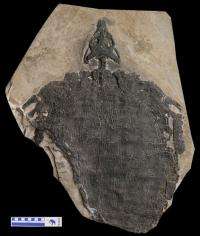
The holotype of Sinosaurosphargis yunguiensis, gen et sp. nov. (IVPP V 17040), in dorsal view. Credit: LI Chun

Paleontologist LI Chun, Institute of Vertebrate Paleontology and Paleoanthropology (IVPP), Chinese Academy of Sciences, and his research team, reported a new genus and species of marine reptile, Sinosaurosphargis yunguiensis, from the Middle Triassic of Yunnan and Guizhou Provinces, southwestern China, according to a paper published in the Journal of Vertebrate Paleontology, 31(2), 2011.

This new species with closed upper temporal fenestrae has a ventrally open cheek. Its external nares are retracted, and its trunk region is short and of rounded contours. The trunk, neck, and proximal limb segments are covered by shield composed of small osteoderms. The dorsal ribs are broadened and flat, contacting one another along their length. The dorsal vertebrae have elongated, distally expanded transverse processes.

“This new diapsid displays a highly derived postcranial skeletal anatomy convergent on cyamodontid placodonts. It represents the first representative from China of a lineage related to Saurosphargis from the Germanic Muschelkalk, and this find adds further support to the close faunal affinities shared by the Eastern and Western Tethyan realm”, said Dr. Xiao-Chun WU, coauthor, Canadian Museum of Nature, Ottawa.

“Saurosphargis, Sinosaurosphargis, and turtles are the only reptiles known with dorsal ribs transversely broadened to such an extent as to establish an anteroposterior contact with one another, forming a closed dorsal ‘rib basket’ (in turtles in the form of costal plates, integrated into the carapace)”, said Dr. Olivier Rieppel, the corresponding author, curator of the Field Museum, Chicago, “The presence of this rib structure in conjunction with a closed osteoderm covering in Sinosaurosphargis is extremely intriguing, because a derivation of the turtle carapace from an ancestral osteoderm covering has repeatedly been proposed. This scenario of turtle shell evolution conflicts with the absence of osteoderms in the ancestral turtle Odontochelys from the early Late Triassic of southwestern China. However, an alternative interpretation of Odontochelys considers its carapace reduced due to skeletal paedomorphosis as an adaptation to an aquatic mode of life.”

This work was supported mainly by the Major Basic Research Projects of the Ministry of Science and Technology of China, the National Natural Science Foundation of China, and the special grant for fossil excavation and preparation of the

Journal reference: Journal of Vertebrate Paleontology search and more info website

Provided by Institute of Vertebrae Paleontology and Paleoanthropology


Rank not rated yet
Relevant PhysicsForums posts

More news stories

Change in developmental timing was crucial in the evolutionary shift from dinosaurs to birds: study

At first glance, it's hard to see how a common house sparrow and a Tyrannosaurus Rex might have anything in common. After all, one is a bird that weighs less than an ounce, and the other is a dinosaur that ...

Other Sciences / Archaeology & Fossils

created 5 hours ago | popularity 5 / 5 (3) | comments 0 | with audio podcast

Social welfare cuts ultimately come with heavy price, researchers say

(Phys.org) -- Slashing government funding for Medicaid, food stamps and other programs that serve the poor – while politically popular with some lawmakers and many conservatives – may do more harm ...

Other Sciences / Social Sciences

created May 24, 2012 | popularity 4.3 / 5 (17) | comments 154

Ancient Bethlehem seal unearthed in Jerusalem

Israeli archaeologists have discovered a 2,700-year-old seal that bears the inscription "Bethlehem," the Israel Antiquities Authority announced Wednesday, in what experts believe to be the oldest artifact ...

Other Sciences / Archaeology & Fossils

created May 23, 2012 | popularity 3.3 / 5 (15) | comments 24

Dollars and sense: Why are some people morally against tax?

As the U.S. presidential election campaigns heat up, the economic debate is dominated by bailouts, austerity and, inevitably, taxation. Now a new study published in Symbolic Interaction asks why tax is such an important issue ...

Other Sciences / Social Sciences

created May 23, 2012 | popularity 3 / 5 (2) | comments 15

Oldest Jewish archaeological evidence on the Iberian Peninsula

German archaeologists of the Friedrich Schiller University Jena found one of the oldest archaeological evidence so far of Jewish Culture on the Iberian Peninsula at an excavation site in the south of Portugal, ...

Other Sciences / Archaeology & Fossils

created May 25, 2012 | popularity 4.2 / 5 (6) | comments 12


Nvidia trumpets Tegra 3 phone design wins for 2012

(Phys.org) -- Nvidia’s competitive war paint has a name, Tegra 3. On the heels of Nvidia announcements about lowering costs of its Tegra 3 processors and Nvidia-enabled tablets running Android Ice Cream ...

'Unzipped' carbon nanotubes could help energize fuel cells, batteries

Multi-walled carbon nanotubes riddled with defects and impurities on the outside could replace some of the expensive platinum catalysts used in fuel cells and metal-air batteries, according to scientists at ...

T cells 'hunt' parasites like animal predators seek prey, study shows

By pairing an intimate knowledge of immune-system function with a deep understanding of statistical physics, a cross-disciplinary team at the University of Pennsylvania has arrived at a surprising finding: T cells use a movement ...

Computer model used to pinpoint prime materials for efficient carbon capture

When power plants begin capturing their carbon emissions to reduce greenhouse gases – and to most in the electric power industry, it's a question of when, not if – it will be an expensive undertaking.

Land and sea species differ in climate change response: study

(Phys.org) -- Marine and terrestrial species will likely differ in their responses to climate warming, new research by Simon Fraser University and Australia’s University of Tasmania has found.

Scientist: Evolution debate will soon be history

(AP) -- Richard Leakey predicts skepticism over evolution will soon be history. Not that the avowed atheist has any doubts himself.