Thai floods ripple through global supply chain
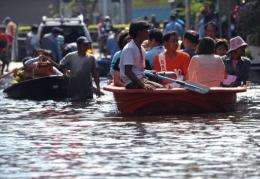
Thailand's worst floods in decades may gradually be subsiding but ripples will be felt by companies and consumers for months to come, analysts say, underlining the fragility of the global supply chain.
Severe flooding since October, which has left hundreds of people dead, has also hurt a wide range of industries in the production hub, particularly the automotive and computer hard-disk drive (HDD) sectors.
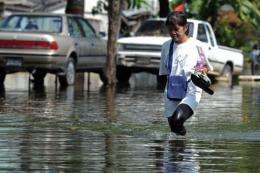
The consequences have been global, hitting companies such as personal computer maker Dell, HDD makers Toshiba and Western Digital, and auto giants Toyota and Ford.
As with supply chain woes after Japan's March earthquake, analysts say the Thai disaster raises questions as to how well companies understand their supply networks for essential parts, and whether risks could be better managed.
However, "companies are limited in what they can do because possessing extra inventory pressures corporate earnings and can heighten risk," said Masaki Nakamura, analyst at MM Research Institute in Tokyo.
In particular, the "just-in-time" delivery system pioneered in Japan and often used in the technology and car sectors to deliver components and raw materials only when needed is vulnerable to such shocks.
"While the basic concept behind 'just-in-time' will remain unchanged, firms will now further reduce production risks" by establishing facilities elsewhere after the floods, said Toru Nishihama, senior economist at Dai-Ichi Life Research Institute.
Thai factories supply about 40 percent of the world HDD market and while analysts do not see much of an impact on PC sales in the Christmas holiday shopping season, conditions will remain tight into 2012.
"During the Christmas season, consumers may not see too much in terms of price increases for PCs" because components for those goods were pre-ordered in the previous quarter, said IHS iSuppli analyst Fang Zhang.
"However, if they need to purchase external HDDs, they will see a big price increase."
In Tokyo's Akihabara electronics district, signs can be seen in shops selling HDDs calling on buyers to purchase now to beat price hikes. Others have stopped selling altogether.
"We can't buy HDD stocks as prices are four to five times higher than normal," said Yu Sugawara, a buyer at Hamada Electrical Equipment Manufacturer.
"Customers won't buy at higher prices, so we can't pass on higher costs through retail prices. We've stopped selling hard disks rather than squeezing our business."
The flooding has made a bad year worse for Japanese firms that were already fighting to restore output after the March earthquake and tsunami, and as they grapple with a profit-eroding strong yen.
By late October more than 400 Japanese companies suspended operations or lowered output due to the Thai floods that claimed more than 560 lives and damaged millions of homes and livelihoods.
Japan is Thailand's biggest foreign investor. The southeast Asian nation's industrial zones and quality infrastructure have attracted Japanese firms looking to escape higher corporate tax and labour costs.
Nevertheless, Indonesia, Vietnam and India look set to receive more investment from Japanese firms than Thailand next year as companies look to ease production concentration risks, Dai-Ichi's Nishihama said.
In September Toyota said global motor vehicle production had recovered to normal after it hired thousands of temporary workers to make up for lost output following the March quake.
But it was forced to halt its three assembly plants in Thailand in early October due to the flooding and will not reopen them until November 21. Toyota and Honda withdrew their annual earnings forecasts as they assess the damage.
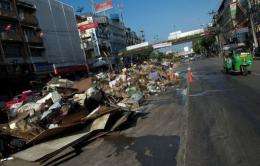
Automakers Nissan and Mitsubishi Motors and electrical firms Pioneer, Sony, Canon and Nikon were also forced to adjust global production due to the Thai plant shutdowns and supply woes.
Some companies in the flooded Ayutthaya industrial zone about 80 kilometres (50 miles) upriver of Bangkok have at least been able to send in divers to retrieve hardware containing crucial data as waters there gradually recede.
While limited production has restarted at some facilities away from the floods, analysts warn the effects of the disaster may last longer than Japan's earthquake and tsunami.
"Japanese companies could start restoration about two months after the tsunami," said Nishihama.
"But with facilities still flooded in Thailand, it is harder to predict when production can return to normal."
(c) 2011 AFP


