Terminator-style info-vision takes step towards reality
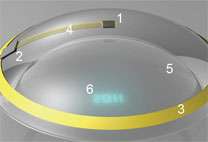
The streaming of real-time information across your field of vision is a step closer to reality with the development of a prototype contact lens that could potentially provide the wearer with hands-free information updates.
In a study published today in IOP's Journal of Micromechanics and Microengineering, researchers constructed a computerised contact lens and demonstrated its safety by testing it on live eyes. There were no signs of adverse side effects.
At the moment, the contact lens device contains only a single pixel but the researchers see this as a "proof-of-concept" for producing lenses with multiple pixels which, in their hundreds, could be used to display short emails and text messages right before your eyes.
The device could overlay computer-generated visual information on to the real world and be of use in gaming devices and navigation systems. It could also be linked to biosensors in the user's body to provide up-to-date information on glucose or lactate levels.
The contact lens, created by researchers at the University of Washington and Aalto University, Finland, consisted of an antenna to harvest power sent out by an external source, as well as an integrated circuit to store this energy and transfer it to a transparent sapphire chip containing a single blue LED.
One major problem the researchers had to overcome was the fact that the human eye, with its minimum focal distance of several centimetres, cannot resolve objects on a contact lens. Any information projected on to the lens would probably appear blurry.
To combat this, the researchers incorporated a set of Fresnel lenses into the device; these are much thinner and flatter than conventional bulky lenses, and were used here to focus the projected image on to the retina.
After testing the contact lens in free space, it was fitted to the eye of a rabbit, under the strict guidelines for animal use in the laboratory, to evaluate the effect of wearing the contact lens on the cornea and the body in general. In addition to visualising techniques, a fluorescent dye was added to the eye of the rabbit to test for any abrasion or thermal burning.
After demonstrating the operation and safety of the contact, the researchers state that significant improvements are necessary to produce fully functional, remotely powered, high-resolution displays. For instance, the device could be wirelessly powered in free space from approximately one metre away, but this was reduced to about two centimetres when placed on the rabbit's eye.
Co-author of the study, Professor Babak Praviz, said "We need to improve the antenna design and the associated matching network and optimize the transmission frequency to achieve an overall improvement in the range of wireless power transmission.
"Our next goal, however, is to incorporate some predetermined text in the contact lens."
More information: A single-pixel wireless contact lens display, Lingley A R et al 2011 J. Micromech. Microeng. 21 125014 http://iopscience. … 21/12/125014
Journal reference:
Journal of Micromechanics and Microengineering
Provided by
Institute of Physics
-
From lemons to lemonade: Reaction uses carbon dioxide to make carbon-based semiconductor,
32 comments
-
Thioridazine kills cancer stem cells in human while avoiding toxic side-effects of conventional cancer treatments,
3 comments
-
SpaceX private rocket blasts off for space station (Update),
42 comments
-
Climate scientists say they have solved riddle of rising sea,
31 comments
-
SpaceX capsule has 'new car' smell, astronauts say (Update),
4 comments
-
Need a rigid insulation material???
20 hours ago
-
magnets or EMF in car bumpers to protect from fender bender
May 26, 2012
-
length of wire in a coil of known dimensions?
May 25, 2012
-
India Engineering Powerhouse
May 25, 2012
-
electromagnet core dereference between hard and soft iron
May 25, 2012
-
Measuring water pressure in an open tank
May 24, 2012
- More from Physics Forums - General Engineering
More news stories
Browser wars flare in mobile space
The browser wars are heating up again, but this time the fight is for dominance of the mobile Internet.
12 hours ago |
5 / 5 (2) |
3
Probability of contamination from severe nuclear reactor accidents is higher than expected: study
Catastrophic nuclear accidents such as the core meltdowns in Chernobyl and Fukushima are more likely to happen than previously assumed. Based on the operating hours of all civil nuclear reactors and the number ...
Technology / Energy & Green Tech
May 22, 2012 |
3.6 / 5 (22) |
56
|
HyperSolar shows dirty water no barrier to power world
(Phys.org) -- The Santa Barbara, California, company, HyperSolar, is set to transparently share the ups and downs of its research experiences toward the companys ultimate vision, successfully producing ...
SpotterRF debuts Radar Backpack Kit (w/ Video)
(Phys.org) -- SpotterRF has announced a special radar backpack kit designed to enhance situational awareness for soldiers on the ground. The company says its special radar is designed for warfighters as part ...
Tesla to launch electric sedan in US on June 22
Tesla Motors said Tuesday it would begin deliveries of "the world's first premium electric sedan" on June 22, slightly ahead of schedule.
Technology / Energy & Green Tech
May 22, 2012 |
4.5 / 5 (12) |
18
Nvidia trumpets Tegra 3 phone design wins for 2012
(Phys.org) -- Nvidias competitive war paint has a name, Tegra 3. On the heels of Nvidia announcements about lowering costs of its Tegra 3 processors and Nvidia-enabled tablets running Android Ice Cream ...
'Unzipped' carbon nanotubes could help energize fuel cells, batteries
Multi-walled carbon nanotubes riddled with defects and impurities on the outside could replace some of the expensive platinum catalysts used in fuel cells and metal-air batteries, according to scientists at ...
T cells 'hunt' parasites like animal predators seek prey, study shows
By pairing an intimate knowledge of immune-system function with a deep understanding of statistical physics, a cross-disciplinary team at the University of Pennsylvania has arrived at a surprising finding: T cells use a movement ...
Computer model used to pinpoint prime materials for efficient carbon capture
When power plants begin capturing their carbon emissions to reduce greenhouse gases and to most in the electric power industry, it's a question of when, not if it will be an expensive undertaking.
Change in developmental timing was crucial in the evolutionary shift from dinosaurs to birds: study
At first glance, it's hard to see how a common house sparrow and a Tyrannosaurus Rex might have anything in common. After all, one is a bird that weighs less than an ounce, and the other is a dinosaur that ...
Land and sea species differ in climate change response: study
(Phys.org) -- Marine and terrestrial species will likely differ in their responses to climate warming, new research by Simon Fraser University and Australia’s University of Tasmania has found.
Nov 21, 2011
Rank: 5 / 5 (4)
Nov 21, 2011
Rank: not rated yet
Nov 21, 2011
Rank: 5 / 5 (1)
I always thought that something like a hockey half visor would be awesome for a combat helmet. This kind of system with that would be awesome. I think that's the kind of thing pilot helmets have now.
Although this may be more aimed at the civilian market where the unobtrusive nature of contact lenses would likely be preferred.
Nov 21, 2011
Rank: not rated yet
Nov 22, 2011
Rank: not rated yet
Nov 22, 2011
Rank: 5 / 5 (1)
Nov 22, 2011
Rank: not rated yet
I am not all Doom and gloom though --once the pixel density gets good enough we are talking IR (or UV vision - is that even useful) anytime you need it. Acurate distancing to target - Tiger Woods here we come -- or vision enhancement such as zooming in on a target -- speaking of IR if used or hacked well these could see through clothes much like the first cameras that has night vision. And great augmented reality information -- the Japanese would go crazy for this.
And if it gets hacked you can just through away your contacts and buy a new pair and stop looking a tthose dirty pictures that carry visual viruses -- oh now thats a thought...
Nov 22, 2011
Rank: not rated yet
Nov 22, 2011
Rank: 5 / 5 (1)
Still though, AR in public is going to be strange, just like when bluetooth headsets came out, I started wondering where all the schizo's came from suddenly...I didn't realize they were talking on the phone. I would think that to a non-user of AR standing in a room full of people using AR, it's going to look mighty strange o,O
Nov 22, 2011
Rank: not rated yet
I hope that we will have HD resolution in lenses screens before 2020
Nov 22, 2011
Rank: not rated yet
We need entire eyes with zoom and filming capabilities.
Nov 22, 2011
Rank: not rated yet
Can you imagine the fun that some kids (often early adopters) will have with this before it catches on? Cheating on tests (mentioned above) will probably be rampant for a short time before the staff starts to figure it out. Then there will be some interesting social changes.
Nov 23, 2011
Rank: 5 / 5 (1)