Team sequencing 1,000 fungal genomes
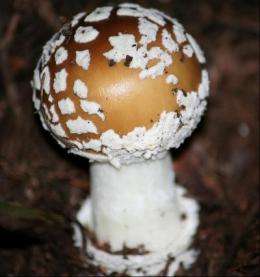
The Amanita mushroom, seen here growing in a forest in Oregon, is a fungus. The white material on the mushroom represents patches or warts that remain when, as part of its development, this type of fungus breaks through the tissue enclosing the entire button mushroom. Credit: Stajich lab, UC Riverside.
A 79-year-old collection of fungal cultures and the U.S. Forest Service's Northern Research Station are part of a team that will sequence 1,000 fungal genomes in the next 5 years.
Dan Lindner, a research plant pathologist with the Northern Research Station's Center for Forest Mycology Research (CFMR), is one of 13 scientists participating in the '1000 Fungal Genomes' project, which in collaboration with the Department of Energy's (DOE) Joint Genome Institute will sequence two species from every known fungal family. The project is a first step in creating an encyclopedia of all fungi, which will one day help researchers understand not only what they do, but how fungi operate.
The '1000 Fungal Genomes' project was one of 41 research projects awarded funding through the Department of Energy's 2012 Community Sequencing Program (CSP), the DOE announced November 3.
The CFMR will provide approximately 200 of the 1,000 species that will be sequenced, with the remaining 800 species provided by four other major culture collections from around the world. Established in 1932, the CFMR's culture collection includes 20,000 cultures from 1,600 species of fungi. "It's an incredible resource," Lindner said. "As far as we know, it's the world's largest collection of wood-inhabiting fungi."
The CFMR culture collection is comprised mainly of Basidiomycetes, or club fungi, which includes the types of fungi that form mushrooms. These fungi play many critical roles in forests, from species that protect tree roots to species that decompose wood to destructive forest pathogens that actively kill trees. Researchers at the CFMR will grow the fungi and isolate the DNA for sequencing by the DOE's Joint Genome Institute.
Fungi are prevalent, hard working, and largely unknown despite their importance to everything from carbon cycling to production of life-saving drugs, including "old-fashioned" wonder drugs such as penicillin as well as best sellers such as the cholesterol lowering statins and the immunosuppresant ciclosporins, which made organ transplants possible. Fungi are also needed for the production of quality of life products like chocolate, beer and specialty cheeses, such as brie and gorgonzola. There are an estimated 1 million to 1.5 million species of fungi; only about 100,000 species have a name. "They are so important in so many ways, and we have so much to learn about them," Lindner said. "We know the tip of the iceberg."
Provided by
USDA Forest Service
-
From lemons to lemonade: Reaction uses carbon dioxide to make carbon-based semiconductor,
32 comments
-
Thioridazine kills cancer stem cells in human while avoiding toxic side-effects of conventional cancer treatments,
3 comments
-
SpaceX private rocket blasts off for space station (Update),
42 comments
-
Climate scientists say they have solved riddle of rising sea,
31 comments
-
SpaceX capsule has 'new car' smell, astronauts say (Update),
4 comments
-
What would stain as translucent on light-coloured fabric?
May 26, 2012
-
How do I identify different bacteria on culture plates?
May 26, 2012
-
Why Do Dogs do Strange things...
May 25, 2012
-
What does exophillic and endophillic mean in terms of mosquito and their control?
May 24, 2012
-
Semen stains glows under black lights (uv light)?
May 23, 2012
-
Question on Human Chromosome 2
May 23, 2012
- More from Physics Forums - Biology
More news stories
Scientist: Evolution debate will soon be history
(AP) -- Richard Leakey predicts skepticism over evolution will soon be history. Not that the avowed atheist has any doubts himself.
23 hours ago |
3.5 / 5 (20) |
87
Manufacturing genes to attack flu virus
An international research team has manufactured a new protein that can combat deadly flu epidemics.
5 hours ago |
not rated yet |
0
|
More plant species responding to global warming than previously thought
(Phys.org) -- Far more wild plant species may be responding to global warming than previous large-scale estimates have suggested.
May 22, 2012 |
4.6 / 5 (14) |
18
|
For monogamous sparrows, it doesn't pay to stray (but they do it anyway)
It's quite common for a female song sparrow to stray from her breeding partner and mate with the male next door, but a new study shows that sleeping around can be costly.
May 22, 2012 |
5 / 5 (2) |
8
|
Thousands of shellfish found dead in Peru
Thousands of crustaceans were found dead off the coast of Lima following the mystery mass death of dolphins and pelicans, the Peruvian Navy said Friday.
May 26, 2012 |
4.7 / 5 (7) |
7
Nvidia trumpets Tegra 3 phone design wins for 2012
(Phys.org) -- Nvidias competitive war paint has a name, Tegra 3. On the heels of Nvidia announcements about lowering costs of its Tegra 3 processors and Nvidia-enabled tablets running Android Ice Cream ...
'Unzipped' carbon nanotubes could help energize fuel cells, batteries
Multi-walled carbon nanotubes riddled with defects and impurities on the outside could replace some of the expensive platinum catalysts used in fuel cells and metal-air batteries, according to scientists at ...
T cells 'hunt' parasites like animal predators seek prey, study shows
By pairing an intimate knowledge of immune-system function with a deep understanding of statistical physics, a cross-disciplinary team at the University of Pennsylvania has arrived at a surprising finding: T cells use a movement ...
Computer model used to pinpoint prime materials for efficient carbon capture
When power plants begin capturing their carbon emissions to reduce greenhouse gases and to most in the electric power industry, it's a question of when, not if it will be an expensive undertaking.
Change in developmental timing was crucial in the evolutionary shift from dinosaurs to birds: study
At first glance, it's hard to see how a common house sparrow and a Tyrannosaurus Rex might have anything in common. After all, one is a bird that weighs less than an ounce, and the other is a dinosaur that ...
Land and sea species differ in climate change response: study
(Phys.org) -- Marine and terrestrial species will likely differ in their responses to climate warming, new research by Simon Fraser University and Australia’s University of Tasmania has found.