Stanford team shows Peruvian villagers how to protect adobe buildings from earthquake collapse
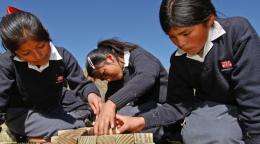
High on a mountainside in the Peruvian Andes – 9,000 feet above sea level – sits a modest adobe schoolhouse that is a lot safer for students and teachers than it was six months ago, thanks in part to the efforts of some Stanford students and their instructors.
The Stanford group was a partner in a project aimed at teaching rural Peruvians about the dangers that earthquakes pose to adobe buildings and giving them the knowledge and skills to retrofit the buildings to make them less prone to collapse.
Adobe – a mixture of dirt, water and straw – is a common building material throughout the Andes. But while adobe has the advantage of being easy to make from locally available materials, it is also extremely heavy, and walls built of adobe bricks are easily toppled during the severe shaking of a major earthquake.
Considered one of the most seismically active regions in the world, Peru has experienced eight earthquakes of magnitude 7.5 or greater since 1900. Over that same span, California – considered the most seismically active part of the lower United States – has experienced only one.
It's the buildings, not the earthquakes
"We tend to think of earthquakes killing people, but really what kills people are manmade structures that are shaken by earthquakes," said Eduardo Miranda, a Stanford associate professor of civil and environmental engineering involved in the project.
"With adobe, it is a deadly combination of extremely poor material, in terms of stability, together with extremely large earthquakes, so the risk is huge."
Some of the highest death tolls from earthquakes worldwide are due to adobe structures collapsing.
The Stanford group partnered with several organizations in Peru, as well as GeoHazards International, a Palo Alto-based nonprofit organization that works around the world to reduce the danger from geologic hazards.
The organizations selected the village of Chocos, about a 7-hour drive from the capital city of Lima over what Stanford graduate student Matt Bussman described as "some pretty death-defying roads."
A principal Peruvian partner was the Pontifical Catholic University of Peru, where researchers have been working on various techniques for strengthening adobe buildings. The school retrofit involved wrapping the walls in sheets of geomesh, a molded plastic grid resembling construction or chain link fencing. Geomesh is commonly used for stabilizing slopes and preventing soil erosion.
Partners in Peru
The design of the retrofit was spearheaded by the partners in Peru. The Stanford students focused on the outreach aspect – how best to teach the villagers the hazard they faced and how to implement the solution. In classes, the students developed teaching tools for use by the volunteers who would go to Chocos in the summer.
The volunteers arrived in June. On their first night in town, they put on a movie night, to introduce themselves and the project to the villagers. Prior to showing the animated Disney film Tangled, they showed some short videos created by the Stanford students, illustrating the danger of adobe construction collapsing during an earthquake.
Using wooden blocks to stand in for adobe bricks, the students had constructed a model building on a tabletop, and then simulated an earthquake by shaking the table until the model collapsed. The next video clip featured two model buildings side by side, but on one the walls had been covered with mosquito netting to simulate the geomesh.
When the table started shaking again, the unreinforced "adobe" building again collapsed. But the "retrofitted" one held up with only some cracks in the walls.
"I can confidently say that video was very effective," said Veronica Cedillos, a Stanford master's alumna who works for GeoHazards International and managed the Chocos project. As evidence, she cited an interaction with one of the villagers about a week later.
"This little 5-year-old Peruvian boy saw us working on another presentation, pointed to a picture of an adobe building, and said, 'That building, it's going to fall.'
"And we said, 'Really, how do you know that?'
"And he said, 'It doesn't have geomesh.'"
Movie night
The whole evening was such a hit that "movie night" became a regular event. And the little boy became an almost daily visitor to the retrofit project headquarters, bringing friends along and asking to see the video again and again.
After some training, the villagers received training in how to do the work and dug in.
The first step was to tear the old roof from the schoolhouse, followed by removing all the old stucco that was plastered over the adobe walls. A trench was dug around the building, where a new concrete foundation would be poured.
After tuckpointing the walls, geomesh was put on.
The workers draped it over the top of the walls and embedded it firmly into the new concrete foundation – just like the mosquito netting in the students' video.
As work progressed, at each movie night, the Stanford team showed a video explaining the progress that had been made during the week.
By the time the project was complete in August, word had circulated, and the final ceremonies were attended by representatives from several other villages, as well as government officials.
"One of the main goals of this project was to create a model that would be replicated in other villages," said Greg Deierlein, a Stanford professor of civil and environmental engineering involved with the project.
"We think that these relatively modest – in terms of cost – retrofits can make a huge difference in terms of reducing the number of fatalities that would occur from an earthquake that is very possible in this part of Peru."
Provided by Stanford University


