All systems go for next communication spacecraft
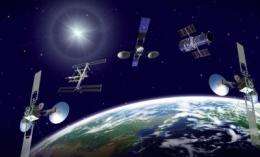
Three TDRS satellites, the International Space Station (ISS) and Hubble Space Telescope orbit a blue-green Earth in this artist's concept. The TDRS network facilitates around the clock communication access between ground stations and other satellites and the ISS. Credit: NASA/Goddard Space Flight Center
The most recent evaluations of NASA's Tracking and Data Relay Satellite (TDRS) project confirmed all systems go for a third generation upgrade of the orbiting communications network. TDRS-K is scheduled for launch aboard an Atlas V rocket from Cape Canaveral, Florida in the fall of 2012.
Approval to move forward came during a recent Agency Project Management Council (APMC) meeting at NASA Headquarters. "I am very proud of the entire TDRS civil servant and contractor team for successfully completing this milestone and demonstrating that the TDRS project is ready to proceed into the integration phase," said Jeff Gramling, TDRS Project Manager. "I am excited to see the TDRS-K satellite enter the thermal vacuum chamber and begin environmental testing." Testing will occur within the Boeing Space Systems Facility in El Segundo, California.
APMC approval allows the project to enter Phase D that will include spacecraft integration and testing. During this phase the spacecraft reflectors will be mounted, the thermal panels and batteries will be installed before the spacecraft will have to endure the rigors of the vibration and acoustic testing. Finally, the spacecraft must pass a pre-ship review prior to being transported to Florida for launch.
Prior to the APMC approval, the project successfully completed a combined Pre-Environment Review (PER) and Systems Integration Review (SIR) in August of this year. The SIR is a significant milestone in the NASA mission lifecycle. During the upcoming environmental test phase, various segments and subsystems are scrutinized for their viability under the same harsh conditions they will endure within the vacuum of space.
"Successful completion of the environmental testing phase of the project will be the last step before we ship the TDRS-K spacecraft to the launch site," said Dave Littmann, TDRS Deputy Project Manager. "Through a rigorous testing program, we will ensure this satellite, once on-orbit, is capable of meeting its functional and performance requirements, to provide reliable services to the customers of NASA's Space Network."
This next generation space communications satellite is part of a follow-on spacecraft fleet being developed and deployed to replenish NASA's Space Network. The TDRS Project Office at Goddard Space Flight Center manages the TDRS development effort. TDRS is the responsibility of the Space Communications and Navigation (SCaN) office within the Human Exploration and Operations (HEO) Mission Directorate at NASA Headquarters in Washington D.C. Operations of the network is the responsibility of the Space Network Project at Goddard.
In December 2007, NASA signed a contract for Boeing Space Systems to build two, third generation TDRS spacecraft for launch in 2012 and 2013. Within the contract were the required modifications that will enable the White Sands Complex ground system to support the new spacecraft.
The launch of TDRS-K will begin the replenishment of the fleet through the development and deployment of the next generation spacecraft. These satellites will ensure NASA's Space Network continues to provide around-the-clock, high throughput communications services to NASA's missions and serving the scientific community and human spaceflight program for years to come.
Provided by
NASA's Goddard Space Flight Center
-
From lemons to lemonade: Reaction uses carbon dioxide to make carbon-based semiconductor,
32 comments
-
Thioridazine kills cancer stem cells in human while avoiding toxic side-effects of conventional cancer treatments,
3 comments
-
SpaceX private rocket blasts off for space station (Update),
42 comments
-
Climate scientists say they have solved riddle of rising sea,
31 comments
-
SpaceX capsule has 'new car' smell, astronauts say (Update),
4 comments
-
Distance of planets from stars and revolution
5 hours ago
-
revamping general concept and cosmological principle
May 25, 2012
-
Transiting Exoplanet Light Curve
May 25, 2012
-
Math behind Theoretical Physics
May 24, 2012
-
Do we know whats at the center of galaxies yet?
May 23, 2012
-
Structure of the Milky Way?
May 20, 2012
- More from Physics Forums - General Astronomy
More news stories
Land and sea species differ in climate change response: study
(Phys.org) -- Marine and terrestrial species will likely differ in their responses to climate warming, new research by Simon Fraser University and Australia’s University of Tasmania has found.
3 hours ago |
3.7 / 5 (3) |
2
|
Yale study concludes public apathy over climate change unrelated to science literacy
Are members of the public divided about climate change because they don't understand the science behind it? If Americans knew more basic science and were more proficient in technical reasoning, would public consensus match ...
5 hours ago |
4.8 / 5 (4) |
11
|
10 million years needed to recover from mass extinction
It took some 10 million years for Earth to recover from the greatest mass extinction of all time, latest research has revealed.
Space & Earth / Earth Sciences
5 hours ago |
5 / 5 (3) |
1
|
Sophisticated simulations predict future warming
The chances of our planet being hit by a global warming of 3 degrees Celsius by 2050 is as likely as it being hit by an increase of 1.4 degrees, new research shows. Presented in the journal Nature Geoscience, the British study ...
Space & Earth / Earth Sciences
May 22, 2012 |
4.4 / 5 (9) |
51
Aliens don't want to eat us, says former SETI director
Alien life probably isnt interested in having us for dinner, enslaving us or laying eggs in our bellies, according to a recent statement by former SETI director Jill Tarter.
Space & Earth / Space Exploration
May 25, 2012 |
4.4 / 5 (14) |
40
Nvidia trumpets Tegra 3 phone design wins for 2012
(Phys.org) -- Nvidias competitive war paint has a name, Tegra 3. On the heels of Nvidia announcements about lowering costs of its Tegra 3 processors and Nvidia-enabled tablets running Android Ice Cream ...
'Unzipped' carbon nanotubes could help energize fuel cells, batteries
Multi-walled carbon nanotubes riddled with defects and impurities on the outside could replace some of the expensive platinum catalysts used in fuel cells and metal-air batteries, according to scientists at ...
T cells 'hunt' parasites like animal predators seek prey, study shows
By pairing an intimate knowledge of immune-system function with a deep understanding of statistical physics, a cross-disciplinary team at the University of Pennsylvania has arrived at a surprising finding: T cells use a movement ...
Computer model used to pinpoint prime materials for efficient carbon capture
When power plants begin capturing their carbon emissions to reduce greenhouse gases and to most in the electric power industry, it's a question of when, not if it will be an expensive undertaking.
Change in developmental timing was crucial in the evolutionary shift from dinosaurs to birds: study
At first glance, it's hard to see how a common house sparrow and a Tyrannosaurus Rex might have anything in common. After all, one is a bird that weighs less than an ounce, and the other is a dinosaur that ...
Scientist: Evolution debate will soon be history
(AP) -- Richard Leakey predicts skepticism over evolution will soon be history. Not that the avowed atheist has any doubts himself.