Soybean adoption came early by many cultures, archaeologists say
November 17, 2011

Soybean adoption came early by many cultures, archaeologists say

Enlarge

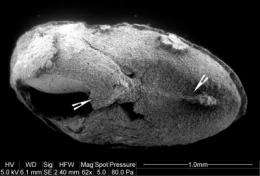
Shown is a charred soybean found at a site at Jinju, South Korea. The specimen was dated to 4,200 years ago. Credit: Courtesy of Gyoung-Ah Lee

Human domestication of soybeans is thought to have first occurred in central China some 3,000 years ago, but archaeologists now suggest that cultures in even earlier times and in other locations adopted the legume (Glycine max).

Comparisons of 949 charred samples from 22 sites in northern China, Japan and South Korea -- found in ancient households including hearths, flooring and dumping pits -- with 180 modern charred and unburned samples were detailed in the Nov. 4 edition of the online journal , a publication of the Public Library of Science. The findings, say lead author Gyoung-Ah Lee, an archaeologist at the University of Oregon, add a new view to long-running assumptions about soybean domestication that had been based on genetic and historical records.

"Preserved beans have been carbonized, and that distorts the sizes," Lee said. "So we experimented with modern soybeans, charring them to compare them with historical samples. All the different sizes and shapes of soybeans may indicate different efforts in different times by different cultural groups in different areas."

Experts argue that larger beans reflect domestication, but the between smaller wild-type soybeans and larger hybridized versions is not understood, Lee said. Small-seeded soybeans indicating wild-type soybeans date to 9,000 years ago. Historical evidence to date shows a close relationship between soybeans and use in China during the Zhou Dynasty, about 2,000 years ago. The new study moves domestication back to perhaps 5,500 years ago.

"Soybeans appeared to be linked to humans almost as soon as villages were established in northern China," said co-author Gary Crawford, a professor of anthropology at the University of Toronto Mississauga, in a news release. "Soybean seems to be a plant that does well in human-impacted habitats. In turn, humans began to learn how tasty soybean was and how useful it was."

Today, of course, soybeans are used as and to make cooking oil, tofu, tempeh, edamame and protein powder for human consumption.

The new archaeological evidence, Lee says, should be a springboard for , crop scientists and plant geneticists to collaborate on understanding cultural contributions, which may lead them to better soybean characteristics. Cultural knowledge, she said, could fill in gaps that relate to domestication and genetic changes of the legume.

"I think one contribution that archaeologists can make is how peoples in ancient times contributed to our heritage of this viable crop and how we can trace their efforts and the methods to help guide us to make even better crops today," Lee said.

In Lee's homeland of , the research team uncovered evidence for a cultural selection for larger sized soybeans at 3,000 years ago. The evidence for such dating, which also surfaced in Japan, indicates that the farming of soybeans was much more widespread in times much earlier than previously assumed, researchers concluded.

Provided by University of Oregon search and more info website


Rank not rated yet
Relevant PhysicsForums posts

More news stories

Change in developmental timing was crucial in the evolutionary shift from dinosaurs to birds: study

At first glance, it's hard to see how a common house sparrow and a Tyrannosaurus Rex might have anything in common. After all, one is a bird that weighs less than an ounce, and the other is a dinosaur that ...

Other Sciences / Archaeology & Fossils

created 5 hours ago | popularity 5 / 5 (3) | comments 0 | with audio podcast

Social welfare cuts ultimately come with heavy price, researchers say

(Phys.org) -- Slashing government funding for Medicaid, food stamps and other programs that serve the poor – while politically popular with some lawmakers and many conservatives – may do more harm ...

Other Sciences / Social Sciences

created May 24, 2012 | popularity 4.3 / 5 (17) | comments 154

Ancient Bethlehem seal unearthed in Jerusalem

Israeli archaeologists have discovered a 2,700-year-old seal that bears the inscription "Bethlehem," the Israel Antiquities Authority announced Wednesday, in what experts believe to be the oldest artifact ...

Other Sciences / Archaeology & Fossils

created May 23, 2012 | popularity 3.3 / 5 (15) | comments 24

Dollars and sense: Why are some people morally against tax?

As the U.S. presidential election campaigns heat up, the economic debate is dominated by bailouts, austerity and, inevitably, taxation. Now a new study published in Symbolic Interaction asks why tax is such an important issue ...

Other Sciences / Social Sciences

created May 23, 2012 | popularity 3 / 5 (2) | comments 15

Oldest Jewish archaeological evidence on the Iberian Peninsula

German archaeologists of the Friedrich Schiller University Jena found one of the oldest archaeological evidence so far of Jewish Culture on the Iberian Peninsula at an excavation site in the south of Portugal, ...

Other Sciences / Archaeology & Fossils

created May 25, 2012 | popularity 4.2 / 5 (6) | comments 12


Nvidia trumpets Tegra 3 phone design wins for 2012

(Phys.org) -- Nvidia’s competitive war paint has a name, Tegra 3. On the heels of Nvidia announcements about lowering costs of its Tegra 3 processors and Nvidia-enabled tablets running Android Ice Cream ...

'Unzipped' carbon nanotubes could help energize fuel cells, batteries

Multi-walled carbon nanotubes riddled with defects and impurities on the outside could replace some of the expensive platinum catalysts used in fuel cells and metal-air batteries, according to scientists at ...

T cells 'hunt' parasites like animal predators seek prey, study shows

By pairing an intimate knowledge of immune-system function with a deep understanding of statistical physics, a cross-disciplinary team at the University of Pennsylvania has arrived at a surprising finding: T cells use a movement ...

Computer model used to pinpoint prime materials for efficient carbon capture

When power plants begin capturing their carbon emissions to reduce greenhouse gases – and to most in the electric power industry, it's a question of when, not if – it will be an expensive undertaking.

Land and sea species differ in climate change response: study

(Phys.org) -- Marine and terrestrial species will likely differ in their responses to climate warming, new research by Simon Fraser University and Australia’s University of Tasmania has found.

Scientist: Evolution debate will soon be history

(AP) -- Richard Leakey predicts skepticism over evolution will soon be history. Not that the avowed atheist has any doubts himself.