Why solar wind is rhombic-shaped?
November 15, 2011

Why solar wind is rhombic-shaped?

Enlarge

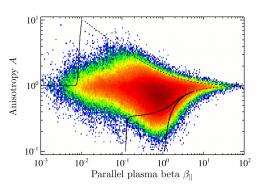
The plasma beta represents the ratio of kinetic to magnetic pressure in the cosmic plasma. The anisotropy is the ratio of the perpendicular and parallel temperatures to the magnetic field lines. The number of measured values is shown in colour (red corresponds to many values, blue to few values). Why the measurements take on the characteristic rhombic shape is explained by a new model by Bochum’s physicists. Source: Physical Review Letters

Why the temperatures in the solar wind are almost the same in certain directions, and why different energy densities are practically identical, was until now not clear.

With a new approach to calculating instability criteria for plasmas, Bochum researchers lead by Prof. Dr. Reinhard Schlickeiser (Chair for IV) have solved both problems at once. They were the first to incorporate the effects of collisions of the solar wind particles in their model. This explains experimental data significantly better than previous calculations and can also be transferred to cosmic plasmas outside our solar system. The scientists report on their findings in .

Temperatures and pressures in the cosmic plasma

The solar wind consists of charged particles and is permeated by a magnetic field. In the analysis of this plasma, researchers investigate two types of pressure: the magnetic pressure describes the tendency of the to repel each other, the kinetic pressure results from the momentum of the particles. The ratio of kinetic to magnetic pressure is called plasma beta and is a measure of whether more energy per volume is stored in magnetic fields or in particle motion. In many cosmic sources, the plasma beta is around the value one, which is the same as energy equipartition. Moreover, in cosmic plasmas near temperature isotropy prevails, i.e. the temperature parallel and perpendicular to the magnetic field lines of the plasma is the same.

Explaining satellite data

For over a decade, the instruments of the near-earth WIND satellite have gathered various solar wind data. When the plasma beta measured is plotted against the temperature anisotropy (the ratio of the perpendicular to the parallel temperature), the data points form a rhombic area around the value one. "If the values move out of the rhombic configuration, the plasma is unstable and the temperature anisotropy and the plasma beta quickly return to the stable region within the rhombus" says Prof. Schlickeiser. However, a specific, detailed explanation of this rhombic shape has, until now, been lacking, especially for low plasma beta.

Collisions in the solar wind

In previous models it was assumed that, due to the low density, the solar wind particles do not directly collide, but only interact via electromagnetic fields. "Such assumptions are, however, no longer justified for small plasma beta, since the damping due to particle collisions needs to be taken into account" explains Dipl.-Phys. Michal Michno. Prof. Schlickeiser's group included this additional damping in their model, which led to new rhombic thresholds i.e. new stability conditions. The Bochum model explains the solar wind data measured significantly better than previous theories.

Universally valid solution

The new model can be applied to other dilute cosmic plasmas which have densities, temperatures and strengths similar to the solar wind. Even if the diagram of temperature and plasma beta does not have exactly the rhombic shape that the researchers found for the , the newly discovered mechanism predicts that the values are always close to one. In this way, the theory also makes an important contribution to the explanation of the energy equipartition in cosmic plasmas outside of our solar system.

More information: R. Schlickeiser, M. J. Michno, D. Ibscher, M. Lazar, T. Skoda (2011): Modified temperature-anisotropy instability thresholds in the solar wind, Physical Review Letters, 107, 201102, doi: 10.1103/PhysRevLett.107.201102

Provided by Ruhr-University Bochum


Rank 5 /5 (1 vote)
Relevant PhysicsForums posts

More news stories

Is a classical electrodynamics law incompatible with special relativity?

(Phys.org) -- The laws of classical electromagnetism that were developed in the 19th century are the same laws that scientists use today. They include Maxwell’s four equations along with the Lorentz la ...

Physics / General Physics

created May 24, 2012 | popularity 4.7 / 5 (18) | comments 43 | with audio podcast feature

Landmark calculation clears the way to answering how matter is formed

(Phys.org) -- An international collaboration of scientists, including Thomas Blum, associate professor of physics, is reporting in landmark detail the decay process of a subatomic particle called a kaon – ...

Physics / General Physics

created May 25, 2012 | popularity 4.3 / 5 (22) | comments 52 | with audio podcast

Lying in wait for WIMPs: Researchers seek to dramatically increase sensitivity of Large Underground Xenon detector

Although it's invisible, dark matter accounts for at least 80 percent of the matter in the universe. No one knows what it is, but most scientists would bet on weakly interacting massive particles, or WIMPs.

Physics / General Physics

created May 23, 2012 | popularity 4 / 5 (7) | comments 18 | with audio podcast

Hawaii lab turns laser-powered bubbles into microrobots

(Phys.org) -- A team of scientists from the University of Hawaii are working on microrobots created from bubbles of air in a saline solution. The bubbles take on their title of “robots” as a laser ...

Physics / General Physics

created May 23, 2012 | popularity 5 / 5 (4) | comments 2 | with audio podcast weblog

Sound increases the efficiency of boiling

Scientists at the Georgia Institute of Technology achieved a 17-percent increase in boiling efficiency by using an acoustic field to enhance heat transfer. The acoustic field does this by efficiently removing vapor bubbles ...

Physics / Soft Matter

created May 24, 2012 | popularity 5 / 5 (2) | comments 2


Stunning image of smallest possible five-ringed structure

Scientists have created and imaged the smallest possible five-ringed structure – about 100,000 times thinner than a human hair – and you'll probably recognise its shape.

'Unzipped' carbon nanotubes could help energize fuel cells, batteries

Multi-walled carbon nanotubes riddled with defects and impurities on the outside could replace some of the expensive platinum catalysts used in fuel cells and metal-air batteries, according to scientists at ...

Change in developmental timing was crucial in the evolutionary shift from dinosaurs to birds: study

At first glance, it's hard to see how a common house sparrow and a Tyrannosaurus Rex might have anything in common. After all, one is a bird that weighs less than an ounce, and the other is a dinosaur that ...

Computer model used to pinpoint prime materials for efficient carbon capture

When power plants begin capturing their carbon emissions to reduce greenhouse gases – and to most in the electric power industry, it's a question of when, not if – it will be an expensive undertaking.

T cells 'hunt' parasites like animal predators seek prey, study shows

By pairing an intimate knowledge of immune-system function with a deep understanding of statistical physics, a cross-disciplinary team at the University of Pennsylvania has arrived at a surprising finding: T cells use a movement ...

Land and sea species differ in climate change response: study

(Phys.org) -- Marine and terrestrial species will likely differ in their responses to climate warming, new research by Simon Fraser University and Australia’s University of Tasmania has found.