Solar power blooms in warren
Nov 18, 2011

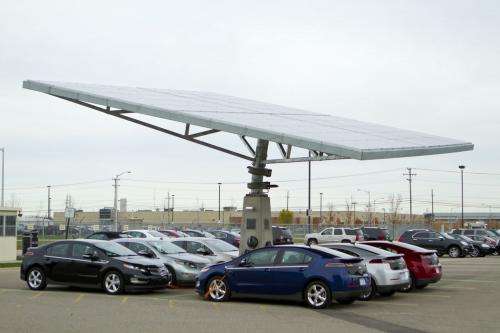
General Motors is introducing a solar charging canopy that moves with the sun. The Tracking Solar Tree is located at GM Company Vehicle Operations.

“We are constantly looking for places where we can add a renewable focus,” said Rob Threlkeld, GM global manager of renewable . “This solar tree is an ideal addition because not only does it provide a space to charge our electric vehicles, but it’s another step in our journey toward cleaner energy use.”

The Tracking Solar Tree, built in America by Envision Solar, features a hybrid multi-axis tracking design which enables the entire canopy to track the , increasing clean renewable energy production by about 25 percent. This structure will produce up to 30,000 kilowatt hours a year and provide enough solar energy to charge six electric vehicles per day.

’ commitment to the environment is clear,” said Desmond Wheatley, president of Envision Solar. “Our tracking Solar Trees are a beautiful and visible embodiment of that commitment. We look forward to deploying many more in the months to come.”

Explore further: Hong Kong launches first electric taxis

add to favorites email to friend print save as pdf

Related Stories

Chevrolet harnesses sun to power volts, dealerships

Jul 29, 2011

Chevrolet is harnessing the power of the sun to install solar-powered electric charging stations for its Volts at dealerships in North America. The Green Zone initiative will generate electricity equivalent ...

Parking lots could become 'solar groves' (w/ Video)

Jul 12, 2010

(PhysOrg.com) -- Architect Robert Noble, who specializes in sustainable design has come up with the idea of turning parking lots into "solar groves" that shade the vehicles, generate electricity, and serve ...

Turning Arizona's dry heat into a comfy chill

Oct 14, 2011

An innovative solar-thermal heating and cooling system installed on top of the UA's Student Recreation Center is expected to harvest almost 200 million kilowatt hours of solar energy per year – enough ...

Recommended for you

Bacteria use hydrogen, carbon dioxide to produce electricity

6 hours ago

Researchers have engineered a strain of electricity-producing bacteria that can grow using hydrogen gas as its sole electron donor and carbon dioxide as its sole source of carbon. Researchers at the University of Massachusetts, ...

German energy shift faces headwinds

23 hours ago

Tense engineers have their eyes peeled on complex colour-coded diagrams on a wall-sized screen that makes their control room look like the inside of a spaceship.

Morocco to harness the wind in energy hunt

May 18, 2013

Morocco is ploughing ahead with a programme to boost wind energy production, particularly in the southern Tarfaya region, where Africa's largest wind farm is set to open in 2014.

Energy-positive with natural ventilation

May 17, 2013

Buildings can be air-conditioned using entirely natural means, without mechanical ventilation systems. This is the claim made by 78-year-old Benjamin Bronsema, who will be awarded his PhD for his thesis on the subject at ...

User comments : 7

Adjust slider to filter visible comments by rank

Display comments: newest first

CapitalismPrevails
1.5 / 5 (2) Nov 18, 2011
Doesn't the average household consume 14,000 kwh a year? But this will charge 6 electric cars in a day?
Pirouette
1.5 / 5 (2) Nov 18, 2011
Doesn't seem very efficient.
ryggesogn2
1 / 5 (1) Nov 18, 2011
Shouldn't 'warren' be capitalized?
kochevnik
3 / 5 (2) Nov 19, 2011
Doesn't seem very efficient.
Compared to what? Heating up the autos and pavement? Relative to that the ratio is infinite.
Eikka
5 / 5 (1) Nov 19, 2011
Doesn't the average household consume 14,000 kwh a year? But this will charge 6 electric cars in a day?


30,000 kWh is roughly 120,000 miles driven, or 20,000 miles per car per year.
Eikka
1 / 5 (1) Nov 19, 2011
20,000 miles is on the upper limits of what an electric car can do in a year, because it would run out of charge on longer day trips. You'd need some special circumstances where you travel e.g. 55 miles every day without fail, or 75 miles for 5 days a week plus ten miles on the weekends, because you can't travel much more than 75 miles a day to pull up the average.

In practice, most electric cars would do 15,000 miles or less in a year according to the idea that EVs are used for commuting and most commute less than 40 miles per day. That makes one solar canopy produce enough energy for eight electric vehicles or more.

Lord_jag
not rated yet Nov 21, 2011
It's 6 cars because 6 cars can park under it.

The next 6 over would have their own tree.

Cars look better in the shade too.

More news stories

AP probe further strains Obama, press rapport

Reports emerged last week that the Department of Justice had secretly obtained two months' worth of phone records of journalists at The Associated Press as part of a larger investigation into a failed al-Qaida ...

German energy shift faces headwinds

Tense engineers have their eyes peeled on complex colour-coded diagrams on a wall-sized screen that makes their control room look like the inside of a spaceship.

Tiny ancient bandicoot shines light on future

(Phys.org) —A 20 million-year-old fossil skull identified as a 'pocket-sized' ancestor of the bandicoot will give insights into the future of Australia's modern endangered animals.

Rise in type 2 diabetes amongst young

The number of young people diagnosed with type 2 diabetes has seen the sharpest rise over the last twenty years compared to a background of a general increase across the board, new University research has ...