Solar concentrator increases collection with less loss
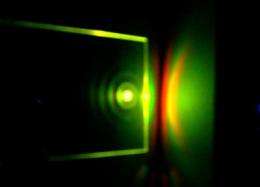
An LSC is illuminated by a laser beam (central spot) resulting in luminescence that is emitted from the edges and projected onto a white business card. The faintly visible concentric rings and different colors of light on the business card result from microcavity effects. Credit: Chris Giebink, Penn State
(PhysOrg.com) -- Converting sunlight into electricity is not economically attractive because of the high cost of solar cells, but a recent, purely optical approach to improving luminescent solar concentrators (LSCs) may ease the problem, according to researchers at Argonne National Laboratories and Penn State.
Using concentrated sunlight reduces the cost of solar power by requiring fewer solar cells to generate a given amount of electricity. LSCs concentrate light by absorbing and re-emiting it at lower frequency within the confines of a transparent slab of material. They can not only collect direct sunlight, but on cloudy days, can collect diffuse light as well. The material then guides the light to the slab's edges, where photovoltaic cells convert the energy to electricity.
"Currently, solar concentrators use expensive tracking systems that need to follow the sun," said Chris Giebink, assistant professor of electrical engineering, Penn State, formerly of Argonne National Laboratory. "If they are a few tenths of a degree off from perfection, the power output of the system drops drastically. If they could maintain high concentration without tracking the sun, they could create electricity more cheaply."
LSCs can do this, potentially concentrating light to the equivalent of more than 100 suns but, in practice, their output has been limited. While LSCs work well when small, their performance deteriorates with increasing size because much of the energy is reabsorbed before reaching the photovoltaics.
Typically, a little bit of light is reabsorbed each time it bounces around in the slab and, because this happens hundreds of times, it adds up to a big problem. The researchers, who included Giebink and Gary Widerrecht and Michael Wasielewski, Argonne-Northwestern Solar Energy Research Center and Northwestern University, note in the current issue of Nature Photonics that "we demonstrate near-lossless propagation for several different chromophores, which ultimately enables a more than twofold increase in concentration ratio over that of the corresponding conventional LSC."
The key to decreasing absorption is microcavity effects that occur when light travels through a small structure with a size comparable to the light's wavelength. These LSCs are made of two thin films on a piece of glass. The first thin film is a luminescent layer that contains a fluourescent dye capable of absorbing and re-emitting sunlight. This sits on a low refractive index layer that looks like air from the light's point of view. This combination makes the microcavity and changing the luminescent layer's thickness across the surface changes the microcavity's resonance. This means that light emitted from one location in the concentrator does not fit back into the luminescent film anywhere else, preventing it from being reabsorbed.
"We were looking for some way to admit the light, but keep it from being absorbed," said Giebink. "One of the things we could change was the shape and thickness of the luminescent layer."
The researchers tried an ordered stair step approach to the surface of the dye layer. They looked at the light output from this new configuration by placing a photovoltaic cell at one edge of the collector and found a 15 percent improvement compared to conventional LSCs.
"Experimentally we are working with devices the size of microscope slides, but we modeled the output for larger, more practical sizes," said Giebink. "Extending out results with the model predicts intensification to 25 suns for a window pane sized collector. This is about two and a half times higher than a conventional LSC."
The researchers do not believe that the stair step approach is the optimal design for these LSCs. A more complicated surface variation is probably even better, but designing that will take more modeling. Other approaches may also include varying the shape of the glass substrate, which would produce a similar effect and potentially be simpler to make.
"We need to find the optimum way to structure this new type of LSC so that it is more efficient but also very inexpensive to make," said Giebink.
Provided by
Pennsylvania State University
-
From lemons to lemonade: Reaction uses carbon dioxide to make carbon-based semiconductor,
32 comments
-
Thioridazine kills cancer stem cells in human while avoiding toxic side-effects of conventional cancer treatments,
3 comments
-
SpaceX private rocket blasts off for space station (Update),
42 comments
-
Climate scientists say they have solved riddle of rising sea,
31 comments
-
SpaceX capsule has 'new car' smell, astronauts say (Update),
4 comments
-
Why does a boiled egg rotates while a raw egg doesn't?
2 hours ago
-
Lightning strike in mindair
2 hours ago
-
Why does light move?
4 hours ago
-
How to calculate the repulsion force between a permanent and an electromagnet?
6 hours ago
-
Why does light allow us to see things?
6 hours ago
-
Room temperature superconductivity
6 hours ago
- More from Physics Forums - General Physics
More news stories
Is a classical electrodynamics law incompatible with special relativity?
(Phys.org) -- The laws of classical electromagnetism that were developed in the 19th century are the same laws that scientists use today. They include Maxwell’s four equations along with the Lorentz la ...
Landmark calculation clears the way to answering how matter is formed
(Phys.org) -- An international collaboration of scientists, including Thomas Blum, associate professor of physics, is reporting in landmark detail the decay process of a subatomic particle called a kaon ...
May 25, 2012 |
4.3 / 5 (22) |
52
|
Lying in wait for WIMPs: Researchers seek to dramatically increase sensitivity of Large Underground Xenon detector
Although it's invisible, dark matter accounts for at least 80 percent of the matter in the universe. No one knows what it is, but most scientists would bet on weakly interacting massive particles, or WIMPs.
May 23, 2012 |
4 / 5 (7) |
18
|
Hawaii lab turns laser-powered bubbles into microrobots
(Phys.org) -- A team of scientists from the University of Hawaii are working on microrobots created from bubbles of air in a saline solution. The bubbles take on their title of robots as a laser ...
Sound increases the efficiency of boiling
Scientists at the Georgia Institute of Technology achieved a 17-percent increase in boiling efficiency by using an acoustic field to enhance heat transfer. The acoustic field does this by efficiently removing vapor bubbles ...
May 24, 2012 |
5 / 5 (2) |
2
Stunning image of smallest possible five-ringed structure
Scientists have created and imaged the smallest possible five-ringed structure about 100,000 times thinner than a human hair and you'll probably recognise its shape.
'Unzipped' carbon nanotubes could help energize fuel cells, batteries
Multi-walled carbon nanotubes riddled with defects and impurities on the outside could replace some of the expensive platinum catalysts used in fuel cells and metal-air batteries, according to scientists at ...
Change in developmental timing was crucial in the evolutionary shift from dinosaurs to birds: study
At first glance, it's hard to see how a common house sparrow and a Tyrannosaurus Rex might have anything in common. After all, one is a bird that weighs less than an ounce, and the other is a dinosaur that ...
Computer model used to pinpoint prime materials for efficient carbon capture
When power plants begin capturing their carbon emissions to reduce greenhouse gases and to most in the electric power industry, it's a question of when, not if it will be an expensive undertaking.
T cells 'hunt' parasites like animal predators seek prey, study shows
By pairing an intimate knowledge of immune-system function with a deep understanding of statistical physics, a cross-disciplinary team at the University of Pennsylvania has arrived at a surprising finding: T cells use a movement ...
Land and sea species differ in climate change response: study
(Phys.org) -- Marine and terrestrial species will likely differ in their responses to climate warming, new research by Simon Fraser University and Australia’s University of Tasmania has found.
Nov 02, 2011
Rank: not rated yet
Nov 02, 2011
Rank: not rated yet