Shift in ancient diet may explain modern orthodontic problems
November 22, 2011 by Bob Yirka
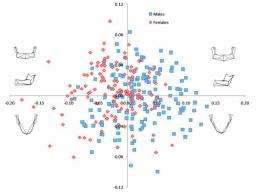
Analysis of sexual dimorphism. PCA of form (rescaled Procrustes variables). Image (c) PNAS, doi: 10.1073/pnas.1113050108 (see the paper for more details)
(PhysOrg.com) -- Many a parent has lamented the crowding of their children’s teeth indicating impending orthodontia bills, but few no doubt have wondered quite as deeply as Noreen von Cramon-Taubadel, an anthropologist from the U.K., on why this seems to be such a common malady for modern people. After some digging, as she explains in her paper published in the Proceedings of the National Academy of Sciences, it might all be due to humans long ago moving from being primarily hunter-gatherers to farmers or more aptly, to societies that eat the crops that farmers produce.
It all comes down, von Cramon-Taubadel says, to the fact that farmed food requires less work in chewing, resulting in less jaw muscle, which over time means shorter jaws. But alas, neither the size nor number of teeth has changed over the same period of time resulting in overcrowding.
von Cramon-Taubadel came to this conclusion after studying skull and associated jaw specimens from eleven different early human populations stored in museums around the world. Of those eleven, five were representative of primarily hunter-gatherer type people’s, while the other six groups primarily relied on food obtained from farming. In her studies, she found that hunter-gatherer groups on the whole tended to have longer jawbones than did those that had resorted to depending on farmed foods. The thinking is, she says, that longer jawbones work better in dealing with hard to chew food, such as meat and some wild vegetation.
The shift from hunting-gathering to farming happened in many areas of the world some 10,000 years ago, and is widely accepted to be one of the main stepping stones to civilization. Many scientists over the years have theorized that the move to farming likely led to shorter jaws, but this is apparently the first time anyone’s thought to actually test the theory.
Realizing that the shorter jaws she’d found in her study of museum specimens could have come about for other reasons, von Cramon-Taubadel next began looking for other ways the specimens could have been correlated, i.e. geography, genetics or weather patterns and could find none. The only thing she could find in common among the groups was the way they obtained their food. Thus, she concludes that it seems reasonable to deduce that or modern dental crowding is likely the result of our ancestors move to farming and the foods we have relied on since then.
More information: Global human mandibular variation reflects differences in agricultural and hunter-gatherer subsistence strategies, PNAS, Published online before print November 21, 2011, doi: 10.1073/pnas.1113050108
Abstract
Variation in the masticatory behavior of hunter-gatherer and agricultural populations is hypothesized to be one of the major forces affecting the form of the human mandible. However, this has yet to be analyzed at a global level. Here, the relationship between global mandibular shape variation and subsistence economy is tested, while controlling for the potentially confounding effects of shared population history, geography, and climate. The results demonstrate that the mandible, in contrast to the cranium, significantly reflects subsistence strategy rather than neutral genetic patterns, with hunter-gatherers having consistently longer and narrower mandibles than agriculturalists. These results support notions that a decrease in masticatory stress among agriculturalists causes the mandible to grow and develop differently. This developmental argument also explains why there is often a mismatch between the size of the lower face and the dentition, which, in turn, leads to increased prevalence of dental crowding and malocclusions in modern postindustrial populations. Therefore, these results have important implications for our understanding of human masticatory adaptation.
Journal reference:
Proceedings of the National Academy of Sciences
© 2011 PhysOrg.com
-
From lemons to lemonade: Reaction uses carbon dioxide to make carbon-based semiconductor,
32 comments
-
Thioridazine kills cancer stem cells in human while avoiding toxic side-effects of conventional cancer treatments,
3 comments
-
SpaceX private rocket blasts off for space station (Update),
42 comments
-
Climate scientists say they have solved riddle of rising sea,
31 comments
-
SpaceX capsule has 'new car' smell, astronauts say (Update),
4 comments
-
What would stain as translucent on light-coloured fabric?
May 26, 2012
-
How do I identify different bacteria on culture plates?
May 26, 2012
-
Why Do Dogs do Strange things...
May 25, 2012
-
What does exophillic and endophillic mean in terms of mosquito and their control?
May 24, 2012
-
Semen stains glows under black lights (uv light)?
May 23, 2012
-
Question on Human Chromosome 2
May 23, 2012
- More from Physics Forums - Biology
More news stories
Change in developmental timing was crucial in the evolutionary shift from dinosaurs to birds: study
At first glance, it's hard to see how a common house sparrow and a Tyrannosaurus Rex might have anything in common. After all, one is a bird that weighs less than an ounce, and the other is a dinosaur that ...
Other Sciences / Archaeology & Fossils
7 hours ago |
5 / 5 (4) |
0
|
Social welfare cuts ultimately come with heavy price, researchers say
(Phys.org) -- Slashing government funding for Medicaid, food stamps and other programs that serve the poor while politically popular with some lawmakers and many conservatives may do more harm ...
Other Sciences / Social Sciences
May 24, 2012 |
4.2 / 5 (20) |
155
Ancient Bethlehem seal unearthed in Jerusalem
Israeli archaeologists have discovered a 2,700-year-old seal that bears the inscription "Bethlehem," the Israel Antiquities Authority announced Wednesday, in what experts believe to be the oldest artifact ...
Other Sciences / Archaeology & Fossils
May 23, 2012 |
3.3 / 5 (15) |
24
Dollars and sense: Why are some people morally against tax?
As the U.S. presidential election campaigns heat up, the economic debate is dominated by bailouts, austerity and, inevitably, taxation. Now a new study published in Symbolic Interaction asks why tax is such an important issue ...
Other Sciences / Social Sciences
May 23, 2012 |
2.3 / 5 (3) |
19
Oldest Jewish archaeological evidence on the Iberian Peninsula
German archaeologists of the Friedrich Schiller University Jena found one of the oldest archaeological evidence so far of Jewish Culture on the Iberian Peninsula at an excavation site in the south of Portugal, ...
Other Sciences / Archaeology & Fossils
May 25, 2012 |
4.2 / 5 (6) |
12
Stunning image of smallest possible five-ringed structure
Scientists have created and imaged the smallest possible five-ringed structure about 100,000 times thinner than a human hair and you'll probably recognise its shape.
'Unzipped' carbon nanotubes could help energize fuel cells, batteries
Multi-walled carbon nanotubes riddled with defects and impurities on the outside could replace some of the expensive platinum catalysts used in fuel cells and metal-air batteries, according to scientists at ...
Computer model used to pinpoint prime materials for efficient carbon capture
When power plants begin capturing their carbon emissions to reduce greenhouse gases and to most in the electric power industry, it's a question of when, not if it will be an expensive undertaking.
T cells 'hunt' parasites like animal predators seek prey, study shows
By pairing an intimate knowledge of immune-system function with a deep understanding of statistical physics, a cross-disciplinary team at the University of Pennsylvania has arrived at a surprising finding: T cells use a movement ...
Land and sea species differ in climate change response: study
(Phys.org) -- Marine and terrestrial species will likely differ in their responses to climate warming, new research by Simon Fraser University and Australia’s University of Tasmania has found.
Yale study concludes public apathy over climate change unrelated to science literacy
Are members of the public divided about climate change because they don't understand the science behind it? If Americans knew more basic science and were more proficient in technical reasoning, would public consensus match ...
Nov 22, 2011
Rank: 5 / 5 (1)
Nov 22, 2011
Rank: not rated yet
Aborigial people who ate their traditional diets had better teeth.
Nov 22, 2011
Rank: 5 / 5 (1)