Sex explains why the fit don't always survive
November 22, 2011

Sex explains why the fit don't always survive

Enlarge

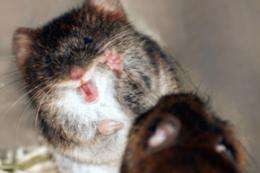
Sexual conflict in bank voles. Credit: M Mökkönen.

(PhysOrg.com) -- New research from The Australian National University has shown how genetic variation persists through generations, rather than being bred out in an evolution towards a ‘perfect type’.

In an international collaboration, researchers from the Research School of Biology at ANU and colleagues from Finland and France carried out a combined field and theoretical study on the breeding behavior of European bank voles - a small mouse-sized rodent common in Europe and Great Britain.

The research team observed that males which carried the for behavioral dominance were more successful at winning mates. However, their gene-sharing female siblings were less successful, having smaller litter sizes. In contrast, females which didn’t carry the genes for behavioural dominance had larger litter sizes.

This phenomenon is called sexual antagonism – where a particular gene is beneficial for one , but decreases success for the opposite sex. Co-author and PhD candidate at the Research School of Biology at ANU Jussi Lehtonen said that the findings show that reproductive success doesn’t run in the family.

“With sexual antagonism such as this, it’s sometimes hard to understand how different genes are maintained in the reproductive process, because if the beneficial effect is much stronger in one sex, one would assume that only the gene with best overall success should be maintained,” said Mr Lehtonen.

The research found that, although genes that were maladaptive for one sex were to some extent carried through to the next generation by its more successful opposite-sex siblings, the disparity in the genes’ effects for the two sexes was so strong that this would be unlikely to maintain genetic variance by itself.

The researchers also found that the dominant gene was only beneficial for males when it was rare in the population, a process known as negative frequency dependence. It is this frequency dependent effect that helped maintain genetic diversity in their study system.

“Males with the dominant gene are quite aggressive, so when the gene gets more common in a population, dominant males are more likely to spend their time fighting, and the tame males get an advantage at that point,” said Mr. Lehtonen.

This research gives a valuable insight into how genetic variance is maintained over and how population factors can influence genetic diversity. The researchers’ findings have been published in Science.

Provided by Australian National University

4.9 /5 (8 votes)  

Filter


Move the slider to adjust rank threshold, so that you can hide some of the comments.


Display comments: newest first

210
Nov 22, 2011

Rank: 2.2 / 5 (10)
So, the human race can look forward to having too few females because of rampant sex selective abortions in the baltic and many asian nations and the females who do survive will all have a crush on Justin - freaking - Bieber.
In the words of Dr. Smith from that Lost in Space Movie, "WE'RE DOOMED!"

word-to-ya-muthas
WorldJunkie
Nov 22, 2011

Rank: not rated yet
"Males with the dominant gene are quite aggressive, so when the gene gets more common in a population, dominant males are more likely to spend their time fighting, and the tame males get an advantage at that point".


There, another reason for being "a lover, not a fighter"!
ziprar2
Nov 22, 2011

Rank: not rated yet
rampant sex selective abortions in the baltic


source??
Djincss
Nov 22, 2011

Rank: 1 / 5 (2)
This is BS. They say that in this way the diversity is bigger?
I doubt that this lead to bigger diversity in other genes.
The only difference between a group of aggressive and non aggressive males is these genes for behavior.This is the only diversity that is maintained, and it has nothing to do with diversity in other genes.(aggressive and non aggressive dont differ on their blood types, immune system and so on)
These two strategies just exist because both are successful at some level, nothing more!
Nerdyguy
Nov 22, 2011

Rank: 5 / 5 (1)
This is BS. ...(aggressive and non aggressive dont differ on their blood types, immune system and so on)


Are you certain of this?
210
Nov 22, 2011

Rank: 1 / 5 (1)
rampant sex selective abortions in the baltic


source??

Albania: girl ratio 'suffers' in sex selective abortions...this is from THIS website just afew days ago.

word-
Djincss
Nov 23, 2011

Rank: 5 / 5 (1)
This is BS. ...(aggressive and non aggressive dont differ on their blood types, immune system and so on)


Are you certain of this?

My point is that among the aggressive group, the diversity will be the same as among the non aggressive, the genes are in different chromosomes, so all the characters are going in the next generation separately and all kind of combinations exist(the genes in one chromosome go together yes, but after a lot of crossing over this correlation is lost too), so the only difference in diversity among a big group of aggressive and non aggressive is only these genes about aggressiveness, so all this is not about diversity as I said.

Man Albania is not baltic, just saying.... balts have lots of abortion but not selective in order to have boys.
hb_
Nov 23, 2011

Rank: 1 / 5 (1)
@Djincss

Well, the diversity of the genes that regulate the dominant behavior is larger than what it would have been if one single behavior would remain.

The interesting thing is if this applies to many vole personality traits, and if this could be generalized to humans, then the diversity of human personalities could be explained.

Another interesting question is why the genome of the voles has not developed to surpress the dominant behavior when the dominance genes are present in the female vole. It does seem like there is any advantage for the female mole to express the dominant behavior.
Djincss
Nov 23, 2011

Rank: 1 / 5 (1)
Well nature is not perfect, the one thing is on the cost of the other, thats why both behaviors exist, it is like with human height, men dont like very tall girls, and women dont like short boys, so the height in humans is diverse because of this factor.
But this doesnt mean what we observe is with some purpose, to have more diversity. the only diversity will be the height in humans, short guys are not different than the tall when it comes to diversity and other genes, the only difference is the height(and with this article thats what I am saying, the diversity regards only behavior and nothing else). So it will be smart for humans to have more sexual dimorphism, but we dont have it, quite the opposite with evolution this dimorphism become less prominent for some reason.
ziprar2
Nov 23, 2011

Rank: not rated yet
rampant sex selective abortions in the BALTIC


source??

Albania: girl ratio 'suffers' in sex selective abortions...this is from THIS website just afew days ago.

word-


Next time please check the world map (atleast read wikipedia) before writing anything stupid.
I dont know about BALKANS (where Albania is), but in the BALTICS no such thing is happening.
(BALKANS is NOT BALTICS)
210
Nov 23, 2011

Rank: 1 / 5 (1)
rampant sex selective abortions in the BALTIC


source??

Albania: girl ratio 'suffers' in sex selective abortions...this is from THIS website just afew days ago.

word-


Next time please check the world map (atleast read wikipedia) before writing anything stupid.
I dont know about BALKANS (where Albania is), but in the BALTICS no such thing is happening.
(BALKANS is NOT BALTICS)

Hey...my bad...I erroneously placed Georgia, in the Baltics...error on my part. BUT, I have learned that HALF the women in the BALTICS have signed on as fans of the Make-Justin-Bieber-Your-Daddy membership drive! You guys have GOT to start your own rock groups and defeat this threat to manhood all over the globe. Its amazing that when they can breed they choose these guys, but after menopause, they come to the guys they rejected and ask, " What the hell was I thinking!?"
Hormones IS some powerful S*IT!
word -

hb_
Nov 24, 2011

Rank: 2.5 / 5 (2)
@Djincss

I am not sure you are right about the effects of personality diversity. In humans, a short temper is linked to high blood pressure. So, it may be that the same genes that affect the temperament also affects the likelyhood of a stroke.

Also, it has been shown that high levels of testosterone protects against coronary heart disease in men. As high level of testosteron is linked to aggressivity, this means that aggressivity and coronary heart disease are linked.

So you see, diversity in personality of voles and men, could have implications for diversity in others traits as well.
Rank 4.9 /5 (8 votes)
Relevant PhysicsForums posts

More news stories

Manufacturing genes to attack flu virus

An international research team has manufactured a new protein that can combat deadly flu epidemics.

Biology / Biotechnology

created 7 hours ago | popularity not rated yet | comments 0 | with audio podcast

Scientist: Evolution debate will soon be history

(AP) -- Richard Leakey predicts skepticism over evolution will soon be history. Not that the avowed atheist has any doubts himself.

Biology / Evolution

created May 26, 2012 | popularity 3.5 / 5 (20) | comments 93

More plant species responding to global warming than previously thought

(Phys.org) -- Far more wild plant species may be responding to global warming than previous large-scale estimates have suggested.

Biology / Ecology

created May 22, 2012 | popularity 4.6 / 5 (14) | comments 18 | with audio podcast

For monogamous sparrows, it doesn't pay to stray (but they do it anyway)

It's quite common for a female song sparrow to stray from her breeding partner and mate with the male next door, but a new study shows that sleeping around can be costly.

Biology / Plants & Animals

created May 22, 2012 | popularity 5 / 5 (2) | comments 8 | with audio podcast

Thousands of shellfish found dead in Peru

Thousands of crustaceans were found dead off the coast of Lima following the mystery mass death of dolphins and pelicans, the Peruvian Navy said Friday.

Biology / Ecology

created May 26, 2012 | popularity 4.7 / 5 (7) | comments 7


Stunning image of smallest possible five-ringed structure

Scientists have created and imaged the smallest possible five-ringed structure – about 100,000 times thinner than a human hair – and you'll probably recognise its shape.

'Unzipped' carbon nanotubes could help energize fuel cells, batteries

Multi-walled carbon nanotubes riddled with defects and impurities on the outside could replace some of the expensive platinum catalysts used in fuel cells and metal-air batteries, according to scientists at ...

Change in developmental timing was crucial in the evolutionary shift from dinosaurs to birds: study

At first glance, it's hard to see how a common house sparrow and a Tyrannosaurus Rex might have anything in common. After all, one is a bird that weighs less than an ounce, and the other is a dinosaur that ...

Computer model used to pinpoint prime materials for efficient carbon capture

When power plants begin capturing their carbon emissions to reduce greenhouse gases – and to most in the electric power industry, it's a question of when, not if – it will be an expensive undertaking.

T cells 'hunt' parasites like animal predators seek prey, study shows

By pairing an intimate knowledge of immune-system function with a deep understanding of statistical physics, a cross-disciplinary team at the University of Pennsylvania has arrived at a surprising finding: T cells use a movement ...

Land and sea species differ in climate change response: study

(Phys.org) -- Marine and terrestrial species will likely differ in their responses to climate warming, new research by Simon Fraser University and Australia’s University of Tasmania has found.