Scissors-type trilayer giant magnetoresistive sensor using heusler alloy ferromagnet
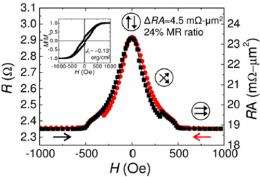
Resistance vs magnetic field of the Co2Fe(Al0.5Si0.5) (4 nm)/Ag(2 nm)/ Co2Fe(Al0.5Si0.5) (4 nm) trilayer CPP-GMR device measured at room temperature and the schematic "scissors-type" magnetization configuration of the two Co2Fe(Al0.5Si0.5) free layers. Inset is the magnetization curve of the unpatterned trilayer film.
Japanese researchers have demonstrated a scissors-type trilayer magnetoresistance device that is promising for narrow readers of ultra-high density hard disk drives (HDD). This device uses an antiferromagnetic interlayer exchange coupling of two Heusler alloy ferromagnetic (FM) layers separated by a thin silver layer. Since the magnetization of the two FM layers rotate around each other like scissors due to the antiferromagnetic coupling, the device is called a scissor-type MR sensor.
To obtain high MR outputs, a highly spin-polarized cobalt-based Heusler alloy is used for the FM layers of the tri-layer current-perpendicular-to-plane giant magnetoresistive device (CPP-GMR). The total device thickness of the scissors-type sensor is only 10 nm, which is less than half of that needed for the recording density of 2 Tera bit per square inch (Tbpsi). Thus, it is considered promising as a narrow reader for the next generation ultra-high density hard disk drives (HDD) with the areal density exceeding 2 Tbpsi.
In the current HDDs with an areal density of 700 Gbpsi, tunneling magnetoresistive (TMR) sensors are used as read heads. To achieve a recording density exceeding 2 Tbpsi in the future, the bit size of the magnetic information must be reduced to 20 nm. There are three technical requirements in the read sensors for a recording density exceeding 2 Tbpsi: large magnetoresistive outputs, low device resistance, and thin device thickness. In the currently-used TMR devices, a high magnetoresistive output can be achieved; however, the reduction of device resistance to a required level is difficult since a thin insulator layer must be used to separate the two ferromagnetic layers. Therefore, current-perpendicular-to-plane giant magnetoresistance (CPP-GMR) devices using a metallic spacer layer is considered as a replacement for the TMR devices in future high density HDDs due to their intrinsically low device resistance. Since bit resolution is determined by the total thickness of the GMR spin valve devices made of multiple thin film layers, a reduction in the total thickness of the GMR spin valves is another technical challenge for the magnetic recording industry
A scissors-type magnetoresistive device using an antiferromagnetic exchange interlayer coupling between two FM layers separated by a nonferromagnetic spacer has been proposed as a potential narrow read sensor for high density recording. Since the magnetizations of the two FM layers are expected to rotate around each other like scissors, the antiferromagnetically exchange coupled tri-layer structure was proposed as a "scissor-type" MR sensor. However, there have not been any experimental demonstrations of such a scissors-type trilayer MR sensor with large MR outputs until now.
In this work, Dr. Nakatani and his collaborators observed an antiferromagnetic (AFM) interlayer exchange coupling (IEC) between two Co2Fe(Al0.5Si0.5) Heusler alloy ferromagnetic layers separated by a 2 nmAg spacer layer. This is the first observation of an antiferromagnetic interlayer exchange coupling in Heusler alloy FM layers. Using the AFM coupled trilayer, they demonstrated a scissors-type trilayer CPP-GMR device with a relatively large magnetoresistive output of ΔRA of 4.5 mΩμm2 and a MR ratio of 24%. Since the anti-ferromagnetic exchange coupling between the two ferromagnetic layers is realized in the tri-layer structure of two 4 nm FM layers and a 2 nm Ag layer, the total device thickness is only 10 nm, which is less than half of the required thickness for the 2 Tbps areal density; thus the tri-layer sensor is considered to be promising for future applications of ultrahigh density HDDs. The MR output was approximately 4 times larger than that reported for the current-in-plane scissor type device using a standard FM alloy.
More information: This result was published in the October 31 issue of Applied Physics Letters, 99, 182505 (2011), http://dx.doi.org/ … 63/1.3657409
Journal reference:
Applied Physics Letters
Provided by National Institute for Materials Science
-
From lemons to lemonade: Reaction uses carbon dioxide to make carbon-based semiconductor,
32 comments
-
Thioridazine kills cancer stem cells in human while avoiding toxic side-effects of conventional cancer treatments,
3 comments
-
SpaceX private rocket blasts off for space station (Update),
42 comments
-
Climate scientists say they have solved riddle of rising sea,
31 comments
-
SpaceX capsule has 'new car' smell, astronauts say (Update),
4 comments
-
Why does a boiled egg rotates while a raw egg doesn't?
2 hours ago
-
Lightning strike in mindair
2 hours ago
-
Why does light move?
4 hours ago
-
How to calculate the repulsion force between a permanent and an electromagnet?
5 hours ago
-
Why does light allow us to see things?
5 hours ago
-
Room temperature superconductivity
5 hours ago
- More from Physics Forums - General Physics
More news stories
Is a classical electrodynamics law incompatible with special relativity?
(Phys.org) -- The laws of classical electromagnetism that were developed in the 19th century are the same laws that scientists use today. They include Maxwell’s four equations along with the Lorentz la ...
Landmark calculation clears the way to answering how matter is formed
(Phys.org) -- An international collaboration of scientists, including Thomas Blum, associate professor of physics, is reporting in landmark detail the decay process of a subatomic particle called a kaon ...
May 25, 2012 |
4.3 / 5 (22) |
52
|
Lying in wait for WIMPs: Researchers seek to dramatically increase sensitivity of Large Underground Xenon detector
Although it's invisible, dark matter accounts for at least 80 percent of the matter in the universe. No one knows what it is, but most scientists would bet on weakly interacting massive particles, or WIMPs.
May 23, 2012 |
4 / 5 (7) |
18
|
Hawaii lab turns laser-powered bubbles into microrobots
(Phys.org) -- A team of scientists from the University of Hawaii are working on microrobots created from bubbles of air in a saline solution. The bubbles take on their title of robots as a laser ...
Sound increases the efficiency of boiling
Scientists at the Georgia Institute of Technology achieved a 17-percent increase in boiling efficiency by using an acoustic field to enhance heat transfer. The acoustic field does this by efficiently removing vapor bubbles ...
May 24, 2012 |
5 / 5 (2) |
2
Stunning image of smallest possible five-ringed structure
Scientists have created and imaged the smallest possible five-ringed structure about 100,000 times thinner than a human hair and you'll probably recognise its shape.
'Unzipped' carbon nanotubes could help energize fuel cells, batteries
Multi-walled carbon nanotubes riddled with defects and impurities on the outside could replace some of the expensive platinum catalysts used in fuel cells and metal-air batteries, according to scientists at ...
Change in developmental timing was crucial in the evolutionary shift from dinosaurs to birds: study
At first glance, it's hard to see how a common house sparrow and a Tyrannosaurus Rex might have anything in common. After all, one is a bird that weighs less than an ounce, and the other is a dinosaur that ...
Computer model used to pinpoint prime materials for efficient carbon capture
When power plants begin capturing their carbon emissions to reduce greenhouse gases and to most in the electric power industry, it's a question of when, not if it will be an expensive undertaking.
T cells 'hunt' parasites like animal predators seek prey, study shows
By pairing an intimate knowledge of immune-system function with a deep understanding of statistical physics, a cross-disciplinary team at the University of Pennsylvania has arrived at a surprising finding: T cells use a movement ...
Land and sea species differ in climate change response: study
(Phys.org) -- Marine and terrestrial species will likely differ in their responses to climate warming, new research by Simon Fraser University and Australia’s University of Tasmania has found.
Nov 30, 2011
Rank: 1 / 5 (1)