Scientists use fossil feathers reveal lineage of extinct, flightless ibis
November 22, 2011

Smithsonian scientists use fossil feathers reveal lineage of extinct, flightless ibis

Enlarge

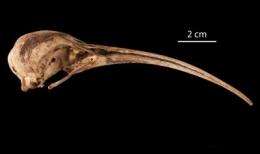
The skull of Apteribis sp. Credit: Carla Dove

A remarkable first occurred recently at the Smithsonian's National Museum of Natural History when ornithologists Carla Dove and Storrs Olson used 700- to 1,100-year-old feathers from a long extinct species of Hawaiian ibis to help determine the bird's place in the ibis family tree. The feathers are the only known plumage of any of the prehistorically extinct birds that once inhabited the Hawaiian Islands.

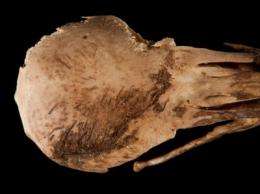
Discovered with a nearly complete skeleton, the retained enough to allow the scientists to confirm the classification of the bird, known by its scientific name Apteribis sp, as a close relative of the American white ibis (Eudocimus albus) and scarlet ibis (Eudocimus buber). DNA analysis confirmed this classification.

Remarkably, the feathers also retained enough pigmentation for Dove and Olson to determine that the bird was brown-black to ivory-beige in color. This is a first―the plumage color of any prehistorically extinct Hawaiian bird up until now had been speculation.

Apteribis sp. is one of only two species of flightless ibis, both now extinct. Its differs so much from its mainland ancestors that the bird's relationship to other ibises could only be determined through the study of its feathers and .

Smithsonian scientists use fossil feathers reveal lineage of extinct, flightless ibis
Enlarge

A detail of the top of the skull showing feathers adhering to the cranium of Apteribis sp. Credit: Carla Dove

"This find is highly unusual because feathers do not preserve well and often decay before a bird is fossilized," Dove said. "These weren't fossil imprints in a rock, but feathers and bones we could actually pick up."

Exceptional geologic circumstances led to the preservation of the feathers inside a lava cave on the Hawaiian Island of Lanai. The floor of the cave was partially covered in a deep layer of flaky gypsum crystals, which, for hundreds of years absorbed humidity in the cave and created an arid environment ideal for preservation of the feathers.

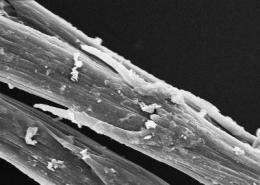
From a taxonomic standpoint feathers are significant because the shape of microscopic barbs on specific areas of a feather have distinct features that taxonomists can use to determine what bird group it belongs to.
Smithsonian scientists use fossil feathers reveal lineage of extinct, flightless ibis
Enlarge

This scanning electron photomicrograph shows the prongs on the downy barbules of an Apteribis sp. feather. Credit: Carla Dove

"The barbs are unique only on the downy, fluffy part at the base of the feather, not at the tip," Dove said. "These microstructures are similar among orders of birds—pigeons, ducks, songbirds, for example.

Using specimens from the Smithsonian's collection, Dove compared the microscopic structures of the ancient feathers to those of modern day birds. Her analysis confirmed that Apteribis sp. is most closely related the New World ibises of the genus Eudocimus. Apteribis sp. was first described from fossils found on the Hawaiian Islands of Molokai and Maui. It is one of dozens of bird species known to have gone extinct following the arrival of humans on the .

"Fossil Feathers from the Hawaiian Flightless Ibis (Apteribis SP.): Plumage Coloration and Systematics of a Prehistorically Extinct Bird," by Carla Dove and Storrs Olson appeared in the September 2011 issue of the Journal of Paleontology.

Journal reference: Journal of Paleontology search and more info website

Provided by Smithsonian search and more info website

Filter


Move the slider to adjust rank threshold, so that you can hide some of the comments.


Display comments: newest first

Nerdyguy
Nov 22, 2011

Rank: not rated yet
"Scientists use fossil feathers reveal lineage of extinct, flightless ibis"

Clear evidence of the use of word mills by global media. This identical headline (with its unique omission of the word "to"), and the ensuing text, were published worldwide by a host of different science-related sites. However, it is not a press release from the Smithsonian. More importantly, the Smithsonian didn't publish it.
Rank 5 /5 (3 votes)
Relevant PhysicsForums posts

More news stories

Change in developmental timing was crucial in the evolutionary shift from dinosaurs to birds: study

At first glance, it's hard to see how a common house sparrow and a Tyrannosaurus Rex might have anything in common. After all, one is a bird that weighs less than an ounce, and the other is a dinosaur that ...

Other Sciences / Archaeology & Fossils

created 7 hours ago | popularity 5 / 5 (4) | comments 0 | with audio podcast

Social welfare cuts ultimately come with heavy price, researchers say

(Phys.org) -- Slashing government funding for Medicaid, food stamps and other programs that serve the poor – while politically popular with some lawmakers and many conservatives – may do more harm ...

Other Sciences / Social Sciences

created May 24, 2012 | popularity 4.2 / 5 (20) | comments 155

Ancient Bethlehem seal unearthed in Jerusalem

Israeli archaeologists have discovered a 2,700-year-old seal that bears the inscription "Bethlehem," the Israel Antiquities Authority announced Wednesday, in what experts believe to be the oldest artifact ...

Other Sciences / Archaeology & Fossils

created May 23, 2012 | popularity 3.3 / 5 (15) | comments 24

Dollars and sense: Why are some people morally against tax?

As the U.S. presidential election campaigns heat up, the economic debate is dominated by bailouts, austerity and, inevitably, taxation. Now a new study published in Symbolic Interaction asks why tax is such an important issue ...

Other Sciences / Social Sciences

created May 23, 2012 | popularity 2.3 / 5 (3) | comments 19

Oldest Jewish archaeological evidence on the Iberian Peninsula

German archaeologists of the Friedrich Schiller University Jena found one of the oldest archaeological evidence so far of Jewish Culture on the Iberian Peninsula at an excavation site in the south of Portugal, ...

Other Sciences / Archaeology & Fossils

created May 25, 2012 | popularity 4.2 / 5 (6) | comments 12


Stunning image of smallest possible five-ringed structure

Scientists have created and imaged the smallest possible five-ringed structure – about 100,000 times thinner than a human hair – and you'll probably recognise its shape.

'Unzipped' carbon nanotubes could help energize fuel cells, batteries

Multi-walled carbon nanotubes riddled with defects and impurities on the outside could replace some of the expensive platinum catalysts used in fuel cells and metal-air batteries, according to scientists at ...

Computer model used to pinpoint prime materials for efficient carbon capture

When power plants begin capturing their carbon emissions to reduce greenhouse gases – and to most in the electric power industry, it's a question of when, not if – it will be an expensive undertaking.

T cells 'hunt' parasites like animal predators seek prey, study shows

By pairing an intimate knowledge of immune-system function with a deep understanding of statistical physics, a cross-disciplinary team at the University of Pennsylvania has arrived at a surprising finding: T cells use a movement ...

Land and sea species differ in climate change response: study

(Phys.org) -- Marine and terrestrial species will likely differ in their responses to climate warming, new research by Simon Fraser University and Australia’s University of Tasmania has found.

Yale study concludes public apathy over climate change unrelated to science literacy

Are members of the public divided about climate change because they don't understand the science behind it? If Americans knew more basic science and were more proficient in technical reasoning, would public consensus match ...