Russia brings astronauts safely back to Earth
November 22, 2011 by Stuart Williams

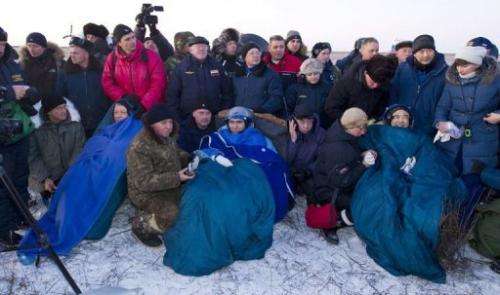
(L-R) Mike Fossum, Sergei Volkov and Satoshi Furukawa sit swathed in blue rugs and blankets moments after they land

Enlarge

Expedition 29 Commander Mike Fossum (L) and Flight Engineers Sergei Volkov (C) and Satoshi Furukawa (R) sit in chairs near the Soyuz TMA-02M capsule minutes after they land in a remote area outside the town of Arkalyk, Kazakhstan on November 22.

Three astronauts landed safely in the Kazakh steppe aboard a Russian Soyuz capsule on Tuesday after a stay of over five months aboard the International Space Station, Russian mission control said.

American Mike Fossum, Japan's Satoshi Furukawa and Russia's Sergei Volkov touched down outside the remote settlement of Arkalyk in Kazakhstan just before sunrise after undocking from the ISS earlier in the day.

"It has landed," said a message flashed on the screen at Moscow mission control shown in a live relay. State television pictures showed the astronauts extracted from the capsule apparently in good health.

The Soyuz capsule landed on its side rather than its bottom after its descent to Earth with a parachute, mission control said, but such landing was not unusual. The landing was on time and on at 0226 GMT.

The hitch-free landing of the Soyuz is a boost for the Russian space programme, which has been battling to restore confidence in its reliability after a spate of disasters in unmanned spaceflight.

State television pictures showed ground workers moving quickly to carry the three men from the capsule to protect them from the initial shock of temperatures of minus 15 degrees Celsius after their half year stay on the ISS.
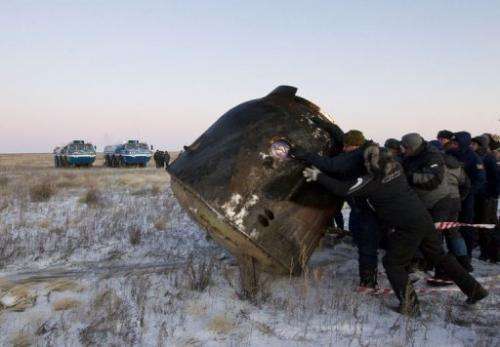
The landing of the Soyuz capsule was on time and on target at 0226 GMT
Enlarge

Russia space agency ground personnel move the Soyuz TMA-02 capsule after it landed near the town of Arkalyk in northern Kazakhstan on November 22. The Soyuz capsule landed on its side rather than its bottom after its descent to Earth with a parachute, mission control said.

Volkov was the first to emerge, followed by Fossum and Furukawa. All were carried out by ground workers as the experience of prolonged means that they cannot initially walk unassisted.

The three men were sat down in chairs, swathed in blue rugs and blankets to protect themselves from the sub zero morning temperatures as dawn broke over the snow-dusted steppe. Fossum was shown chatting on a mobile phone.

They were then lifted -- still in their chairs -- to a nearby medical tent put up next to the touchdown site to have their space suits removed and go through standard .

The three were then to be helicoptered to the northern Kazakh city of Kostanay for a farewell ceremony before splitting up, with Fossum and Furukawa returning to the United States and Volkov flying to Moscow.

It was during their stay on the ISS that a Russian unmanned Progress supply ship carrying supplies for the station crashed into Siberia in August shortly after launch, forcing a complete rejig of the timetable for manned spaceflight.

This capped a disastrous year for the Russian space agency which also saw the loss of three navigation satellites, an advanced military satellite and a telecommunications satellite due to faulty launches.
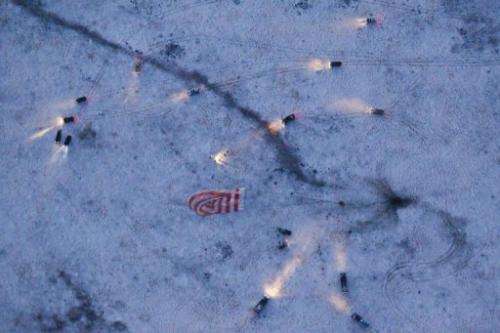
The three returned astronauts had spent 167 days in space
Enlarge

This photo taken from a helicopter shows the landing site of the Soyuz TMA-02 capsule near the town of Arkalyk in northern Kazakhstan. The hitch-free landing is a boost for the Russian space programme, which has been battling to restore confidence in its reliability after a spate of disasters in unmanned spaceflight.

Hours after the landing, the Russian space agency publicly acknowledged for the first time that its Phobos-Grunt probe for Mars's largest moon, launched on November 9, was also likely lost.

The probe has failed to head out of Earth's orbit on its course to the red planet and its moon Phobos.

"There is little chance that we will be able to realise this mission," the deputy head of Roscosmos Vitaly Davydov said at , quoted by Russian news agencies.

The three returned astronauts had spent 167 days in space -- slightly more than the 161 day mission originally envisaged as the return was delayed by almost a week due to the Progress mishap.

Their return to Earth leaves three astronauts remaining on the ISS, American Dan Burbank and Russians Anton Shkaplerov and Anatoly Ivanishin who blasted off from Russia's Baikonur cosmodrome in Kazakhstan on November 14.

They will be joined by another multinational crew of three astronauts that is due to take off from Baikonur on December 21.

Following the retirement of the US shuttle in July, Russia is currently the only nation capable of transporting humans to the ISS.

Unlike the horizontal landing shuttle, the Soyuz returns to Earth vertically with a parachute in a procedure whose basic principle has changed little in the last decades but is admired worldwide for its simplicity and reliability.

(c) 2011 AFP


Rank 5 /5 (2 votes)
Relevant PhysicsForums posts
  • Distance of planets from stars and revolution
    created7 hours ago
  • revamping general concept and cosmological principle
    createdMay 25, 2012
  • Transiting Exoplanet Light Curve
    createdMay 25, 2012
  • Math behind Theoretical Physics
    createdMay 24, 2012
  • Do we know whats at the center of galaxies yet?
    createdMay 23, 2012
  • Structure of the Milky Way?
    createdMay 20, 2012
  • More from Physics Forums - General Astronomy

More news stories

Land and sea species differ in climate change response: study

(Phys.org) -- Marine and terrestrial species will likely differ in their responses to climate warming, new research by Simon Fraser University and Australia’s University of Tasmania has found.

Space & Earth / Environment

created 5 hours ago | popularity 3.7 / 5 (3) | comments 5 | with audio podcast

Yale study concludes public apathy over climate change unrelated to science literacy

Are members of the public divided about climate change because they don't understand the science behind it? If Americans knew more basic science and were more proficient in technical reasoning, would public consensus match ...

Space & Earth / Environment

created 7 hours ago | popularity 4.8 / 5 (5) | comments 15 | with audio podcast

10 million years needed to recover from mass extinction

It took some 10 million years for Earth to recover from the greatest mass extinction of all time, latest research has revealed.

Space & Earth / Earth Sciences

created 7 hours ago | popularity 4 / 5 (4) | comments 1 | with audio podcast

Sophisticated simulations predict future warming

The chances of our planet being hit by a global warming of 3 degrees Celsius by 2050 is as likely as it being hit by an increase of 1.4 degrees, new research shows. Presented in the journal Nature Geoscience, the British study ...

Space & Earth / Earth Sciences

created May 22, 2012 | popularity 4.4 / 5 (9) | comments 51

Aliens don't want to eat us, says former SETI director

Alien life probably isn’t interested in having us for dinner, enslaving us or laying eggs in our bellies, according to a recent statement by former SETI director Jill Tarter.

Space & Earth / Space Exploration

created May 25, 2012 | popularity 4.4 / 5 (15) | comments 41


Stunning image of smallest possible five-ringed structure

Scientists have created and imaged the smallest possible five-ringed structure – about 100,000 times thinner than a human hair – and you'll probably recognise its shape.

'Unzipped' carbon nanotubes could help energize fuel cells, batteries

Multi-walled carbon nanotubes riddled with defects and impurities on the outside could replace some of the expensive platinum catalysts used in fuel cells and metal-air batteries, according to scientists at ...

Change in developmental timing was crucial in the evolutionary shift from dinosaurs to birds: study

At first glance, it's hard to see how a common house sparrow and a Tyrannosaurus Rex might have anything in common. After all, one is a bird that weighs less than an ounce, and the other is a dinosaur that ...

Computer model used to pinpoint prime materials for efficient carbon capture

When power plants begin capturing their carbon emissions to reduce greenhouse gases – and to most in the electric power industry, it's a question of when, not if – it will be an expensive undertaking.

T cells 'hunt' parasites like animal predators seek prey, study shows

By pairing an intimate knowledge of immune-system function with a deep understanding of statistical physics, a cross-disciplinary team at the University of Pennsylvania has arrived at a surprising finding: T cells use a movement ...

Scientists develop ultra-sensitive test that detects diseases in their earliest stages

Scientists have developed an ultra-sensitive test that should enable them to detect signs of a disease in its earliest stages, in research published today in the journal Nature Materials.