New study reveals coral reefs may support much more biodiversity than previously thought
November 2, 2011

New study reveals coral reefs may support much more biodiversity than previously thought

Enlarge

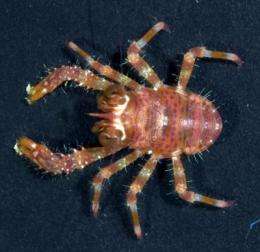
The coral reef crustacean Sadayoshia edwardsii. Credit: Smithsonian

Smithsonian scientists and colleagues conducted the first DNA barcoding survey of crustaceans living on samples of dead coral taken from the Indian, Pacific and Caribbean oceans. The results suggest that the diversity of organisms living on the world's coral reefs is seriously underestimated. The team's research "The Diversity of Coral Reefs: What Are We Missing?" was published in October in the journal PLoS ONE.

At depths of 26 to 39 feet, the scientists collected dead coral from five different locations. At two sites where removing coral is prohibited, the scientists collected man-made sampling devices that had been left in the water for one year. Combined, the coral and devices had a surface area of just 6.3 square meters (20.6 square feet), yet 525 different species of crustaceans were found living on them.

"So much in such a small, limited sample area shows that the diversity of crustaceans in the world's coral reefs -- and by implication the diversity of reefs overall -- is seriously under-detected and underestimated," said Nancy Knowlton, the Sant Chair for at the Smithsonian's National Museum of Natural History and co-author of the survey. "We found almost as many in 6.3-square meters of coral as can be found in all of the seas of Europe. Compared to the results of much longer and labor-intensive surveys, we found a surprisingly large percentage of species with a fraction of the effort."
New study reveals coral reefs may support much more biodiversity than previously thought
Enlarge

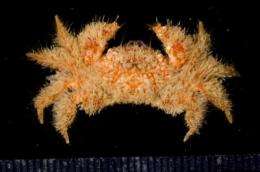
Here is a Pilumnus tahitensis. Credit: Smithsonian

The world's coral reefs are some of the most endangered habitats on Earth. Given coral's and global range, offered the scientists a quick and efficient method for their survey. "DNA barcoding provides a standardized, cost-effective method of coming to grips with the staggering diversity of the world's oceans," Knowlton said. "It has enormous potential for use in broad global surveys, allowing us to find out what is living in the ocean now, and to keep track of it in the future."

Crustaceans collected for the survey were only those the scientists could see, and ranged from 0.2 to 1.9 inches long. All animals from which DNA was sequenced were preserved so they could be examined later by taxonomists.

"We collected dead corals because live corals defend themselves from being inhabited by other invertebrates," said Laetitia Plaisance of the Smithsonian's and the Scripps Institution of Oceanography, and lead author of the survey.

Once a coral dies its structure becomes covered with algae, sponges, crustaceans, worms, mollusks and other creatures.

"Given the complexity and extent of the world's coral reefs, the survey covered only a very limited depth and range," said Plaisance. "And yet we have so many more species than we ever expected."

Present estimates of species diversity in reefs are 600,000 to more than 9 million species worldwide. "We cannot give a new estimate today, but we may be able to in a few years," Plaisance said. Using man-made sampling structures at some 50 sites around the world, Plaisance is now working with the Smithsonian and the National Oceanographic and Atmospheric Administration on another survey that will include all of the many organisms that live on .

Provided by Smithsonian search and more info website


Rank not rated yet
Relevant PhysicsForums posts

More news stories

Land and sea species differ in climate change response: study

(Phys.org) -- Marine and terrestrial species will likely differ in their responses to climate warming, new research by Simon Fraser University and Australia’s University of Tasmania has found.

Space & Earth / Environment

created 5 hours ago | popularity 3.7 / 5 (3) | comments 5 | with audio podcast

Yale study concludes public apathy over climate change unrelated to science literacy

Are members of the public divided about climate change because they don't understand the science behind it? If Americans knew more basic science and were more proficient in technical reasoning, would public consensus match ...

Space & Earth / Environment

created 7 hours ago | popularity 4.8 / 5 (5) | comments 15 | with audio podcast

10 million years needed to recover from mass extinction

It took some 10 million years for Earth to recover from the greatest mass extinction of all time, latest research has revealed.

Space & Earth / Earth Sciences

created 7 hours ago | popularity 4 / 5 (4) | comments 1 | with audio podcast

Sophisticated simulations predict future warming

The chances of our planet being hit by a global warming of 3 degrees Celsius by 2050 is as likely as it being hit by an increase of 1.4 degrees, new research shows. Presented in the journal Nature Geoscience, the British study ...

Space & Earth / Earth Sciences

created May 22, 2012 | popularity 4.4 / 5 (9) | comments 51

Aliens don't want to eat us, says former SETI director

Alien life probably isn’t interested in having us for dinner, enslaving us or laying eggs in our bellies, according to a recent statement by former SETI director Jill Tarter.

Space & Earth / Space Exploration

created May 25, 2012 | popularity 4.4 / 5 (15) | comments 41


Stunning image of smallest possible five-ringed structure

Scientists have created and imaged the smallest possible five-ringed structure – about 100,000 times thinner than a human hair – and you'll probably recognise its shape.

'Unzipped' carbon nanotubes could help energize fuel cells, batteries

Multi-walled carbon nanotubes riddled with defects and impurities on the outside could replace some of the expensive platinum catalysts used in fuel cells and metal-air batteries, according to scientists at ...

Change in developmental timing was crucial in the evolutionary shift from dinosaurs to birds: study

At first glance, it's hard to see how a common house sparrow and a Tyrannosaurus Rex might have anything in common. After all, one is a bird that weighs less than an ounce, and the other is a dinosaur that ...

Computer model used to pinpoint prime materials for efficient carbon capture

When power plants begin capturing their carbon emissions to reduce greenhouse gases – and to most in the electric power industry, it's a question of when, not if – it will be an expensive undertaking.

T cells 'hunt' parasites like animal predators seek prey, study shows

By pairing an intimate knowledge of immune-system function with a deep understanding of statistical physics, a cross-disciplinary team at the University of Pennsylvania has arrived at a surprising finding: T cells use a movement ...

Scientists develop ultra-sensitive test that detects diseases in their earliest stages

Scientists have developed an ultra-sensitive test that should enable them to detect signs of a disease in its earliest stages, in research published today in the journal Nature Materials.