Seals rehab works, it's official
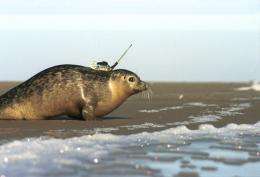
(PhysOrg.com) -- Injured seals nursed back to life by the RSPCA have as good a chance of surviving when sent back into the wild as their healthy peers, according to new research.
The study, in collaboration with scientists at the University of St Andrews, proves for the first time that rehab programmes for seals work.
The research was carried out in collaboration by staff at the RSPCA East Winch Wildlife Centre and scientists from the Sea Mammal Research Unit at St Andrews.
It involved recovering seals being sent back into the wild with tracking equipment – similar to a stethoscope – that enabled researchers to measure their breath capacity whilst diving, much the same as NHS patients being sent home with heart monitors.
The study conclusively shows that rehabilitated common harbour seals return to the wild without any adverse effects, and can swim and dive just as well as normal healthy wild seals.
Alison Charles, manager at East Winch Wildlife Centre, said: “We have always done everything possible to return sick and injured seals back into the wild, and give them the best chance of survival once released, but until now we have never had the scientific evidence to back this work up.
“The RSPCA funded this vital research because we felt it was really important to show people that these seals deserve a second chance and that rehabilitation does work.”
The six seals tracked included Skippy, a juvenile harbour seal washed up at a Norfolk beach, underweight and with multiple infected wounds on her neck and hind flippers. After 155 days of treatment, she was released and monitored using the satellite tracking devices developed by Dr Bernie McConnell at the University of St Andrews.
The satellite transmitter, glued to the fur on the back of the necks of six rehabilitated harbour seals, could not only keep track of whether they were alive but also for the first time allowed experts to remotely monitor the seals’ health. The transmitters are usually lost when the seals moult.
For around six months following release, data was collected by scientists monitoring trends in the diving ability of the recovered seals – a clear indication on how fit they were. The data was then compared to the dive patterns of five wild adult harbour seals, to see if there were any differences between their dives.
Alison continued, “Previous research had always shown that seals did survive after release, but it never gave an indication as to how well they were surviving and coping.
“Through this study we can clearly see that our rehabilitated seals could dive just as well as wild seals and this was a clear indicator of their health and strength when back in the open waters.”
The findings also found that the rehabilitated seal pups travelled significant distances once they were released.
Dr McConnell, a senior research fellow at St Andrews, has been monitoring the movement and behaviour of marine mammals, from the Antarctic to the Arctic, for over 25 years. He commented, “The important finding here is that on release all rehabilitated animals immediately demonstrated diving capabilities that persisted during their tracking periods. This behaviour was similar to the diving capabilities of apparently healthy adult seals.
“While we assume that the debilitated seals were released in an apparently healthy condition, there could be concern that captivity per se could impair dive capability. However, we find that this is not the case.
“There was no statistically significant difference between the behaviour of rehabilitated seals and healthy adult seals, indicating no evidence that short-term survival was less in the rehabilitated group.”
Case study – Skippy
-- Skippy was one of the six tracked juvenile hand-reared Harbour seals monitored in this study. Skippy was rescued from the beach at Bacton, Norfolk on 18/09/2003 and weighed only 12.5kg.
-- She arrived at noon, and was then checked over by a vet and it was revealed that she had an ulcerated hard palate, multiple infected wounds on her neck and hind flippers and was thin.
-- For the first 24 hours she had 400mls of Lectade (oral rehydration solution) every three hours by stomach tube.
-- During the next 24hrs – 40omls of 1/4 fish soup (liquidised herring, multivitamins and Lectade) and ¾ Lectade every three hours.
-- During the next 24hrs 1/2 and 1/2 fish soup and Lectade every three hours.
-- Then for the next 24hrs are ¾ fish soup and 1/4 Lectade then finally onto full fish soup.
-- Once she was onto full fish soup East Winch wildlife centre staff slowly introduced herring, first by force feeding them and then by offering her them by hand to allow her to eat them on her own.
-- She was then moved from her own isolation cubicle, and was put in with Hercules to give her company. She was then moved to an intermediate pool to allow her access to a shallow pool at all times. As she improved and gained weight she was moved to a deeper outside pool with four more seals to exercise and gain fitness in preparation for release.
-- She was released into the Wash on the 20/02/2004 with Shrek and Nemo. She had 155 days of hospitalisation and when she was released she weighed 32kg.
Provided by University of St Andrews


